
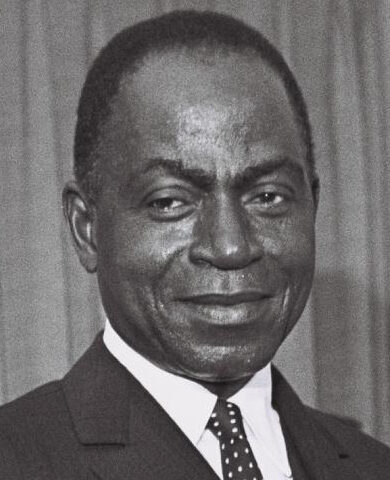
Félix Houphouët-Boigny
Félix Houphouët-Boigny was a First President of Ivory Coast, from 1960 to 1993. Born October 18, 1905, in Yamoussoukro. Died December 7, 1993, in Yamoussoukro. Positions held include member of the French National Assembly (1945–1959), Prime Minister of Ivory Coast (1960) and Minister of State (1958–1959). Educated at École normale supérieure William Ponty. Awards include honorary doctor of the University of Rennes, Knight Grand Cross with Collar of the Order of Merit of the Italian Republic and honorary doctorate of the University of the Mediterranean - Aix Marseille II.
Facts
29 facts · 2 confirmed by two sources · 14 cited · 12 from one source · 1 where the sources disagree
What’s different
- Born: we show October 18, 1905 (Confirmed). Wikidata also lists October 16, 1905
- Born in: we show Yamoussoukro (Sources disagree). Wikidata also lists N’Gokro
Where this comes from
Papalocal keeps its own record. It started from these sources; what each one said is kept here as it was copied, so a change on their side never changes this page by itself. Tap one to read its version.
What Wikidata says · copied November 16, 2026 · revision 2563148904
- Described as
- First President of Ivory Coast, from 1960 to 1993 (1905-1993)
- Other names
- Dia Houphouët, Papa Houphouët, Le Vieux ("The Old One")
- Born
- October 18, 1905 · 12 references; October 16, 1905 · 1 reference
- Died
- December 7, 1993 · 12 references
- Born in
- N’Gokro · 1 reference; Yamoussoukro · 2 references
- Died in
- Yamoussoukro · 2 references
- Cause of death
- prostate cancer · 2 references
- Name at birth
- Dia Houphouët
- Citizen of
- France; Ivory Coast · 2 references
- Occupation
- politician · 1 reference
- Positions held
- member of the French National Assembly (1945–1959) · 1 reference; Prime Minister of Ivory Coast (1960); Minister of State (1958–1959); President of the Ivory Coast (1960–1993) · 1 reference; Minister of Foreign Affairs of the Republic of Côte d'Ivoire (1960–1963)
- Political party
- Democratic Party of Côte d'Ivoire – African Democratic Rally
- Education
- École normale supérieure William Ponty
- Member of
- Académie des sciences d'outre-mer (1973–1993)
- Awards
- honorary doctor of the University of Rennes (1965) · 1 reference; Knight Grand Cross with Collar of the Order of Merit of the Italian Republic (1969) · 1 reference; honorary doctorate of the University of the Mediterranean - Aix Marseille II (1978) · 2 references; honorary doctor of Paris Descartes University (1978) · 2 references; Collar of the Spanish Order of the Civil Merit (1979) · 1 reference; honorary doctorate from University of Montpellier-I (1987) · 1 reference
- Spouse
- Marie-Thérèse Houphouët-Boigny (1952–) · 1 reference; Kady Racine Sow (1930–1951) · 1 reference
- Children
- Guillaume Houphouët-Boigny · 1 reference; Marie Houphouët-Boigny
- Religion
- Catholic Church; animism
- Wikipedias with a page
- 62
Wikidata item Q214407 (wikidata.org/wiki/Q214407), public domain (CC0). Copied November 16, 2026.
What Wikipedia says · copied November 16, 2026 · revision 1384333257
Félix Houphouët-Boigny (French: [feliks ufwɛ(t) bwaɲi]; 18 October 1905 – 7 December 1993), affectionately called Papa Houphouët or Le Vieux ("the old one"), was an Ivorian politician and physician who served as the first president of Ivory Coast, from 1960 until his death in 1993. A tribal chief, he worked as a medical aide, union leader, and planter before being elected to the French Parliament in 1945. He served in several ministerial positions within the Government of France before leading Ivory Coast following independence in 1960. Throughout his life, he played a significant role in politics and the decolonisation of Africa.
Under Houphouët-Boigny's politically rightist leadership, Ivory Coast prospered economically. This success, uncommon in poverty-ridden West Africa, became known as the "Ivorian miracle"; it was due to a combination of sound planning, the maintenance of strong ties with the West (particularly France), and development of the country's significant coffee and cocoa industries. However, reliance on the agricultural sector caused difficulties in 1980, after a sharp drop in the prices of coffee and cocoa.
Throughout his presidency, Houphouët-Boigny maintained a close relationship with France, a policy known as Françafrique, and he built strong ties with Jacques Foccart, the chief adviser on African policy in the French government under Charles de Gaulle and Georges Pompidou. He aided the conspirators who ousted Kwame Nkrumah from power in Ghana in 1966, took part in the failed coup against Mathieu Kérékou in Benin in 1977, was suspected of involvement in the 1987 coup d'état that removed Thomas Sankara from power in Burkina Faso, and provided assistance to UNITA, a United States-supported, anti-communist rebel movement led by Jonas Savimbi in Angola. Houphouët-Boigny maintained a strong anti-communist foreign policy, which resulted in, among other things, severing diplomatic relations with the Soviet Union in 1969 (after first establishing relations in 1967) and refusing to recognise the People's Republic of China until 1983. He re-established relations with the Soviet Union in 1986.
In the West, Houphouët-Boigny was commonly known as the "Sage of Africa" or the "Grand Old Man of Africa". Houphouët-Boigny moved the country's capital from Abidjan to his hometown of Yamoussoukro and built the world's largest church there, the Basilica of Our Lady of Peace, at a cost of US$300 million. At the time of his death, he was the longest-serving leader in Africa's history and the third longest-serving leader in the world, after Fidel Castro of Cuba and Kim Il Sung of North Korea. In 1989, UNESCO created the Félix Houphouët-Boigny Peace Prize for the "safeguarding, maintaining and seeking of peace".
After his death, conditions in Ivory Coast quickly deteriorated. Between 1994 and 2002, there were a number of coups, a devaluation of the CFA franc, and an economic recession; a civil war began in 2002.
- Born, in its opening lines
- October 18, 1905
- Died, in its opening lines
- December 7, 1993
From the Wikipedia article “Félix Houphouët-Boigny” (en.wikipedia.org/wiki/Félix_Houphouët-Boigny), by its contributors, under CC BY-SA 4.0 (creativecommons.org/licenses/by-sa/4.0/). Copied November 16, 2026; not changed.
Confirmed Two sources agree. Cited One source, and it names where it got it. One source One source, without a reference of its own. Sources disagree The sources disagree. We show the best-supported value and keep theirs below.
