
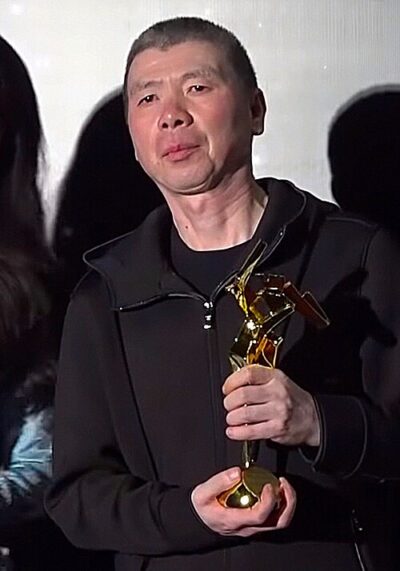
Feng Xiaogang
Feng Xiaogang is a Chinese filmmaker and actor. Born March 18, 1958, in Beijing. Positions held include member of the National Committee of the Chinese People's Political Consultative Conference. Known for The Dream Factory, A World Without Thieves and The Banquet. Awards include Golden Horse Award for Best Leading Actor, Golden Horse Award for Best Director and China Film Director's Guild Award for Best Director.
Facts
24 facts · 1 confirmed by two sources · 4 cited · 19 from one source
Where this comes from
Papalocal keeps its own record. It started from these sources; what each one said is kept here as it was copied, so a change on their side never changes this page by itself. Tap one to read its version.
What Wikidata says · copied November 18, 2026 · revision 2554167460
- Described as
- Chinese filmmaker and actor
- Other names
- Xiaogang Feng, Fung Siu-Gong, Feng Xiao-Gang
- Born
- March 18, 1958 · 1 reference
- Born in
- Beijing
- Citizen of
- People's Republic of China
- Occupation
- film director; screenwriter · 1 reference; film actor; film producer; television director; actor · 1 reference; director · 1 reference
- Positions held
- member of the National Committee of the Chinese People's Political Consultative Conference
- Known for
- The Dream Factory; A World Without Thieves; The Banquet; Aftershock; Assembly; If You Are the One
- Awards
- Golden Horse Award for Best Leading Actor (2015) · 1 reference; Golden Horse Award for Best Director (2016); China Film Director's Guild Award for Best Director; Hundred Flowers Awards; Shanghai International Film Festival (2011); Golden Rooster Award for Best Director
- Spouse
- Xu Fan (1999–)
- Wikipedias with a page
- 21
Wikidata item Q716114 (wikidata.org/wiki/Q716114), public domain (CC0). Copied November 18, 2026.
What Wikipedia says · copied November 18, 2026 · revision 1378222591
Feng Xiaogang (simplified Chinese: 冯小刚; traditional Chinese: 馮小剛; pinyin: Féng Xiǎogāng; born 18 March 1958 in Beijing) is a Chinese filmmaker and actor. After making his directorial debut with the romance film Lost My Love (1994), Feng had three film projects in succession disrupted by Chinese censorship, prompting him to pivot toward comedy. He rose to fame through his collaboration with actor Ge You and played a pivotal role in shaping the Chinese New Year film genre with popular comedies such as The Dream Factory (1997), Be There or Be Square (1998), Sorry Baby (1999), Big Shot's Funeral (2001), and the film series If You Are the One (2008–2023). From the 2000s onward, Feng diversified by directing dramas and epics such as Cell Phone (2003), A World Without Thieves (2004), The Banquet (2006), Assembly (2007), Aftershock (2010), Back to 1942 (2012), I Am Not Madame Bovary (2016), for which he won the Golden Horse Award for Best Director, Youth (2017), and We Girls (2025).
As an actor, Feng mostly appeared in cameo roles. His only two major roles are in Father (2000) and Mr. Six (2015), for the latter of which he won the Golden Horse Award for Best Leading Actor.
- Born, in its opening lines
- March 18, 1958
From the Wikipedia article “Feng Xiaogang” (en.wikipedia.org/wiki/Feng_Xiaogang), by its contributors, under CC BY-SA 4.0 (creativecommons.org/licenses/by-sa/4.0/). Copied November 18, 2026; not changed.
Confirmed Two sources agree. Cited One source, and it names where it got it. One source One source, without a reference of its own. Sources disagree The sources disagree. We show the best-supported value and keep theirs below.
