
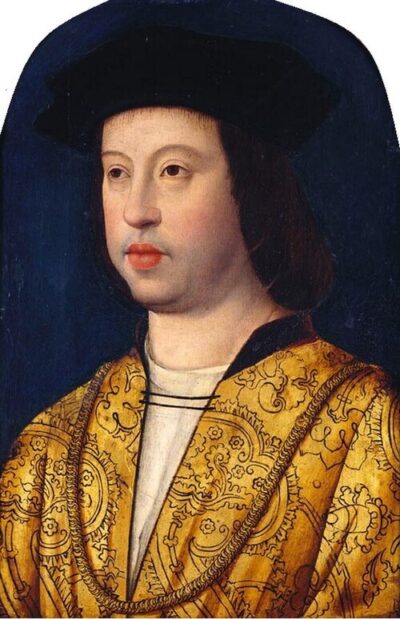
Ferdinand II of Aragon
Ferdinand II of Aragon was a King of Aragon, Sicily, Naples, and Valencia. Born March 10, 1452, in Palacio de los Sada. Died January 23, 1516, in Casa de Santa María. Positions held include monarch of the Crown of Aragon (1479–1516), regent (1504–1516) and Grand Master of the Order of Santiago (1476–1477). Awards include Knight of the Order of the Golden Fleece, Order of Calatrava and Grand Master of the Order of Santiago.
Facts
43 facts · 2 confirmed by two sources · 13 cited · 28 from one source
Where this comes from
Papalocal keeps its own record. It started from these sources; what each one said is kept here as it was copied, so a change on their side never changes this page by itself. Tap one to read its version.
What Wikidata says · copied November 16, 2026 · revision 2569017666
- Described as
- King of Aragon, Sicily, Naples, and Valencia (1452-1516)
- Other names
- Ferdinand the Catholic, Ferrando II, Ferdinand II
- Born
- March 10, 1452 · 7 references
- Died
- January 23, 1516 · 4 references
- Born in
- Palacio de los Sada · 1 reference
- Died in
- Casa de Santa María · 1 reference
- Buried in
- Royal Chapel of Granada · 1 reference
- Citizen of
- Crown of Aragon
- Occupation
- ruler
- Positions held
- monarch of the Crown of Aragon (1479–1516); regent (1504–1516); Grand Master of the Order of Santiago (1476–1477); King of Castile and León (Iure uxoris) (1476–1504); Count of Ribagorza (1458–1469); King of Sardinia (1479–1516); Duke of Gandía
- Member of
- Order of Santiago; Catholic Monarchs · 1 reference
- Awards
- Knight of the Order of the Golden Fleece; Order of Calatrava · 1 reference; Grand Master of the Order of Santiago; Order of Santiago · 1 reference; Knight of the Garter (1480) · 1 reference
- Spouse
- Isabella I of Castile (1469–1504) · 3 references; Germaine of Foix (1505–1516) · 2 references
- Children
- Isabel of Aragon · 1 reference; John, Prince of Asturias · 1 reference; Juana I of Castile · 1 reference; Maria of Aragon · 1 reference; Catherine of Aragon · 1 reference; Alonso de Aragón; John of Aragon, Prince of Girona; Alonso de Estrada; Miguel Fernandez Of Grenade; Juana de Aragón; María Esperanza de Aragón
- Father
- John II of Aragon · 1 reference
- Mother
- Juana Enríquez de Mendoza y Fernández de Córdoba · 1 reference
- Siblings
- Blanche II of Navarre; Joanna of Aragon, Queen of Naples · 1 reference; Leonor I of Navarre; Charles, Prince of Viana; Alfonso de Aragón y Escobar; Joan d'Aragó
- Religion
- Catholicism · 1 reference
- Wikipedias with a page
- 90
Wikidata item Q12860 (wikidata.org/wiki/Q12860), public domain (CC0). Copied November 16, 2026.
What Wikipedia says · copied November 16, 2026 · revision 1383574251
Ferdinand II (10 March 1452 – 23 January 1516), also known as Ferdinand the Catholic (Spanish: Fernando el Católico, Catalan: Ferran el Catòlic), was King of Aragon from 1479 until his death in 1516. As the husband and co-ruler of Queen Isabella I of Castile, he was also King of Castile from 1475 to 1504 (as Ferdinand V). He reigned jointly with Isabella over a dynastically unified Spain; together, they are known as the Catholic Monarchs. Ferdinand is considered the de facto first king of Spain, and was described as such during his reign, even though, legally, Castile and Aragon remained two separate kingdoms until they were formally united by the Nueva Planta decrees issued between 1707 and 1716.
The Crown of Aragon that Ferdinand inherited in 1479 included the kingdoms of Aragon, Valencia, Mallorca, Sardinia, and Sicily, as well as the Principality of Catalonia. His marriage to Isabella is regarded as the "cornerstone in the foundation of the Spanish monarchy". They played a major role in the European colonization of the Americas, sponsoring the first voyage of Christopher Columbus in 1492. That year, the couple defeated Granada, the last Muslim state in Western Europe, thus completing the centuries-long Reconquista.
Following Isabella's death in 1504, the couple's daughter Joanna became queen of the Crown of Castile. That year, after a war with France, Ferdinand conquered the Kingdom of Naples. In 1507, he became regent of Castile on behalf of Joanna, who was alleged to be mentally unstable. In 1506, as part of a treaty with France, Ferdinand married Germaine of Foix, with whom he had no surviving children. In 1512, he conquered most of the Kingdom of Navarre, ruling all the territories comprising modern-day Spain until his death in 1516. He was nominally succeeded by his daughter Joanna, but power was soon assumed by her son Charles I (later Holy Roman Emperor Charles V).
- Born, in its opening lines
- March 10, 1452
- Died, in its opening lines
- January 23, 1516
From the Wikipedia article “Ferdinand II of Aragon” (en.wikipedia.org/wiki/Ferdinand_II_of_Aragon), by its contributors, under CC BY-SA 4.0 (creativecommons.org/licenses/by-sa/4.0/). Copied November 16, 2026; not changed.
Confirmed Two sources agree. Cited One source, and it names where it got it. One source One source, without a reference of its own. Sources disagree The sources disagree. We show the best-supported value and keep theirs below.
