
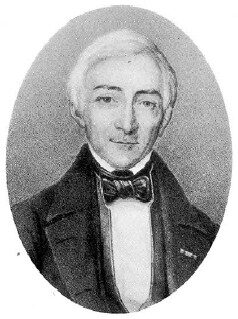
Ferdinand Reich
Ferdinand Reich was a German chemist. Born February 19, 1799, in Bernburg. Died April 27, 1882, in Freiberg. Educated at Leipzig University.
Facts
15 facts · 2 confirmed by two sources · 6 cited · 7 from one source
Where this comes from
Papalocal keeps its own record. It started from these sources; what each one said is kept here as it was copied, so a change on their side never changes this page by itself. Tap one to read its version.
What Wikidata says · copied November 17, 2026 · revision 2568989641
- Described as
- German chemist (1799–1882)
- Born
- February 19, 1799 · 1 reference
- Died
- April 27, 1882 · 1 reference
- Born in
- Bernburg · 1 reference
- Died in
- Freiberg · 1 reference
- Citizen of
- Duchy of Anhalt
- Occupation
- chemist · 1 reference; physicist · 1 reference; university teacher · 1 reference; engineer · 1 reference; Bergbeamter · 1 reference
- Worked for
- Freiberg University of Mining and Technology
- Education
- Leipzig University
- Member of
- Saxon Academy of Sciences and Humanities (1846–); German Academy of Sciences Leopoldina (1866–); Göttingen Academy of Sciences and Humanities in Lower Saxony
- Wikipedias with a page
- 26
Wikidata item Q77307 (wikidata.org/wiki/Q77307), public domain (CC0). Copied November 17, 2026.
What Wikipedia says · copied November 17, 2026 · revision 1370382095
Ferdinand Reich (19 February 1799 – 27 April 1882) was a German chemist who co-discovered indium in 1863 with Hieronymous Theodor Richter.
Reich was born in Bernburg, Anhalt-Bernburg, Holy Roman Empire and died in Freiberg. He was color blind, or could only see in whites and blacks, and that is why Theodor Richter became his science partner. Richter would examine the colors produced in reactions that they studied.
Reich and Richter ended up isolating the indium, creating a small supply, although it was later found in more regions. They isolated the indium at the Freiberg University of Mining and Technology in Germany.In 1803, Laplace and Gauss both derived that, if a heavy object is dropped from a height h at latitude Φ, and the earth rotates from west to east with angular velocity Ω, then the object would be deflected to the east by a distance of d=2/3Ωcos(Φ)(2h3/g). In 1831, Reich set out to test this prediction by actually dropping objects in a mine pit (Drei-Brüder-Schacht, with latitude 50° 53′ 12.5″ N) 158.5 m deep, in Freiberg, Saxony, for 106 times. The average deflection is 2.84 cm to the east and 0.44 cm to the south. The eastward deflection is almost exactly equal to the theoretical value of 2.75 cm, but the southward deflection remains unexplained to this day.
The experiment is published inFallversuche über die Umdrehung der Erde angestellt auf hohe Oberbergamtliche Anordnung in dem Dreibrüderschacht bei Freiberg, Digitized (published in 1832)
- Born, in its opening lines
- February 19, 1799
- Died, in its opening lines
- April 27, 1882
From the Wikipedia article “Ferdinand Reich” (en.wikipedia.org/wiki/Ferdinand_Reich), by its contributors, under CC BY-SA 4.0 (creativecommons.org/licenses/by-sa/4.0/). Copied November 17, 2026; not changed.
Confirmed Two sources agree. Cited One source, and it names where it got it. One source One source, without a reference of its own. Sources disagree The sources disagree. We show the best-supported value and keep theirs below.
