
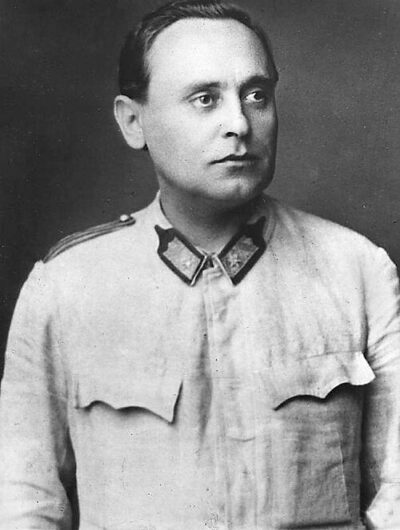
Ferenc Szálasi
Ferenc Szálasi was a Hungarian fascist politician, executed for war crimes. Born January 6, 1897, in Košice. Died March 12, 1946, in Budapest. Positions held include Prime Minister of Hungary (1944–1945), Minister of Education and Religious Affairs of Hungary (1945) and Leader of the Nation of Hungary (1944–1945). Educated at Theresian Military Academy.
Facts
19 facts · 2 confirmed by two sources · 8 cited · 9 from one source
Where this comes from
Papalocal keeps its own record. It started from these sources; what each one said is kept here as it was copied, so a change on their side never changes this page by itself. Tap one to read its version.
What Wikidata says · copied November 16, 2026 · revision 2563067923
- Described as
- Hungarian fascist politician, executed for war crimes (1897-1946)
- Other names
- Ferenc Szalasi
- Born
- January 6, 1897 · 3 references
- Died
- March 12, 1946 · 3 references
- Born in
- Košice · 1 reference
- Died in
- Budapest · 1 reference
- Buried in
- New Public Cemetery, Budapest
- Cause of death
- hanging to death · 1 reference
- Citizen of
- Hungary
- Occupation
- politician · 1 reference; military personnel
- Positions held
- Prime Minister of Hungary (1944–1945); Minister of Education and Religious Affairs of Hungary (1945) · 1 reference; Leader of the Nation of Hungary (1944–1945) · 1 reference
- Political party
- Arrow Cross Party
- Education
- Theresian Military Academy (–1915)
- Field
- Nazism · 1 reference
- Spouse
- Gizella Lutz · 1 reference
- Religion
- Catholicism · 1 reference
- Military branch
- Austro-Hungarian Army · 1 reference
- Military rank
- Major · 1 reference
- Wikipedias with a page
- 45
Wikidata item Q156473 (wikidata.org/wiki/Q156473), public domain (CC0). Copied November 16, 2026.
What Wikipedia says · copied November 16, 2026 · revision 1385809928
Ferenc Szálasi (6 January 1897 – 12 March 1946) was a Hungarian military officer, politician, Nazi sympathizer and founder of the far-right fascist Arrow Cross Party who headed the government of Hungary during the country's occupation by Nazi Germany in the final stages of World War II.
Szálasi served with distinction during World War I as an officer in the Austro-Hungarian Army. In 1925, he became a staff officer of the restored Kingdom of Hungary under Regent Miklós Horthy. Initially apolitical, Szálasi embraced right-wing ultranationalism in the early 1930s and became a passionate advocate of the irredentist Hungarism. In 1937, he founded the Hungarian National Socialist Party, having retired from the military and fully devoted himself to politics. He attracted considerable support through his virulently nationalist and antisemitic program, while his followers became increasingly radical, leading to his imprisonment in 1938. While in prison, he was proclaimed leader of the far-right Nazi Arrow Cross Party, which quickly became one of the most powerful political forces in the country. Szálasi was granted amnesty in 1940, but had to operate his party clandestinely after Horthy outlawed it on the outbreak of World War II.
Following the German occupation of Hungary in March 1944 and Horthy's ousting in October, Szálasi was made head of government and head of state. His pro-Nazi puppet government, known as the Government of National Unity, was dominated by members of the Arrow Cross Party. The regime imposed martial law, participated in Germany's war efforts and recommenced the Holocaust in Hungary, which had been halted by Horthy. His militias were singularly responsible for the murder of 10,000–15,000 Hungarian Jews and for the deportation of a further 650,000 to death camps.
Szálasi's collaborationist government, with its authority limited to the city of Budapest and its environs, only lasted 163 days. Facing the advance of Soviet and Romanian forces, Szálasi and his cabinet fled the country shortly before the Siege of Budapest began. He was captured by American troops in Austria in May 1945 and returned to Hungary to face trial. The Government of National Unity, which had relocated to Munich, was formally dissolved the next day. The People's Tribunal in Budapest found him guilty of war crimes and high treason, and sentenced him to death. He was executed by hanging on 12 March 1946.
- Born, in its opening lines
- January 6, 1897
- Died, in its opening lines
- March 12, 1946
From the Wikipedia article “Ferenc Szálasi” (en.wikipedia.org/wiki/Ferenc_Szálasi), by its contributors, under CC BY-SA 4.0 (creativecommons.org/licenses/by-sa/4.0/). Copied November 16, 2026; not changed.
Confirmed Two sources agree. Cited One source, and it names where it got it. One source One source, without a reference of its own. Sources disagree The sources disagree. We show the best-supported value and keep theirs below.
