
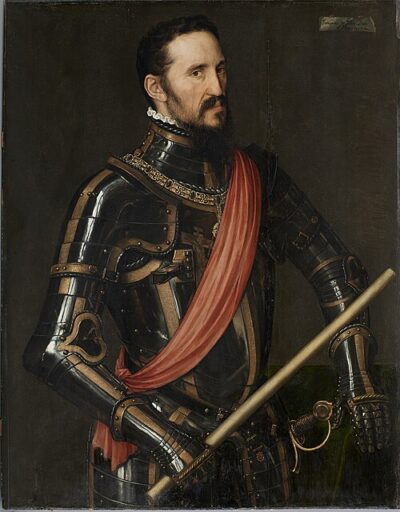
Fernando Álvarez de Toledo, 3rd Duke of Alba
Fernando Álvarez de Toledo, 3rd Duke of Alba was a Spanish military tactician and diplomat. Born October 29, 1507, in Piedrahíta. Died December 11, 1582, in Lisbon. Positions held include Constable of Portugal (1581–1582), Governor of the Spanish Netherlands (1567–1573) and Governor of Milan (1555–1556). Awards include Knight of the Order of the Golden Fleece.
Facts
30 facts · 2 confirmed by two sources · 5 cited · 23 from one source
Where this comes from
Papalocal keeps its own record. It started from these sources; what each one said is kept here as it was copied, so a change on their side never changes this page by itself. Tap one to read its version.
What Wikidata says · copied November 16, 2026 · revision 2568963014
- Described as
- Spanish military tactician and diplomat (1507-1582)
- Other names
- Fernando Alvarez de Toledo, duque de Alba, 3er duque de Alba Fernando Álvarez de Toledo y Pimentel, Fernando Alvarez de, duque de Alba Toledo, Fernando, duque de Alba Alvarez de Toledo, duque de Alba Fernando Alvarez de Toledo, Fernando Alvarez, duque de Alba De Toledo, Duke of Alba, Duke of Alva, Fernando Álvarez de Toledo
- Born
- October 29, 1507 · 3 references
- Died
- December 11, 1582 · 2 references
- Born in
- Piedrahíta
- Died in
- Lisbon · 1 reference
- Buried in
- Convento de Sant Esteban (1619–)
- Name at birth
- Fernando Álvarez de Toledo y Pimentel
- Citizen of
- Spain; Kingdom of Portugal
- Occupation
- military officer; military personnel · 1 reference; diplomat; politician · 1 reference
- Positions held
- Constable of Portugal (1581–1582); Governor of the Spanish Netherlands (1567–1573); Governor of Milan (1555–1556); viceroy of Naples (1555–1558); viceroy of Portugal (1580–1582); Duke of Alba (1531–1582); mayordomo mayor of the King of Spain (1541–1582)
- Awards
- Knight of the Order of the Golden Fleece
- Spouse
- Donna Maria Enriquez de Toledo
- Children
- Fadrique Álvarez de Toledo, 4th Duke of Alba; Don Diego Alvarez de Toledo, Conde de Lerin · 1 reference; Fernando Álvarez de Toledo
- Father
- García Álvarez de Toledo y Zúñiga
- Mother
- Doña Beatriz Alsonso Pimentel y Pacheco · 1 reference
- Religion
- Catholicism · 1 reference
- Military branch
- infantry
- Military rank
- general; Capitán General
- Wikipedias with a page
- 48
Wikidata item Q80847 (wikidata.org/wiki/Q80847), public domain (CC0). Copied November 16, 2026.
What Wikipedia says · copied November 16, 2026 · revision 1381491324
Fernando Álvarez de Toledo y Pimentel, 3rd Duke of Alba (29 October 1507 – 11 December 1582), known as the Grand Duke of Alba (Spanish: Gran Duque de Alba, Portuguese: Grão Duque de Alba) in Spain and Portugal and as the Iron Duke (Dutch: IJzeren Hertog) or shortly 'Alva' in the Netherlands and Belgium, was a Spanish military officer, statesman and diplomat.
He has often been considered the most effective general of his generation, as well as one of the greatest in history. Historian John Lothrop Motley wrote of him "no man had studied military science more deeply, or practiced it more constantly" at his day. He was a royal promoter of military action against France and Protestantism, although he also defended a moral and strategic alliance with England that never realized. Alba achieved notoriety for his role during the Eighty Years' War in the Spanish Netherlands, where his prolonged campaigns and repressive political actions caused his figure to be reviled in European history as a symbol of tyranny.
Born into a prominent Castilian military family, Alba first distinguished himself in the 1535 conquest of Tunis during the Ottoman–Habsburg Wars as part of a long conflict for predominance over the western Mediterranean Sea. He then commanded the Spanish troops at the Battle of Mühlberg (1547), where the army of Holy Roman Emperor Charles V defeated the German Protestant princes in the Schmalkaldic War. Alba was the commander-in-chief of the Spanish-Habsburg army during the Italian War of 1551–1559, and became governor of Milan in 1555 and viceroy of Naples in 1556.
In 1567, King Philip II of Spain appointed Alba governor of the Netherlands and tasked him with the suppression of Dutch rebels. Alba instituted the Council of Troubles, which led to the condemnations of thousands and came to be known as the "Council of Blood". Alba repeatedly defeated the troops of William of Orange during the first stages of the Eighty Years' War, but failed to extinguish politically the rebellion, and in 1573 he was recalled to Spain in temporary political disgrace. Alba's last military successes were in the Portuguese succession crisis of 1580, for which he was rewarded the titles viceroy and constable of Portugal. He held both titles until his death in Lisbon in 1582.
- Born, in its opening lines
- October 29, 1507
- Died, in its opening lines
- December 11, 1582
From the Wikipedia article “Fernando Álvarez de Toledo, 3rd Duke of Alba” (en.wikipedia.org/wiki/Fernando_Álvarez_de_Toledo,_3rd_Duke_of_Alba), by its contributors, under CC BY-SA 4.0 (creativecommons.org/licenses/by-sa/4.0/). Copied November 16, 2026; not changed.
Confirmed Two sources agree. Cited One source, and it names where it got it. One source One source, without a reference of its own. Sources disagree The sources disagree. We show the best-supported value and keep theirs below.
