
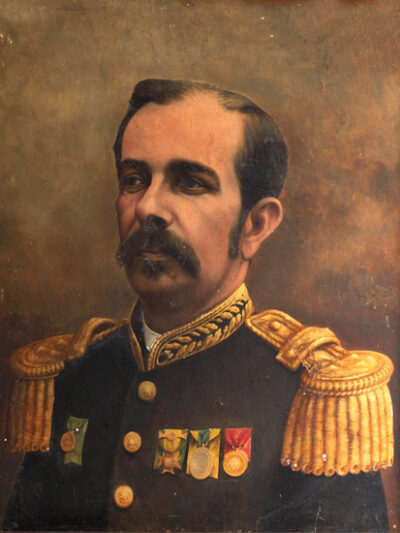
Floriano Peixoto
Floriano Peixoto was a Brazilian politician. Born April 30, 1839, in Maceió. Died June 29, 1895, in Rio de Janeiro. Positions held include Alagoas senator (1890–1891), President of Brazil (1891–1894) and Vice President of the Federative Republic of Brazil (1891). Educated at Academia Militar das Agulhas Negras.
Facts
17 facts · 2 confirmed by two sources · 3 cited · 12 from one source
What’s different
- Died: we show June 29, 1895 (Confirmed). Wikidata also lists July 29, 1895
Where this comes from
Papalocal keeps its own record. It started from these sources; what each one said is kept here as it was copied, so a change on their side never changes this page by itself. Tap one to read its version.
What Wikidata says · copied November 16, 2026 · revision 2566866633
- Described as
- Brazilian politician (1839-1895)
- Other names
- Floriano Vieira Peixoto, Marechal de Ferro
- Born
- April 30, 1839 · 1 reference
- Died
- July 29, 1895 · 1 reference; June 29, 1895 · 1 reference
- Born in
- Maceió
- Died in
- Rio de Janeiro
- Buried in
- Cemitério de São João Batista · 1 reference
- Citizen of
- Brazil
- Occupation
- politician · 1 reference
- Positions held
- Alagoas senator (1890–1891) · 2 references; President of Brazil (1891–1894) · 1 reference; Vice President of the Federative Republic of Brazil (1891) · 1 reference; President of the Federal Senate of Brazil (1891); provincial president of Brazil
- Political party
- independent politician · 1 reference
- Education
- Academia Militar das Agulhas Negras
- Spouse
- Josina Peixoto
- Military branch
- Brazilian Army
- Military rank
- marshal
- Wikipedias with a page
- 46
Wikidata item Q238688 (wikidata.org/wiki/Q238688), public domain (CC0). Copied November 16, 2026.
What Wikipedia says · copied November 16, 2026 · revision 1381094547
Floriano Vieira Peixoto (Brazilian Portuguese: [floɾiˈɐ̃nu viˈe(j)ɾɐ pe(j)ˈʃotu]; 30 April 1839 – 29 June 1895), was a Brazilian military officer and politician who served as the second president of Brazil from 1891 to 1894, being the first vice president of Brazil to have succeeded the president mid-term. Previously, from February to November 1891, he served as the first vice president of Brazil. His administration encompasses the greater part of the period in Brazilian history known as the "Republic of the Sword". A veteran of the Paraguayan War and several other conflicts in Brazil, Peixoto was nicknamed "The Iron Marshal" or "Consolidator of the Republic".
Born in the province of Alagoas, he moved to Rio de Janeiro at the age of sixteen to complete his secondary education. In 1858, he entered the Military School of Rio de Janeiro, graduating as a second lieutenant in 1861. As a member—and later commander—of the 1st Battalion of Homeland Volunteers during the Paraguayan War, he took part in key episodes of the conflict, including the battles of Tuyutí, Ytororó, Lomas Valentinas, and Angostura. In 1870, he returned to the capital and earned a bachelor's degree in physical and mathematical sciences. In 1884, he assumed the position of president of the province of Mato Grosso, serving for just over a year. He was an active participant in the Proclamation of the Republic, refusing to lead the imperial resistance against the republican coup d'état. Having risen to the highest rank in the Brazilian Army, he became Minister of War in 1890. Elected vice president in February 1891, he assumed the presidency of Brazil in November of the same year, following the resignation of the incumbent president, Deodoro da Fonseca, amidst a severe political crisis.
His administration was marked by an intense climate of rebellion, authoritarianism, and republican radicalism. In 1892, aiming to challenge the legitimacy of Peixoto's government, a group of senior military officers published the Manifesto of the 13 Generals, in which they argued that, constitutionally, Peixoto should have called for new elections rather than assuming the presidency for the remainder of Deodoro's term. The Second Naval Revolt—stemming from various conflicts between the Army and the Navy—and the Federalist Revolution—a political crisis that sought to oust the governor of Rio Grande do Sul, Júlio de Castilhos—both broke out in 1893. Peixoto suppressed these conflicts with violence, consolidating his grip on power and earning him the nickname "Iron Marshal". The cult of personality surrounding him, known as Florianism, was the first significant political phenomenon in Brazil to center on a specific republican figure.
- Born, in its opening lines
- April 30, 1839
- Died, in its opening lines
- June 29, 1895
From the Wikipedia article “Floriano Peixoto” (en.wikipedia.org/wiki/Floriano_Peixoto), by its contributors, under CC BY-SA 4.0 (creativecommons.org/licenses/by-sa/4.0/). Copied November 16, 2026; not changed.
Confirmed Two sources agree. Cited One source, and it names where it got it. One source One source, without a reference of its own. Sources disagree The sources disagree. We show the best-supported value and keep theirs below.
