
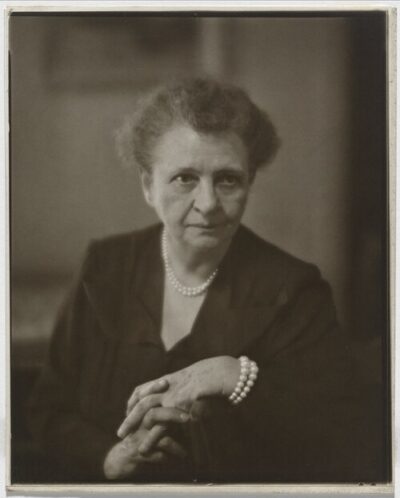
Frances Perkins
Frances Perkins was a Workers-rights advocate and United States Secretary of Labor 1933–1945. Born April 10, 1880, in Boston. Died May 14, 1965, in New York City. Positions held include United States Secretary of Labor (1933–1945). Educated at Columbia University and The Wharton School. Awards include National Women's Hall of Fame, Labor Hall of Honor and honorary doctor of Brandeis University.
Facts
35 facts · 2 confirmed by two sources · 29 cited · 4 from one source
Where this comes from
Papalocal keeps its own record. It started from these sources; what each one said is kept here as it was copied, so a change on their side never changes this page by itself. Tap one to read its version.
What Wikidata says · copied November 15, 2026 · revision 2562622554
- Described as
- Workers-rights advocate and United States Secretary of Labor 1933–1945
- Other names
- Frances Coralie Perkins, Frances Perkins Wilson, Fannie Coralie Perkins
- Born
- April 10, 1880 · 8 references
- Died
- May 14, 1965 · 9 references
- Born in
- Boston · 7 references
- Died in
- New York City · 5 references
- Buried in
- Newcastle · 2 references
- Cause of death
- stroke · 1 reference
- Name at birth
- Fannie Coralie Perkins · 3 references
- Citizen of
- United States · 1 reference
- Occupation
- politician · 2 references; sociologist · 1 reference; factory inspector; writer · 1 reference; social worker · 4 references; official · 4 references; suffragist · 1 reference; biographer · 1 reference
- Positions held
- United States Secretary of Labor (1933–1945) · 1 reference
- Political party
- Democratic Party · 1 reference
- Worked for
- Cornell University
- Education
- Columbia University (–1910) · 2 references; The Wharton School · 3 references; Mount Holyoke College (–1902) · 3 references
- Awards
- National Women's Hall of Fame (1982) · 1 reference; Labor Hall of Honor (1989) · 2 references; honorary doctor of Brandeis University; Elizabeth Blackwell Award (1962) · 1 reference
- Field
- sociology · 1 reference; politics · 1 reference; labor movement · 1 reference; New Deal · 2 references; economy of the United States · 1 reference; government program · 1 reference
- Father
- Frederick William Perkins · 1 reference
- Religion
- Episcopal Church
- Lived in
- Frances Perkins House (1937–1940) · 2 references
- Wikipedias with a page
- 38
Wikidata item Q254478 (wikidata.org/wiki/Q254478), public domain (CC0). Copied November 15, 2026.
What Wikipedia says · copied November 15, 2026 · revision 1384715398
Frances Perkins (born Fannie Coralie Perkins; April 10, 1880 – May 14, 1965) was an American workers-rights advocate who served as the fourth United States secretary of labor from 1933 to 1945, the longest serving in that position. A member of the Democratic Party, Perkins was the first woman ever to serve in a presidential cabinet. As a loyal supporter of her longtime friend, President Franklin D. Roosevelt, she helped make labor issues important in the emerging New Deal coalition. She advocated for immigrants’ rights as well. She was one of two Roosevelt cabinet members to remain in office for his entire presidency (the other being Interior Secretary Harold L. Ickes).
Perkins's most important role came in developing a policy for social security in 1935. She also helped form government policy for working with labor unions. Perkins's Labor Department helped to mediate strikes by way of the United States Conciliation Service. She dealt with numerous labor issues during World War II, when skilled labor was vital to the economy and women were moving into jobs formerly held by men.
Perkins was born in Boston. After graduating from Mount Holyoke College, she briefly worked as a teacher and at the Hull House settlement in Chicago. She obtained graduate degrees at Columbia University and became a labor leader and consumer advocate in New York City, where she first met Roosevelt in 1910. Perkins was appointed a commissioner in New York City government and later in the state government. On January 14, 1929, Perkins was appointed the head of New York's Department of Labor, in the role of Industrial Commissioner, by Roosevelt when he was governor of New York. She addressed the early effects of the Great Depression in this role. When Roosevelt was elected president in 1932, Perkins was asked to join his cabinet and she presented him with a list of programs to help workers. She oversaw many New Deal programs during the Depression and labor programs during World War II. The Frances Perkins Building, headquarters of the U.S. Labor Department, is named for her, and she is remembered with a feast day in the Episcopal Church.
- Born, in its opening lines
- April 10, 1880
- Died, in its opening lines
- May 14, 1965
From the Wikipedia article “Frances Perkins” (en.wikipedia.org/wiki/Frances_Perkins), by its contributors, under CC BY-SA 4.0 (creativecommons.org/licenses/by-sa/4.0/). Copied November 15, 2026; not changed.
Confirmed Two sources agree. Cited One source, and it names where it got it. One source One source, without a reference of its own. Sources disagree The sources disagree. We show the best-supported value and keep theirs below.
