
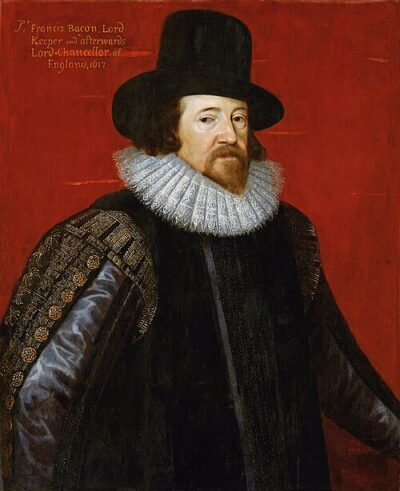
Francis Bacon
Francis Bacon was an English philosopher and statesman. Born January 22, 1561, in London. Died April 9, 1626, in London. Positions held include Member of Parliament in the Parliament of England, Attorney General for England and Wales (1613–1617) and Member of the 1572-83 Parliament. Known for New Atlantis and inductive reasoning. Educated at Trinity College and University of Poitiers. Awards include Knight Bachelor.
Facts
52 facts · 2 confirmed by two sources · 24 cited · 24 from one source · 2 where the sources disagree
What’s different
- Born in: we show London (Sources disagree). Wikidata also lists York House, Strand
- Died in: we show London (Sources disagree). Wikidata also lists Highgate
Where this comes from
Papalocal keeps its own record. It started from these sources; what each one said is kept here as it was copied, so a change on their side never changes this page by itself. Tap one to read its version.
What Wikidata says · copied November 16, 2026 · revision 2567936648
- Described as
- English philosopher and statesman (1561–1626)
- Other names
- Bacon, Francis, 1561-1626, Francis Bacon of Verulamius, Francis Bacon, Viscount Saint Alban, Franciscus Bacon, Francis Bacon, Lord Verulam, Sir Francis Bacon
- Born
- January 22, 1561 · 4 references
- Died
- April 9, 1626 · 6 references
- Born in
- York House, Strand; London · 2 references
- Died in
- Highgate · 1 reference; London · 2 references
- Buried in
- St Michael's Church, St Albans
- Cause of death
- pneumonia
- Citizen of
- Kingdom of England
- Occupation
- philosopher · 4 references; writer · 4 references; judge; politician · 3 references; lawyer · 1 reference; astrologer · 1 reference; scientist · 1 reference; historian · 1 reference
- Positions held
- Member of Parliament in the Parliament of England; Attorney General for England and Wales (1613–1617); Member of the 1572-83 Parliament · 1 reference; Member of the 1584-85 Parliament · 2 references; Member of the 1586-87 Parliament · 2 references; Member of the 1589 Parliament · 2 references; Member of the 1593 Parliament · 2 references; Member of the 1597-98 Parliament · 2 references; Member of the 1601 Parliament · 2 references; Member of the 1604-11 Parliament · 2 references; Member of the 1614 Parliament · 2 references; Lord Chancellor (1617–1621); Solicitor General for England and Wales (1607–1613); Lord Keeper of the Great Seal (1617–1621) · 1 reference; Governor of the Charterhouse (1619–)
- Education
- Trinity College; University of Poitiers
- Member of
- Gray's Inn
- Known for
- New Atlantis; inductive reasoning · 1 reference
- Awards
- Knight Bachelor
- Field
- philosophy · 1 reference; scientist · 1 reference; philosopher · 1 reference; politician · 1 reference; epistemology · 1 reference; empiricism · 1 reference
- Spouse
- Alice Barnham (1606–1625) · 2 references
- Father
- Nicholas Bacon · 3 references
- Mother
- Anne Bacon · 3 references
- Siblings
- Elizabeth Bacon; Anthony Bacon · 2 references; Nathaniel Bacon; Edward Bacon; Sir Nicholas Bacon, 1st Baronet, of Redgrave; Anne Bacon · 1 reference
- Religion
- Anglicanism
- Wikipedias with a page
- 188
Wikidata item Q37388 (wikidata.org/wiki/Q37388), public domain (CC0). Copied November 16, 2026.
What Wikipedia says · copied November 16, 2026 · revision 1385565697
Francis Bacon, 1st Viscount St Alban (; 22 January 1561 – 9 April 1626) was an English philosopher and statesman who served as Attorney General and Lord Chancellor of England under King James I. Bacon argued for the importance of natural philosophy, guided by the scientific method, and his works remained influential throughout the Scientific Revolution.
Bacon has been called the father of empiricism. He argued for the possibility of scientific knowledge based only upon inductive reasoning and careful observation of events in nature. He believed that science could be achieved by the use of a sceptical and methodical approach whereby scientists aim to avoid misleading themselves. Although his most specific proposals about such a method, the Baconian method, did not have long-lasting influence, the general idea of the importance and possibility of a sceptical methodology makes Bacon one of the founders of the scientific method. His portion of the method based in scepticism was a new rhetorical and theoretical framework for science, whose practical details are still central to debates on science and methodology. He is famous for his role in the scientific revolution, promoting scientific experimentation as a way of glorifying God and fulfilling scripture.
Bacon was a patron of libraries and developed a system for cataloguing books under three categories – history, poetry, and philosophy – which could further be divided into specific subjects and subheadings. Regarding books, he wrote: "Some books are to be tasted; others swallowed; and some few to be chewed and digested." The Baconian theory of Shakespeare authorship, a fringe theory which was first proposed in the mid-19th century, contends that Bacon wrote at least some and possibly all of the plays conventionally attributed to William Shakespeare.
Bacon was educated at Trinity College, Cambridge, where he rigorously followed the medieval curriculum, which was presented largely in Latin. He was the first recipient of the Queen's counsel designation, conferred in 1597 when Elizabeth I appointed him as her legal advisor. After the accession of James I in 1603, Bacon was knighted, then created Baron Verulam in 1618 and Viscount St Alban in 1621. After his impeachment on corruption charges, he was found guilty and briefly imprisoned, then forbidden from again holding public office. He had no heirs, and so both his titles became extinct on his death in 1626 at the age of 65. He is buried at St Michael's Church, St Albans, Hertfordshire.
- Born, in its opening lines
- January 22, 1561
- Died, in its opening lines
- April 9, 1626
From the Wikipedia article “Francis Bacon” (en.wikipedia.org/wiki/Francis_Bacon), by its contributors, under CC BY-SA 4.0 (creativecommons.org/licenses/by-sa/4.0/). Copied November 16, 2026; not changed.
Confirmed Two sources agree. Cited One source, and it names where it got it. One source One source, without a reference of its own. Sources disagree The sources disagree. We show the best-supported value and keep theirs below.
