
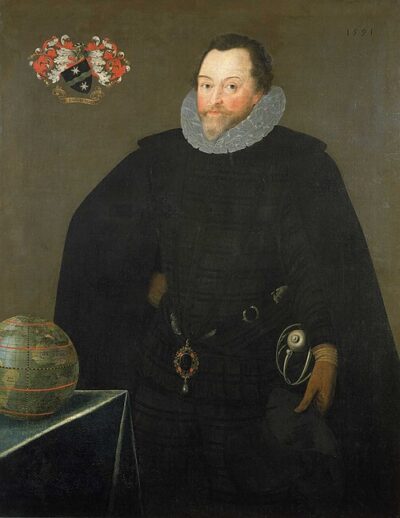
Francis Drake
Francis Drake was an English sailor and privateer (c. 1540 – 1596). Born 1540, in Tavistock. Died January 28, 1596, in Portobelo. Positions held include Member of the 1572-83 Parliament, Member of the 1584-85 Parliament and Member of the 1593 Parliament. Awards include Knight Bachelor.
Facts
25 facts · 2 confirmed by two sources · 11 cited · 12 from one source
Where this comes from
Papalocal keeps its own record. It started from these sources; what each one said is kept here as it was copied, so a change on their side never changes this page by itself. Tap one to read its version.
What Wikidata says · copied November 16, 2026 · revision 2569839615
- Described as
- English sailor and privateer (c. 1540 – 1596)
- Other names
- Sir Francis Drake
- Born
- 1540 · 1 reference
- Died
- January 28, 1596 · 4 references
- Born in
- Tavistock · 2 references
- Died in
- Portobelo · 2 references
- Cause of death
- dysentery
- Citizen of
- Kingdom of England · 1 reference
- Occupation
- explorer · 1 reference; sailor; politician; engineer; vice admiral; privateer; pirate · 1 reference; seafarer · 1 reference
- Positions held
- Member of the 1572-83 Parliament · 1 reference; Member of the 1584-85 Parliament · 1 reference; Member of the 1593 Parliament · 1 reference
- Awards
- Knight Bachelor
- Spouse
- Mary Newman (1569–1582) · 1 reference; Elizabeth Sydenham (1585–1596)
- Father
- Edmund Drake · 1 reference
- Mother
- Mary Mylwaye · 1 reference
- Military branch
- Royal Navy · 1 reference
- Military rank
- vice admiral
- Lived in
- Buckland Abbey (1589–1594)
- Wikipedias with a page
- 122
Wikidata item Q36517 (wikidata.org/wiki/Q36517), public domain (CC0). Copied November 16, 2026.
What Wikipedia says · copied November 16, 2026 · revision 1380598640
Sir Francis Drake (c. 1540 – 28 January 1596) was an English explorer and privateer known for making the second circumnavigation of the world in a single expedition between 1577 and 1580 (being the first English expedition to accomplish this). He is also known for participating in the early English slaving voyages of his cousin, John Hawkins, and John Lovell. Having started as a simple seaman, in 1588 he was part of the fight against the Spanish Armada as a vice admiral.
At an early age, Drake was placed into the household of a relative, William Hawkins, a prominent sea captain in Plymouth. In 1572, he set sail on his first independent mission, privateering along the Spanish Main. Drake's circumnavigation began on 13 December 1577. He crossed the Pacific Ocean, until then an area of exclusive Spanish interest, and laid claim to New Albion, plundering coastal towns and ships for treasure and supplies as he went. He arrived back in England on 26 September 1580. Elizabeth I awarded Drake a knighthood in 1581 which he received aboard his galleon the Golden Hind.
Drake's circumnavigation of the Earth inaugurated an era of conflict with the Spanish and in 1585, the Anglo-Spanish War began. Drake was in command of an expedition to the Americas that attacked Spanish shipping and ports. When Philip II sent the Spanish Armada to England in 1588 as a precursor to its invasion, Drake was second-in-command of the English fleet that fought against and repulsed the Spanish fleet. A year later he led the English Armada in a failed attempt to destroy the remaining Spanish fleet.
Drake was a Member of Parliament (MP) for three constituencies: Camelford in 1581, Bossiney in 1584, and Plymouth in 1593. Drake's exploits made him a hero to the English, but his privateering led the Spanish to brand him a pirate, known to them as El Draque ("The Dragon" in old Spanish). He died of dysentery after his failed assault on Panama in January 1596.
- Born, in its opening lines
- c. 1540
- Died, in its opening lines
- January 28, 1596
From the Wikipedia article “Francis Drake” (en.wikipedia.org/wiki/Francis_Drake), by its contributors, under CC BY-SA 4.0 (creativecommons.org/licenses/by-sa/4.0/). Copied November 16, 2026; not changed.
Confirmed Two sources agree. Cited One source, and it names where it got it. One source One source, without a reference of its own. Sources disagree The sources disagree. We show the best-supported value and keep theirs below.
