
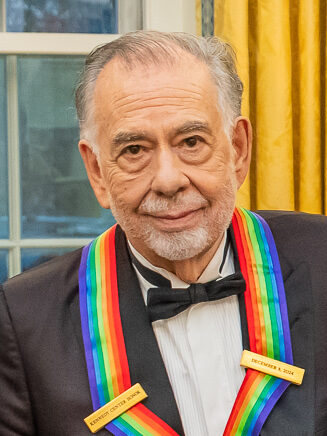
Francis Ford Coppola
Francis Ford Coppola is an American filmmaker. Born April 7, 1939, in Detroit. Positions held include President of the Jury at the Cannes Festival (1996). Known for The Godfather, Rumble Fish and Apocalypse Now. Educated at Hofstra University and UCLA School of Theater, Film and Television. Awards include Writers Guild of America Award (3 times), Donostia Award and Directors Guild of America Award.
Facts
65 facts · 1 confirmed by two sources · 22 cited · 42 from one source
Where this comes from
Papalocal keeps its own record. It started from these sources; what each one said is kept here as it was copied, so a change on their side never changes this page by itself. Tap one to read its version.
What Wikidata says · copied November 13, 2026 · revision 2568614129
- Described as
- American filmmaker (born 1939)
- Other names
- Francis Coppola
- Born
- April 7, 1939 · 10 references
- Born in
- Detroit · 2 references
- Citizen of
- United States · 1 reference
- Occupation
- film director · 1 reference; film producer · 2 references; screenwriter · 1 reference; film editor; executive producer; composer; winegrower; director · 2 references
- Positions held
- President of the Jury at the Cannes Festival (1996)
- Education
- Hofstra University; UCLA School of Theater, Film and Television; University of California, Los Angeles; John L. Miller Great Neck North High School; Jamaica High School; New York Military Academy
- Member of
- American Academy of Arts and Sciences; Writers Guild of America West
- Genre
- crime film; drama film; horror film; mystery film; war film; thriller film
- Known for
- The Godfather; Rumble Fish; Apocalypse Now; The Conversation; Megalopolis; Bram Stoker's Dracula; The Rain People; The Outsiders; Apocalypse Now Redux; Peggy Sue Got Married
- Awards
- Writers Guild of America Award (3 times) (1971, 1973, 1975); Donostia Award (2002); Directors Guild of America Award; Princess of Asturias Award for the Arts (2015); Praemium Imperiale (2013) · 1 reference; Academy Award for Best Director (1975) · 1 reference; Academy Award for Best Writing, Original Screenplay (1971) · 1 reference; Academy Award for Best Writing, Adapted Screenplay (2 times) (1973, 1975) · 1 reference; Academy Award for Best Picture (1975) · 1 reference; California Hall of Fame (2014); Fellow of the American Academy of Arts and Sciences; Lumière Award, Lyon Festival of cinema (2019); National Board of Review Award for Best Film; BAFTA Award for Best Direction (1980) · 1 reference; Inkpot Award (1992) · 1 reference
- Field
- film production · 1 reference; film direction · 1 reference; film screenwriting · 1 reference; viticulture
- Spouse
- Eleanor Coppola (1963–2024) · 1 reference
- Children
- Sofia Coppola · 1 reference; Roman Coppola · 1 reference; Gian-Carlo Coppola
- Father
- Carmine Coppola · 1 reference
- Mother
- Italia Coppola
- Siblings
- Talia Shire · 1 reference; August Coppola · 1 reference
- Lived in
- Napa Valley AVA
- Height
- 1.82 m (6 ft 0 in)
- Wikipedias with a page
- 103
Wikidata item Q56094 (wikidata.org/wiki/Q56094), public domain (CC0). Copied November 13, 2026.
What Wikipedia says · copied November 13, 2026 · revision 1385051647
Francis Ford Coppola ( KOH-pə-lə; born April 7, 1939) is an American filmmaker. One of the leading figures of the New Hollywood, Coppola is widely regarded as one of the greatest and most influential filmmakers in the history of cinema. He has received various accolades including five Academy Awards, a BAFTA Award, three Golden Globe Awards, and two Palmes d'Or, as well as nominations for two Emmy Awards and a Grammy Award. Coppola was also honored with the Irving G. Thalberg Memorial Award in 2010, the Kennedy Center Honors in 2024, and the AFI Life Achievement Award in 2025. Four of his films have been inducted into the National Film Registry by the Library of Congress.
Coppola made his directorial debut with Dementia 13 (1963). He then directed You're a Big Boy Now (1966), Finian's Rainbow (1968), and The Rain People (1970). After co-writing Patton (1970)—for which he and Edmund H. North earned the Academy Award for Best Original Screenplay—his reputation as a filmmaker was cemented with the release of The Godfather (1972) and The Godfather Part II (1974), which both earned Academy Awards for Best Picture, and the latter earned him Best Director. The films revolutionized the gangster genre. During that time, Coppola released the thriller The Conversation (1974), which received the Palme d'Or at the Cannes Film Festival.
Coppola's next film, the Vietnam War epic Apocalypse Now (1979), had a notoriously lengthy and strenuous production and also won the Palme d'Or, making Coppola one of only ten filmmakers to have won the award twice. He later directed films such as The Outsiders and Rumble Fish (both 1983), The Cotton Club (1984), Peggy Sue Got Married (1986), The Godfather Part III (1990), Bram Stoker's Dracula (1992), and The Rainmaker (1997). Coppola also produced American Graffiti (1973), The Black Stallion (1979), and The Secret Garden (1993). Dissatisfied with the studio system, he transitioned to independent and experimental filmmaking with Youth Without Youth (2007), Tetro (2009), Twixt (2011), and Megalopolis (2024).
Coppola's father Carmine was a composer whose music featured in his son's films. Many of his relatives have found success in film: his sister Talia Shire is an actress, his daughter Sofia is a director, his son Roman is a screenwriter and his nephews Jason Schwartzman and Nicolas Cage are actors. Coppola resides in Napa, California, and since the 2010s has been a vintner, owning a family-branded winery of his own. He was accused of sexual misconduct in 2024, including facing a civil lawsuit in Georgia while filming Megalopolis.
- Born, in its opening lines
- April 7, 1939
From the Wikipedia article “Francis Ford Coppola” (en.wikipedia.org/wiki/Francis_Ford_Coppola), by its contributors, under CC BY-SA 4.0 (creativecommons.org/licenses/by-sa/4.0/). Copied November 13, 2026; not changed.
Confirmed Two sources agree. Cited One source, and it names where it got it. One source One source, without a reference of its own. Sources disagree The sources disagree. We show the best-supported value and keep theirs below.
