
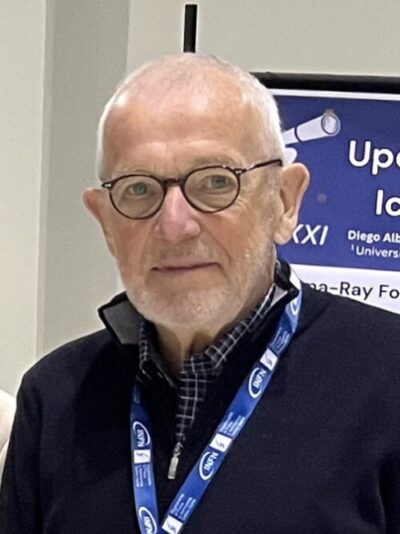
Francis Halzen
Francis Halzen is a Belgian-American astrophysicist. Born March 23, 1944, in Tienen. Known for IceCube Neutrino Observatory. Educated at Catholic University of Leuven (1834–1968). Awards include Fellow of the American Physical Society, Balzan Prize and Cocconi Prize.

Facts
19 facts · 1 confirmed by two sources · 8 cited · 10 from one source
Where this comes from
Papalocal keeps its own record. It started from these sources; what each one said is kept here as it was copied, so a change on their side never changes this page by itself. Tap one to read its version.
What Wikidata says · copied November 13, 2026 · revision 2566632701
- Described as
- Belgian-American astrophysicist
- Other names
- Francis Louis Halzen, Francis L. Halzen, Francis L Halzen, F. Halzen
- Born
- March 23, 1944 · 1 reference
- Born in
- Tienen · 1 reference
- Citizen of
- United States; Belgium
- Occupation
- university teacher; physicist · 1 reference
- Worked for
- University of Wisconsin–Madison
- Education
- Catholic University of Leuven (1834–1968) · 1 reference
- Member of
- Academia Europaea (2018–); Koninklijke Vlaamse Academie van België voor Wetenschappen en Kunsten · 1 reference
- Known for
- IceCube Neutrino Observatory · 1 reference
- Awards
- Fellow of the American Physical Society; Balzan Prize (2015) · 1 reference; Cocconi Prize (2015) · 1 reference; Julius Wess Prize (2017) · 1 reference; APS Medal for Exceptional Achievement in Research (2026) · 1 reference; Nobel Prize in Physics (2026) · 3 references; Bruno Pontecorvo Prize · 1 reference
- Field
- neutrino physics
- Wikipedias with a page
- 46
Wikidata item Q20942818 (wikidata.org/wiki/Q20942818), public domain (CC0). Copied November 13, 2026.
What Wikipedia says · copied November 13, 2026 · revision 1381473977
Francis Louis Halzen (born 23 March 1944) is a Belgian-American physicist who has worked in both theoretical and experimental particle physics, including high-energy astrophysics. Born in Belgium, he was educated at the Catholic University of Leuven and worked as a scientific associate at CERN before moving to the United States, where he has been a professor at the University of Wisconsin–Madison since 1972. Since 2001 he has been the principal investigator and co-spokesperson of the IceCube Neutrino Observatory, the world's largest neutrino detector, based at the Amundsen–Scott South Pole Station in Antarctica. He received the 2026 Nobel Prize in Physics "for decisive contributions to the IceCube Neutrino Observatory and the discovery of high-energy neutrinos of astrophysical origin."
- Born, in its opening lines
- March 23, 1944
From the Wikipedia article “Francis Halzen” (en.wikipedia.org/wiki/Francis_Halzen), by its contributors, under CC BY-SA 4.0 (creativecommons.org/licenses/by-sa/4.0/). Copied November 13, 2026; not changed.
Confirmed Two sources agree. Cited One source, and it names where it got it. One source One source, without a reference of its own. Sources disagree The sources disagree. We show the best-supported value and keep theirs below.
