
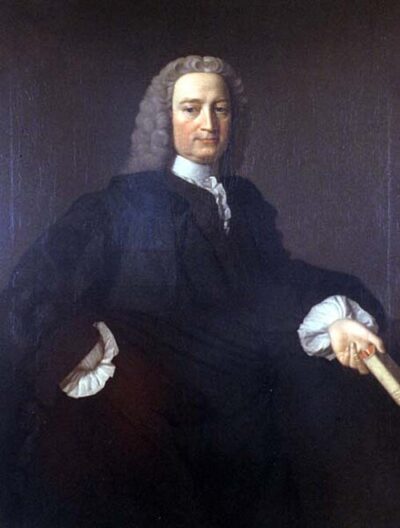
Francis Hutcheson
Francis Hutcheson was a Scottish philosopher. Born August 8, 1694, in Drumalig. Died August 8, 1746, in Dublin. Educated at University of Glasgow.
Facts
20 facts · 2 confirmed by two sources · 12 cited · 5 from one source · 1 where the sources disagree
What’s different
- Born in: we show Drumalig (Sources disagree). Wikidata also lists Saintfield
Where this comes from
Papalocal keeps its own record. It started from these sources; what each one said is kept here as it was copied, so a change on their side never changes this page by itself. Tap one to read its version.
What Wikidata says · copied November 16, 2026 · revision 2565544304
- Described as
- Scottish philosopher (1694–1746)
- Other names
- Franciscus Hutchinson, Franciscus Hutcheson, Frances Hutcheson, Franciscus Hutchesonius, Franz Hutcheson
- Born
- August 8, 1694 · 11 references
- Died
- August 8, 1746 · 5 references
- Born in
- Drumalig · 3 references; Saintfield · 1 reference
- Died in
- Dublin · 2 references
- Buried in
- St. Mary's Church, Dublin
- Citizen of
- Kingdom of Great Britain · 1 reference; Ireland · 4 references
- Occupation
- philosopher · 15 references; economist; theologian · 1 reference; writer · 1 reference; university teacher · 1 reference
- Worked for
- University of Glasgow (1729–) · 1 reference
- Education
- University of Glasgow (1710–1716)
- Field
- philosophy · 1 reference; economics · 1 reference; theology · 1 reference; Age of Enlightenment · 1 reference
- Children
- Francis Hutcheson · 1 reference
- Religion
- Presbyterianism
- Wikipedias with a page
- 47
Wikidata item Q316367 (wikidata.org/wiki/Q316367), public domain (CC0). Copied November 16, 2026.
What Wikipedia says · copied November 16, 2026 · revision 1378834062
Francis Hutcheson (; 8 August 1694 – 8 August 1746) was an Irish philosopher widely regarded as one of the key figures of the early Scottish Enlightenment. He served as Professor of Moral Philosophy at the University of Glasgow and was a major advocate of moral sense theory, which holds that humans possess an innate sense that guides moral judgments. Hutcheson is best known for his ethical writings, in which he defends benevolence as the primary source of moral virtue and anticipates later utilitarian theories with his formulation of "the greatest happiness for the greatest number".
Beyond ethics, Hutcheson made significant contributions to aesthetics, epistemology, logic, and metaphysics. He was among the first modern thinkers to explore beauty as a product of an internal sense, helping to establish aesthetics as a distinct branch of philosophy. In epistemology, he engaged critically with John Locke's empiricism while defending the role of innate dispositions. In logic and metaphysics, he proposed early versions of common-sense realism and contributed to the development of the Scottish school of common sense.
Hutcheson also developed an early argument for animal rights, contending that sentient creatures deserve moral consideration based on their capacity to experience pleasure and pain. His influence extended to later Enlightenment thinkers such as David Hume, Adam Smith, Jeremy Bentham, and Thomas Reid, and his writings were widely read in both Britain and colonial America.
- Born, in its opening lines
- August 8, 1694
- Died, in its opening lines
- August 8, 1746
From the Wikipedia article “Francis Hutcheson (philosopher)” (en.wikipedia.org/wiki/Francis_Hutcheson_(philosopher)), by its contributors, under CC BY-SA 4.0 (creativecommons.org/licenses/by-sa/4.0/). Copied November 16, 2026; not changed.
Confirmed Two sources agree. Cited One source, and it names where it got it. One source One source, without a reference of its own. Sources disagree The sources disagree. We show the best-supported value and keep theirs below.
