
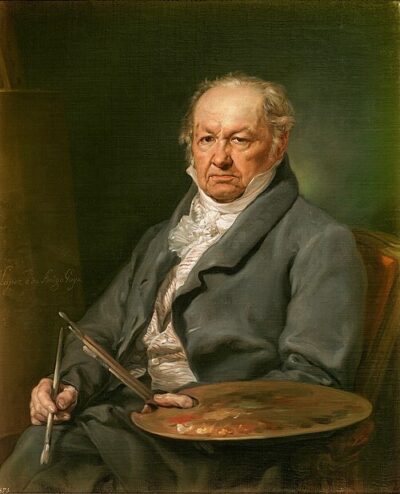
Francisco Goya
Francisco Goya was a Spanish painter and printmaker. Born March 30, 1746, in Fuendetodos. Died April 16, 1828, in Bordeaux. Positions held include court painter. Known for La maja desnuda, San Bernardino of Siena preaching before Alfonso V of Aragon and The Third of May 1808. Educated at School of St. Thomas Aquinas of the Piarist Schools of Zaragoza and Real Academia de Nobles y Bellas Artes de San Luis.
Facts
41 facts · 2 confirmed by two sources · 14 cited · 24 from one source · 1 where the sources disagree
What’s different
- Buried in: we show Chartreuse Cemetery (Sources disagree). Wikidata also lists San Isidro Cemetery and Royal Chapel of St. Anthony of La Florida
Where this comes from
Papalocal keeps its own record. It started from these sources; what each one said is kept here as it was copied, so a change on their side never changes this page by itself. Tap one to read its version.
What Wikidata says · copied November 16, 2026 · revision 2569603561
- Described as
- Spanish painter and printmaker (1746–1828)
- Other names
- Francesco Goya, Francisco de Paula Jose Goya y Lucientes, francesco goya, José Goya y Lucientes, Francisco de Paula, Francisco Jose y Lucientes de Goya, Francisko Goja, f. de goya, Francisco Goya Y Lucientes, Francisco de Goya, fr. jose de goya, Francisco José Goya Lucientes, j. f. de goya y lucientes
- Born
- March 30, 1746 · 7 references
- Died
- April 16, 1828 · 8 references
- Born in
- Fuendetodos · 4 references
- Died in
- Bordeaux · 4 references
- Buried in
- Chartreuse Cemetery; San Isidro Cemetery; Royal Chapel of St. Anthony of La Florida
- Citizen of
- Spain
- Occupation
- painter · 3 references; printmaker · 1 reference; lithographer · 2 references; etcher · 2 references; draftsperson · 2 references; visual artist · 2 references
- Positions held
- court painter
- Education
- School of St. Thomas Aquinas of the Piarist Schools of Zaragoza; Real Academia de Nobles y Bellas Artes de San Luis; Royal Academy of Fine Arts of San Fernando
- Member of
- Real Academia de Nobles y Bellas Artes de San Luis
- Genre
- portrait painting · 1 reference; mythological painting · 1 reference; battle painting · 1 reference; history painting · 1 reference; religious painting · 1 reference; portrait · 1 reference
- Known for
- La maja desnuda; San Bernardino of Siena preaching before Alfonso V of Aragon; The Third of May 1808; The Clothed Maja; Caprichos; The Second of May 1808; General José de Palafox on Horseback; Our Lady of the Pillar; Adoration of the Name of God; Regina Martyrum
- Field
- painting · 1 reference; engraving process
- Spouse
- Josefa Bayeu
- Children
- Francisco Javier Goya Bayeu
- Father
- José Benito de Goya y Franque
- Mother
- Gracia de Lucientes y Salvador
- Siblings
- Camilo Goya y Lucientes · 1 reference
- Lived in
- Quinta del Sordo (1819–1824)
- Wikipedias with a page
- 188
Wikidata item Q5432 (wikidata.org/wiki/Q5432), public domain (CC0). Copied November 16, 2026.
What Wikipedia says · copied November 16, 2026 · revision 1384606318
Francisco José de Goya y Lucientes (; Spanish: [fɾanˈθisko xoˈse ðe ˈɣoʝa i luˈθjentes]; 30 March 1746 – 16 April 1828) was a Spanish romantic painter and printmaker. He is considered the most important Spanish artist of the late 18th and early 19th centuries. His paintings, drawings, and engravings reflected contemporary historical upheavals and influenced important 19th- and 20th-century painters. Goya is often referred to as the last of the Old Masters and the first of the moderns. He is widely regarded as one of the most influential figures in the history of Western art.
Goya was born in Fuendetodos, Aragon, to a middle-class family in 1746. He studied painting from age 14 under José Luzán y Martínez and moved to Madrid to study with Anton Raphael Mengs. He married Josefa Bayeu in 1773. Goya became a court painter to the Spanish Crown in 1786 and this early portion of his career is marked by portraits of the Spanish aristocracy and royalty, and Rococo-style tapestry cartoons designed for the royal palace.
Although Goya's letters and writings survive, little is known about his thoughts. He had a severe and undiagnosed illness in 1793 that left him deaf, after which his work became progressively darker and more pessimistic. His later easel and mural paintings, prints, and drawings appear to reflect a bleak outlook on personal, social, and political levels and contrast with his social climbing. He was appointed Director of the Royal Academy in 1795, the year Manuel Godoy made an unfavorable treaty with France. In 1799, Goya became Primer Pintor de Cámara (Prime Court Painter), the highest rank for a Spanish court painter. In the late 1790s, commissioned by Godoy, he completed his La maja desnuda, a remarkably daring nude for the time and clearly indebted to Diego Velázquez. In 1800–01, he painted Charles IV of Spain and His Family, also influenced by Velázquez.
In 1807, Napoleon led the French army into the Peninsular War against Spain. Goya remained in Madrid during the war, which seems to have affected him deeply. Although he did not speak his thoughts in public, they can be inferred from his Disasters of War series of prints (although published 35 years after his death) and his 1814 paintings The Second of May 1808 and The Third of May 1808. Other works from his mid-period include the Caprichos and Los Disparates etching series, and a wide variety of paintings concerned with insanity, mental asylums, witches, fantastical creatures and religious and political corruption, all of which suggest that he feared for both his country's fate and his own mental and physical health.
His late period culminates with the Black Paintings of 1819–1823, applied on oil on the plaster walls of his house the Quinta del Sordo (House of the Deaf Man) where, disillusioned by political and social developments in Spain, he lived in near isolation. Goya eventually abandoned Spain in 1824 to retire to the French city of Bordeaux, accompanied by his much younger maid and companion, Leocadia Weiss, who may have been his lover. There he completed his La Tauromaquia series and a number of other works. Following a stroke that left him paralyzed on his right side, Goya died and was buried on 16 April 1828 aged 82.
- Born, in its opening lines
- March 30, 1746
- Died, in its opening lines
- April 16, 1828
From the Wikipedia article “Francisco Goya” (en.wikipedia.org/wiki/Francisco_Goya), by its contributors, under CC BY-SA 4.0 (creativecommons.org/licenses/by-sa/4.0/). Copied November 16, 2026; not changed.
Confirmed Two sources agree. Cited One source, and it names where it got it. One source One source, without a reference of its own. Sources disagree The sources disagree. We show the best-supported value and keep theirs below.
