
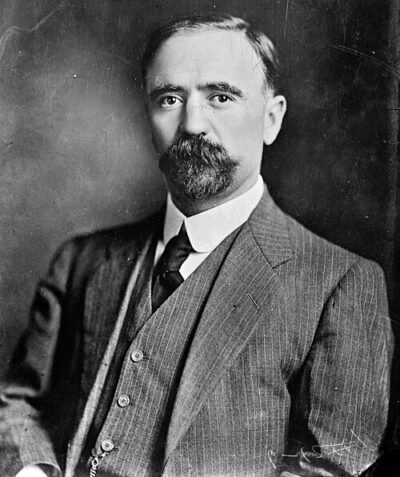
Francisco I. Madero
Francisco I. Madero was a Mexican revolutionary leader and president. Born October 30, 1873, in Parras de la Fuente. Died February 22, 1913, in Mexico City. Positions held include President of Mexico (1911–1913). Educated at HEC Paris and Lycée Hoche.
Facts
29 facts · 2 confirmed by two sources · 4 cited · 23 from one source
Where this comes from
Papalocal keeps its own record. It started from these sources; what each one said is kept here as it was copied, so a change on their side never changes this page by itself. Tap one to read its version.
What Wikidata says · copied November 16, 2026 · revision 2566091690
- Described as
- Mexican revolutionary leader and president (1873-1913)
- Other names
- Francisco Ignacio Madero Gonzáles, Francisco Ignacio Madero, Francisco Ignacio Madero González
- Born
- October 30, 1873 · 5 references
- Died
- February 22, 1913 · 3 references
- Born in
- Parras de la Fuente · 1 reference
- Died in
- Mexico City · 1 reference
- Buried in
- Monumento a la Revolución · 1 reference
- Cause of death
- gunshot wound
- Citizen of
- Mexico
- Occupation
- politician · 1 reference; writer; musician; military personnel; businessperson · 1 reference; revolutionary · 1 reference
- Positions held
- President of Mexico (1911–1913)
- Political party
- Partido Nacional Antirreeleccionista; Progressive Constitutionalist Party
- Education
- HEC Paris (1888–1892); Lycée Hoche; Mount St. Mary's University; University of California, Berkeley (1893)
- Member of
- HEC Alumni
- Spouse
- Sara Pérez de Madero
- Father
- Francisco Madero Hernández
- Siblings
- Gustavo A. Madero; Raúl Madero; Emilio Madero González; Gabriel J. Madero; Evaristo E. Madero; Julio Madero
- Wikipedias with a page
- 64
Wikidata item Q216766 (wikidata.org/wiki/Q216766), public domain (CC0). Copied November 16, 2026.
What Wikipedia says · copied November 16, 2026 · revision 1382833783
Francisco Ignacio Madero González (Spanish pronunciation: [fɾanˈsisko jɣˈnasjo maˈðeɾo ɣonˈsales]; 30 October 1873 – 22 February 1913) was a Mexican businessman, revolutionary, writer, politician, and statesman who served as the 37th president of Mexico from 1911 until he was deposed and assassinated in a coup d'état in February 1913. He came to prominence as an advocate for democracy and as an opponent of President and dictator Porfirio Díaz. After Díaz claimed to have won the fraudulent election of 1910 despite promising a return to democracy, Madero started the Mexican Revolution to oust Díaz. The Mexican revolution would continue until 1920, well after Madero and Díaz's deaths, with hundreds of thousands dead.
A member of one of Mexico's wealthiest families, Madero studied business at the École des Hautes Études Commerciales de Paris. An advocate for social justice and democracy, his 1908 book The Presidential Succession in 1910 called for Mexican voters to prevent the reelection of Porfirio Díaz, whose regime had become increasingly authoritarian. Bankrolling the opposition Anti-Reelectionist Party, Madero's candidacy garnered widespread support in the country. He challenged Díaz in the 1910 election, which resulted in his arrest. After Díaz declared himself winner for an eighth term in a rigged election, Madero escaped from jail, fled to the United States, and called for the overthrow of the Díaz regime in the Plan of San Luis Potosí, sparking the Mexican Revolution.
Madero's armed support was concentrated in northern Mexico and was aided by access to arms and finances in the United States. In Chihuahua, Madero recruited wealthy landowner Abraham González to his movement, appointing him provisional governor of the state. González then enlisted Pancho Villa and Pascual Orozco as revolutionary leaders. Madero crossed from Texas into Mexico and took command of a band of revolutionaries, but was defeated in the Battle of Casas Grandes by the Federal Army, which led him to abandon military command roles. Concerned the Battle of Ciudad Juárez would cause casualties in the American city of El Paso and prompt foreign intervention, Madero ordered Villa and Orozco to retreat, but they disobeyed and captured Juárez. Díaz resigned on 25 May 1911 after the signing of the Treaty of Ciudad Juárez and went into exile. Madero retained the Federal Army and dismissed the revolutionary fighters who had forced Díaz's resignation.
Madero was enormously popular among many sectors but did not immediately assume the presidency. An interim president was installed, and elections were scheduled. Madero was elected in a landslide and sworn into office on 6 November 1911. The Madero administration soon encountered opposition from conservatives and more radical revolutionaries. Hesitation to implement large-scale land reform efforts upset many of his followers, who viewed it as a promised demand from conflict participation. Workers also became disillusioned by his moderate policies. Former supporter Emiliano Zapata declared himself in rebellion against Madero in the Plan of Ayala, and in the north, Pascual Orozco led an insurrection against him. Foreign investors became concerned that Madero could not maintain political stability, while foreign governments were concerned that a destabilized Mexico would threaten international order.
In February 1913, a coup d'état backed by the United States and led by conservative generals Félix Díaz (a nephew of Porfirio Díaz), Bernardo Reyes, and Victoriano Huerta was staged in Mexico City, with the latter taking the presidency. Madero was captured and assassinated along with vice president José María Pino Suárez in a series of events now called the Ten Tragic Days, during which his brother Gustavo was tortured and killed. After his assassination, Madero became a unifying force among revolutionary factions against the Huerta regime. In the north, Venustiano Carranza, then governor of Coahuila, led the nascent Constitutionalist Army; meanwhile, Zapata continued his rebellion against the federal government under the Plan of Ayala. Once Huerta was ousted in July 1914, the revolutionary coalitions met in the Convention of Aguascalientes, where disagreements persisted, and Mexico entered a new stage of civil war.
- Born, in its opening lines
- October 30, 1873
- Died, in its opening lines
- February 22, 1913
From the Wikipedia article “Francisco I. Madero” (en.wikipedia.org/wiki/Francisco_I._Madero), by its contributors, under CC BY-SA 4.0 (creativecommons.org/licenses/by-sa/4.0/). Copied November 16, 2026; not changed.
Confirmed Two sources agree. Cited One source, and it names where it got it. One source One source, without a reference of its own. Sources disagree The sources disagree. We show the best-supported value and keep theirs below.
