
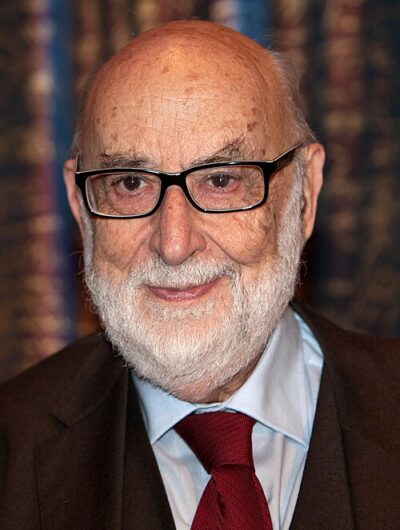
François Englert
François Englert was a Belgian theoretical physicist. Born November 6, 1932, in Etterbeek. Died June 18, 2026, in Uccle. Educated at Free University of Brussels. Awards include Wolf Prize in Physics, Francqui Prize and Nobel Prize in Physics.
Facts
33 facts · 2 confirmed by two sources · 20 cited · 11 from one source
Where this comes from
Papalocal keeps its own record. It started from these sources; what each one said is kept here as it was copied, so a change on their side never changes this page by itself. Tap one to read its version.
What Wikidata says · copied November 16, 2026 · revision 2563197612
- Described as
- Belgian theoretical physicist (1932–2026)
- Other names
- Francois Englert
- Born
- November 6, 1932 · 3 references
- Died
- June 18, 2026 · 3 references
- Born in
- Etterbeek · 2 references
- Died in
- Uccle · 1 reference
- Citizen of
- Belgium · 1 reference; France · 1 reference
- Occupation
- physicist · 2 references; university teacher; theoretical physicist
- Worked for
- Cornell University · 1 reference; Université libre de Bruxelles; Tel Aviv University · 1 reference; Chapman University · 1 reference
- Education
- Free University of Brussels · 1 reference
- Awards
- Wolf Prize in Physics (2004); Francqui Prize (1982) · 1 reference; Nobel Prize in Physics (2013) · 1 reference; Princess of Asturias Award for Technical and Scientific Research (2013) · 1 reference; High Energy and Particle Physics Prize (1997) · 1 reference; Sakurai Prize (2010) · 1 reference; Honorary doctor of the University of Mons (2004) · 1 reference; honorary doctor of the Peking University (2014); honorary doctor of the University of Edinburgh (2014); honorary doctor of the Bar-Ilan University (2015); honorary doctorate of the Vrije Universiteit Brussel (2005) · 2 references; honorary doctor of the University of Miami (2018) · 1 reference; honorary doctorate at the Blaise-Pascal university (2013) · 1 reference; Clarivate Citation Laureates (2013)
- Field
- theoretical physics; physics · 1 reference; particle physics · 1 reference; superstring theory · 1 reference; cosmology · 1 reference
- Wikipedias with a page
- 76
Wikidata item Q151746 (wikidata.org/wiki/Q151746), public domain (CC0). Copied November 16, 2026.
What Wikipedia says · copied November 16, 2026 · revision 1379697679
François, Baron Englert (French: [ɑ̃ɡlɛʁ]; 6 November 1932 – 18 June 2026) was a Belgian theoretical physicist and 2013 Nobel Prize laureate.
Englert was professor emeritus at the Université libre de Bruxelles (ULB), where he was a member of the Service de Physique Théorique. He was also a Sackler Professor by Special Appointment in the School of Physics and Astronomy at Tel Aviv University and a member of the Institute for Quantum Studies at Chapman University in California. He was awarded the 2010 J. J. Sakurai Prize for Theoretical Particle Physics (with Gerry Guralnik, C. R. Hagen, Tom Kibble, Peter Higgs, and Robert Brout), the Wolf Prize in Physics in 2004 (with Brout and Higgs) and the High Energy and Particle Prize of the European Physical Society (with Brout and Higgs) in 1997 for the mechanism which unifies short and long range interactions by generating massive gauge vector bosons.
Englert made contributions in statistical physics, quantum field theory, cosmology, string theory, and supergravity. He was the recipient of the 2013 Prince of Asturias Award in technical and scientific research, together with Peter Higgs and CERN.
Englert was awarded the 2013 Nobel Prize in Physics, together with Peter Higgs for the discovery of the Brout–Englert–Higgs mechanism.
- Born, in its opening lines
- November 6, 1932
- Died, in its opening lines
- June 18, 2026
From the Wikipedia article “François Englert” (en.wikipedia.org/wiki/François_Englert), by its contributors, under CC BY-SA 4.0 (creativecommons.org/licenses/by-sa/4.0/). Copied November 16, 2026; not changed.
Confirmed Two sources agree. Cited One source, and it names where it got it. One source One source, without a reference of its own. Sources disagree The sources disagree. We show the best-supported value and keep theirs below.
