
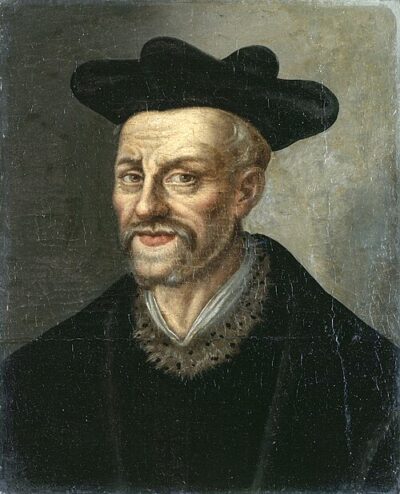
François Rabelais
François Rabelais was the 16th-century French writer and humanist. Born 1494, in Seuilly. Died April 9, 1553, in Paris. Known for Abbaye de Thélème and Gargantua and Pantagruel. Educated at University of Montpellier and University of Poitiers.
Facts
21 facts · 0 confirmed by two sources · 9 cited · 12 from one source
Where this comes from
Papalocal keeps its own record. It started from these sources; what each one said is kept here as it was copied, so a change on their side never changes this page by itself. Tap one to read its version.
What Wikidata says · copied November 16, 2026 · revision 2568740027
- Described as
- 16th-century French writer and humanist (1494–1553)
- Other names
- Françoys Rabelais, Rabelais, Francois Rabelais
- Born
- 1494 · 1 reference
- Died
- April 9, 1553 · 3 references
- Born in
- Seuilly · 1 reference
- Died in
- Paris · 3 references
- Buried in
- Paris
- Citizen of
- Kingdom of France
- Occupation
- writer · 3 references; physician writer; novelist; humorist; humanist · 1 reference; physician · 1 reference; librettist · 1 reference; satirist · 1 reference
- Education
- University of Montpellier (1530); University of Poitiers
- Known for
- Abbaye de Thélème; Gargantua and Pantagruel
- Father
- Antoine Rabelais
- Religion
- Christianity
- Lived in
- House of Rabelais (1545–1547)
- Wikipedias with a page
- 134
Wikidata item Q131018 (wikidata.org/wiki/Q131018), public domain (CC0). Copied November 16, 2026.
What Wikipedia says · copied November 16, 2026 · revision 1385040238
François Rabelais (UK: , US: ; French: [fʁɑ̃swa ʁablɛ]; born between 1483 and 1494; died 1553) was a French writer who has been called the first great French prose author. A humanist of the French Renaissance and Greek scholar, he attracted opposition from both Protestant theologian John Calvin and from the hierarchy of the Catholic Church. Though in his day he was best known as a physician, scholar, diplomat, and Catholic priest, later he became better known as a satirist for his depictions of the grotesque, and for his larger-than-life characters.
Living in the religious and political turmoil of the Reformation, Rabelais treated the great questions of his time in his novels. Rabelais admired Erasmus and like him is considered a Christian humanist. He was critical of medieval scholasticism and lampooned the abuses of powerful princes and popes.
Rabelais is widely known for the first two volumes relating the childhoods of the giants Gargantua and Pantagruel written in the style of bildungsroman; his later works—the Third Book (which prefigures the philosophical novel) and the Fourth Book are considerably more erudite in tone. His literary legacy gave rise to the word Rabelaisian, an adjective meaning "marked by gross robust humor, extravagance of caricature, or bold naturalism."
From the Wikipedia article “François Rabelais” (en.wikipedia.org/wiki/François_Rabelais), by its contributors, under CC BY-SA 4.0 (creativecommons.org/licenses/by-sa/4.0/). Copied November 16, 2026; not changed.
Confirmed Two sources agree. Cited One source, and it names where it got it. One source One source, without a reference of its own. Sources disagree The sources disagree. We show the best-supported value and keep theirs below.
