Gargantua and Pantagruel
Gargantua and Pantagruel is a five novels by François Rabelais. It came out in 1534.
- Released
- 1534
- Written by
- François Rabelais
- Genre
- fantasy
- Country of origin
- France
All 11 facts, and where they come from
Facts
11 facts · 0 confirmed by two sources · 0 cited · 11 from one source
Where this comes from
Papalocal keeps its own record. It started from these sources; what each one said is kept here as it was copied, so a change on their side never changes this page by itself. Tap one to read its version.
What Wikidata says · copied November 17, 2026 · revision 2527017543
- Described as
- five novels by François Rabelais
- What it is
- novel series; literary pentalogy
- Written by
- François Rabelais
- Genre
- fantasy · 1 reference; satire · 1 reference
- Released
- 1534
- Language
- Middle French; French · 1 reference
- Country of origin
- France
- Named after
- Gargantua; Pantagruel
- Wikipedias with a page
- 45
Wikidata item Q822290 (wikidata.org/wiki/Q822290), public domain (CC0). Copied 2026-11-17.
What Wikipedia says · copied November 17, 2026 · revision 1380172904
The Five Books of the Lives and Deeds of Gargantua and Pantagruel (French: Les Cinq livres des faits et dits de Gargantua et Pantagruel), often shortened to Gargantua and Pantagruel or the Cinq Livres (Five Books), is a pentalogy of novels written in the 16th century by François Rabelais. It tells the adventures of two giants, Gargantua ( gar-GAN-tew-ə; French: [ɡaʁɡɑ̃tɥa]) and his son Pantagruel ( pan-TAG-roo-el, -əl, PAN-tə-GROO-əl; French: [pɑ̃taɡʁyɛl]). The work is written in an amusing, extravagant, and satirical vein, features much erudition, vulgarity, and wordplay, and is regularly compared with the works of William Shakespeare and James Joyce. Rabelais was a polyglot, and the work introduced "a great number of new and difficult words ... into the French language".
The work was stigmatised as obscene by the censors of the Collège de la Sorbonne. In a social climate of increasing religious oppression in the lead up to the French Wars of Religion, contemporaries treated it with suspicion and avoided mentioning it.
The characters of Gargantua and his son Pantagruel were not created by Rabelais but inspired by various folk tales which had been collated in the early sixteenth century into five different works, collectively referred to as the Gargantuan Chronicles, the most popular of which, Les Grandes et Inestimables Cronicques du grant et enorme geant Gargantua, Rabelais references in his prologue.
It is the origin of the word Pantagruelism, meaning "buffoonery or coarse humor with a satirical or serious purpose"; and also gargantuan, meaning "enormous".
From the Wikipedia article “Gargantua and Pantagruel” (en.wikipedia.org/wiki/Gargantua_and_Pantagruel), by its contributors, under CC BY-SA 4.0 (creativecommons.org/licenses/by-sa/4.0/). Copied 2026-11-17; not changed.
Confirmed Two sources agree. Cited One source, and it names where it got it. One source One source, without a reference of its own. Sources disagree The sources disagree. We show the best-supported value and keep theirs below.
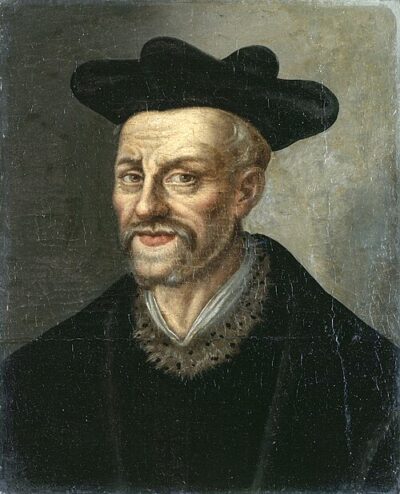
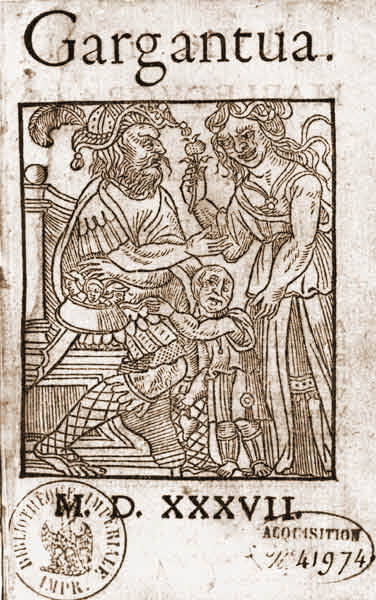
Picture: anonymous Book: Rabelais, via Wikimedia Commons · Public domain