
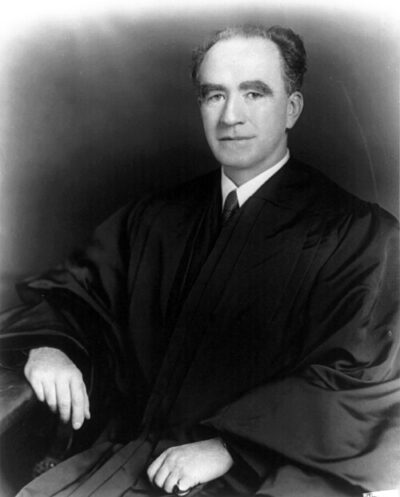
Frank Murphy
Frank Murphy was an U.S. Supreme Court justice from 1940 to 1949. Born April 13, 1890, in Harbor Beach. Died July 19, 1949, in Detroit. Positions held include Associate Justice of the Supreme Court of the United States (1940–1949), United States Attorney General (1939–1940) and Governor of Michigan (1937–1939). Educated at University of Michigan Law School and Trinity College, Dublin.
Facts
28 facts · 2 confirmed by two sources · 8 cited · 18 from one source
Where this comes from
Papalocal keeps its own record. It started from these sources; what each one said is kept here as it was copied, so a change on their side never changes this page by itself. Tap one to read its version.
What Wikidata says · copied November 16, 2026 · revision 2566801288
- Described as
- U.S. Supreme Court justice from 1940 to 1949 (1890–1949)
- Other names
- William Francis Murphy
- Born
- April 13, 1890 · 4 references
- Died
- July 19, 1949 · 4 references
- Born in
- Harbor Beach
- Died in
- Detroit · 1 reference
- Buried in
- Our Lady of Lake Huron Catholic Cemetery · 1 reference
- Cause of death
- coronary thrombosis
- Name at birth
- William Francis Murphy
- Citizen of
- United States
- Occupation
- legal counselor; lawyer · 1 reference; politician · 1 reference; judge · 1 reference; jurist · 1 reference; captain · 1 reference; mayor · 1 reference
- Positions held
- Associate Justice of the Supreme Court of the United States (1940–1949); United States Attorney General (1939–1940); Governor of Michigan (1937–1939); High Commissioner to the Philippines (1935–1936); Governor-General of the Philippines (1933–1935); Mayor of Detroit, Michigan (1930–1933)
- Political party
- Democratic Party
- Worked for
- University of Detroit Mercy
- Education
- University of Michigan Law School; Trinity College, Dublin; University of Detroit Mercy; University of Michigan
- Field
- law of the United States
- Wikipedias with a page
- 22
Wikidata item Q887724 (wikidata.org/wiki/Q887724), public domain (CC0). Copied November 16, 2026.
What Wikipedia says · copied November 16, 2026 · revision 1385882190
William Francis Murphy (April 13, 1890 – July 19, 1949) was an American politician, lawyer, and jurist from Harbor Beach, Michigan. He was a Democrat who was named to the Supreme Court of the United States in 1940 after a political career that included serving as United States Attorney General, 35th governor of Michigan, and Mayor of Detroit. He also served as the last American Governor-General of the Philippines and the first High Commissioner to the Philippines.
Born in "The Thumb" region of Michigan, Murphy graduated from the University of Michigan Law School in 1914. After serving in the United States Army during World War I, he served as a federal attorney and trial judge. He served as Mayor of Detroit from 1930 to 1933. A panel of 69 scholars in 1993 ranked him among the ten best mayors in American history. In 1933 he was appointed as Governor-General of the Philippine Islands. He returned home in 1936 and defeated incumbent Republican governor Frank Fitzgerald in the 1936 Michigan gubernatorial election and served a single term as Governor of Michigan. Murphy lost re-election to Fitzgerald in 1938 and accepted an appointment as the United States Attorney General the following year.
In 1940, President Franklin D. Roosevelt appointed Murphy to the Supreme Court to fill a vacancy caused by the death of Pierce Butler. Murphy served on the Court from 1940 until his death in 1949, and was succeeded by Tom C. Clark. Murphy is famous for writing the Court's majority opinions in Chaplinsky v. New Hampshire and SEC v. W. J. Howey Co., and for his fiery dissent in Korematsu v. United States.
- Born, in its opening lines
- April 13, 1890
- Died, in its opening lines
- July 19, 1949
From the Wikipedia article “Frank Murphy” (en.wikipedia.org/wiki/Frank_Murphy), by its contributors, under CC BY-SA 4.0 (creativecommons.org/licenses/by-sa/4.0/). Copied November 16, 2026; not changed.
Confirmed Two sources agree. Cited One source, and it names where it got it. One source One source, without a reference of its own. Sources disagree The sources disagree. We show the best-supported value and keep theirs below.
