
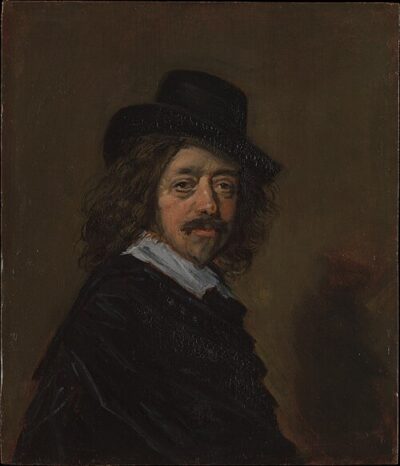
Frans Hals
Frans Hals was a Dutch painter. Born 1580s, in Antwerp. Died August 26, 1666, in Haarlem. Known for The Banquet of the Officers of the St George Militia Company in 1616, The Officers of the St George Militia Company in 1639 and Laughing Cavalier.
Facts
39 facts · 1 confirmed by two sources · 22 cited · 15 from one source · 1 where the sources disagree
What’s different
- Born: we show 1580s (Sources disagree). Wikipedia says c. 1582
Where this comes from
Papalocal keeps its own record. It started from these sources; what each one said is kept here as it was copied, so a change on their side never changes this page by itself. Tap one to read its version.
What Wikidata says · copied November 16, 2026 · revision 2566218049
- Described as
- Dutch painter (1580–1666)
- Other names
- Frans Hal, François Haals, Frans Khalʹs, Frankals, Frantz Hal, Franshalce, Hals François, Franakhale, François Hall, Francois Hals, Fran. Halse, F. Hals
- Born
- 1580s · 2 references
- Died
- August 26, 1666 · 4 references
- Born in
- Antwerp · 4 references
- Died in
- Haarlem · 4 references
- Buried in
- Grote Kerk
- Citizen of
- Dutch Republic
- Occupation
- painter · 4 references; printmaker · 1 reference; architectural drafter · 1 reference; visual artist · 1 reference
- Member of
- Haarlem schutterij; Haarlem Guild of St. Luke
- Genre
- portrait painting · 3 references; genre painting · 3 references; schutterstuk · 1 reference
- Known for
- The Banquet of the Officers of the St George Militia Company in 1616; The Officers of the St George Militia Company in 1639; Laughing Cavalier; Malle Babbe; The Officers of the St Adrian Militia Company in 1633; Portrait of Dorothea Berck; Portrait of Isaak Abrahamsz. Massa; Regents of the Old Men's Almshouse; Two laughing boys with mug of beer; Peeckelhaeringh
- Spouse
- Anneke Hermansz (1610–) · 1 reference; Lysbeth Reyniers (1617–) · 1 reference
- Children
- Harmen Hals · 2 references; Frans Hals Junior · 2 references; Jan Hals · 2 references; Reynier Hals · 2 references; Nicolaes Hals · 2 references; Adriaentje Hals · 1 reference; Jacob Hals · 1 reference; Johannes Hals · 1 reference
- Father
- Franchois Fransz. Hals van Mechelen · 1 reference
- Mother
- Adriaentje van Geertenryck · 1 reference
- Siblings
- Dirck Hals · 1 reference
- Lived in
- Peuzelaarsteeg
- Wikipedias with a page
- 68
Wikidata item Q167654 (wikidata.org/wiki/Q167654), public domain (CC0). Copied November 16, 2026.
What Wikipedia says · copied November 16, 2026 · revision 1381798392
Frans Hals the Elder (UK: , US: ; Dutch: [frɑns ˈɦɑls]; c. 1582 – 26 August 1666) was a Dutch Golden Age painter. He lived and worked in Haarlem, a city in which the local authority of the day frowned on religious painting in places of worship but citizens liked to decorate their homes with works of art. Hals was highly sought after by wealthy burgher commissioners of individual, married-couple, family, and institutional-group portraits. He also painted tronies for the general market.
There were two quite distinct schools of portraiture in 17th-century Haarlem: the neat (represented, for example, by Verspronck); and a looser, more painterly style at which Frans Hals excelled. Some of Hals's portrait work is characterised by a subdued palette, reflecting the politely serious tones of his fashionable clients' wardrobe. In contrast, the personalities he paints are full of life, typically with a friendly glint in the eye or the glimmer of a smile on the lips.
Hals was born at Antwerp in the southern Spanish Netherlands, but because of the chaos wrought there by the Spanish at that time, his family moved to Haarlem when he was little. Many of his Haarlem clients were also émigrés from the South.
- Born, in its opening lines
- c. 1582
- Died, in its opening lines
- August 26, 1666
From the Wikipedia article “Frans Hals” (en.wikipedia.org/wiki/Frans_Hals), by its contributors, under CC BY-SA 4.0 (creativecommons.org/licenses/by-sa/4.0/). Copied November 16, 2026; not changed.
Confirmed Two sources agree. Cited One source, and it names where it got it. One source One source, without a reference of its own. Sources disagree The sources disagree. We show the best-supported value and keep theirs below.
