
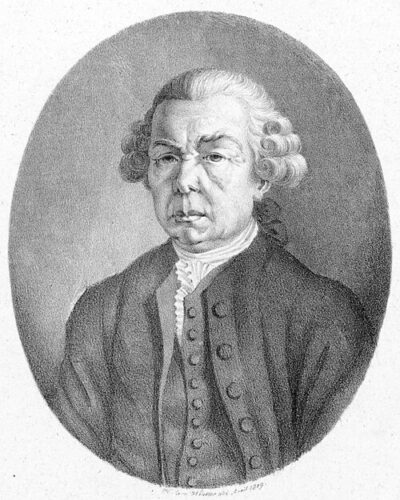
Franz Xaver Richter
Franz Xaver Richter was an Austro-Moravian singer, violinist, composer, conductor and music theoretician. Born December 1, 1709, in Holešov. Died September 12, 1789, in Strasbourg. Positions held include chapelmaster (1769–).
Facts
19 facts · 2 confirmed by two sources · 9 cited · 8 from one source
Where this comes from
Papalocal keeps its own record. It started from these sources; what each one said is kept here as it was copied, so a change on their side never changes this page by itself. Tap one to read its version.
What Wikidata says · copied November 18, 2026 · revision 2568971977
- Described as
- Austro-Moravian singer, violinist, composer, conductor and music theoretician
- Other names
- Franz, Xaver Richter
- Born
- December 1, 1709 · 8 references
- Died
- September 12, 1789 · 10 references
- Born in
- Holešov · 3 references
- Died in
- Strasbourg · 1 reference
- Buried in
- Cimetière Saint-Gall de Strasbourg · 1 reference
- Citizen of
- Holy Roman Empire
- Occupation
- composer · 3 references; violinist · 1 reference; conductor; music educator; bandleader · 2 references; theorist · 1 reference; singer · 2 references; double-bassist · 1 reference
- Positions held
- chapelmaster (1769–) · 1 reference
- Member of
- Mannheim school
- Genre
- symphony
- Instrument
- violin
- Lived in
- Rue des Chandelles (1770)
- Wikipedias with a page
- 22
Wikidata item Q113911 (wikidata.org/wiki/Q113911), public domain (CC0). Copied November 18, 2026.
What Wikipedia says · copied November 18, 2026 · revision 1385501975
Franz (Czech: František) Xaver Richter, known as François Xavier Richter in France (December 1, 1709 – September 12, 1789) was an Austro-Moravian singer, violinist, composer, conductor and music theoretician who spent most of his life first in Austria and later in Mannheim and in Strasbourg, where he was music director of the cathedral. From 1783 on, Haydn's favourite pupil, Ignaz Pleyel, was his deputy director.
The most traditional of the first-generation composers of the so-called Mannheim school, he was highly regarded in his day as a contrapuntist. As a composer he was equally at home in the concerto and the "strict church style". Mozart heard a mass by Richter on his journey back from Paris to Salzburg in 1778 and called it "charmingly written". Richter, as a contemporary engraving clearly shows, must have been one of the first conductors to actually have conducted with a music sheet roll in his hand.
Richter wrote chiefly symphonies, concertos for woodwinds as well as trumpet, and chamber and church music, his masses receiving special praise. He was a man of a transitional period, and his symphonies in a way constitute one of the missing links between the generation of Bach and Handel and the "First Viennese school". Although sometimes contrapuntal in a learned way, Richter's orchestral works nevertheless exhibit considerable drive and verve. Until a few years ago, apparently the only available recordings of Richter's music were performances of his trumpet concerto in D major, but recently a number of chamber orchestras and ensembles have included many of his pieces, particularly symphonies and concertos, in their repertoires.
- Born, in its opening lines
- December 1, 1709
- Died, in its opening lines
- September 12, 1789
From the Wikipedia article “Franz Xaver Richter” (en.wikipedia.org/wiki/Franz_Xaver_Richter), by its contributors, under CC BY-SA 4.0 (creativecommons.org/licenses/by-sa/4.0/). Copied November 18, 2026; not changed.
Confirmed Two sources agree. Cited One source, and it names where it got it. One source One source, without a reference of its own. Sources disagree The sources disagree. We show the best-supported value and keep theirs below.
