
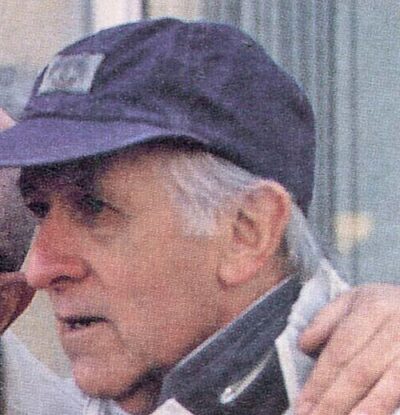
Freddie Francis
Freddie Francis was a cinematographer, film director. Born December 22, 1917, in London. Died March 17, 2007, in Middlesex. Awards include Academy Award for Best Cinematography, Black-and-White and Academy Award for Best Cinematography.
Facts
15 facts · 2 confirmed by two sources · 6 cited · 7 from one source
Where this comes from
Papalocal keeps its own record. It started from these sources; what each one said is kept here as it was copied, so a change on their side never changes this page by itself. Tap one to read its version.
What Wikidata says · copied November 18, 2026 · revision 2539181567
- Described as
- cinematographer, film director (1917-2007)
- Other names
- Frederick William Francis
- Born
- December 22, 1917 · 5 references
- Died
- March 17, 2007 · 5 references
- Born in
- London · 1 reference
- Died in
- Middlesex
- Buried in
- Mortlake Crematorium · 1 reference
- Cause of death
- stroke
- Citizen of
- United Kingdom
- Occupation
- cinematographer · 2 references; film director; screenwriter; director · 1 reference
- Member of
- British Society of Cinematographers
- Awards
- Academy Award for Best Cinematography, Black-and-White (1961) · 1 reference; Academy Award for Best Cinematography (1990) · 1 reference
- Military branch
- British Army
- Wikipedias with a page
- 23
Wikidata item Q1337082 (wikidata.org/wiki/Q1337082), public domain (CC0). Copied November 18, 2026.
What Wikipedia says · copied November 18, 2026 · revision 1379694358
Frederick William Francis BSC (22 December 1917 – 17 March 2007) was an English cinematographer and film director whose filmmaking career spanned over 60 years, from the late 1930s until the late 1990s. One of the most celebrated British cinematographers of his time, he received numerous accolades for his photography, including two Academy Awards and five BAFTA Awards. As a director he was best known for his horror films, notably those made for production companies Amicus and Hammer in the 1960s and 1970s.
Francis was a cinematographer for notable British films such as Jack Clayton's drama Room at the Top (1959), Jack Cardiff's Sons and Lovers (1960) – which earned him his first Oscar – and the psychological horror film The Innocents (1961). He became well known for his rich black-and-white CinemaScope framing, and was regarded as one of the top cameramen in the British film industry. He made his directorial debut with the romantic comedy Two and Two Make Six (1962), but gained the most attention for his horror films and thrillers. During the 1960s he was a house director for Hammer Productions, where he made Paranoiac (1963; an early starring vehicle for Oliver Reed), The Evil of Frankenstein (1964), and Dracula Has Risen from the Grave (1968). In the 1970s he worked mainly for Amicus Productions, for which he notably directed the horror anthology Tales from the Crypt (1972).
After nearly two decades as a director, Francis returned to cinematography with The Elephant Man (1980). This established a collaboration with director David Lynch, for whom he also shot Dune (1984), and The Straight Story (1999). He won his second Oscar for the American Civil War film Glory (1989). He also earned acclaim for his work on Karel Reisz's The French Lieutenant's Woman (1981), and Martin Scorsese's Cape Fear (1991).
In addition to his Oscar and BAFTA wins, Francis received an international achievement award from the American Society of Cinematographers in 1997, a lifetime achievement award from the British Society of Cinematographers the same year, and BAFTA's special achievement award in 2004.
- Born, in its opening lines
- December 22, 1917
- Died, in its opening lines
- March 17, 2007
From the Wikipedia article “Freddie Francis” (en.wikipedia.org/wiki/Freddie_Francis), by its contributors, under CC BY-SA 4.0 (creativecommons.org/licenses/by-sa/4.0/). Copied November 18, 2026; not changed.
Confirmed Two sources agree. Cited One source, and it names where it got it. One source One source, without a reference of its own. Sources disagree The sources disagree. We show the best-supported value and keep theirs below.
