
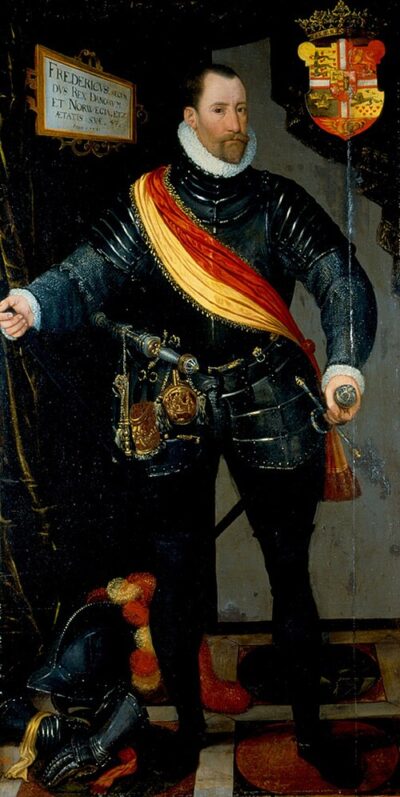
Frederick II of Denmark
Frederick II of Denmark was a King of Denmark and Norway. Born July 1, 1534, in Haderslev. Died April 4, 1588, in Slagelse. Positions held include Monarch of Denmark (1559–1588) and Monarch of Norway (1559–1588). Awards include Knight of the Garter.
Facts
25 facts · 2 confirmed by two sources · 10 cited · 13 from one source
Where this comes from
Papalocal keeps its own record. It started from these sources; what each one said is kept here as it was copied, so a change on their side never changes this page by itself. Tap one to read its version.
What Wikidata says · copied November 16, 2026 · revision 2568256801
- Described as
- King of Denmark and Norway (1534–1588)
- Other names
- Frederick II
- Born
- July 1, 1534 · 3 references
- Died
- April 4, 1588 · 8 references
- Born in
- Haderslev
- Died in
- Slagelse
- Buried in
- Roskilde Cathedral · 1 reference
- Citizen of
- Denmark–Norway · 1 reference
- Occupation
- art collector · 1 reference
- Positions held
- Monarch of Denmark (1559–1588); Monarch of Norway (1559–1588)
- Awards
- Knight of the Garter (1578)
- Spouse
- Sophie of Mecklenburg-Güstrow (1572–1588) · 2 references
- Children
- Elizabeth of Denmark, Duchess of Brunswick-Wolfenbüttel · 1 reference; Anne of Denmark · 1 reference; Christian IV of Denmark · 1 reference; Ulrik of Denmark; Augusta of Denmark · 1 reference; Hedwig of Denmark · 1 reference; John, Prince of Schleswig-Holstein
- Father
- Christian III of Denmark · 1 reference
- Mother
- Dorothea of Saxe-Lauenburg · 1 reference
- Siblings
- Anne of Denmark, Electress of Saxony; Dorothea of Denmark, Duchess of Brunswick-Lüneburg; Magnus, Duke of Holstein; John the Younger, Duke of Schleswig-Holstein-Sonderburg
- Religion
- Lutheranism
- Wikipedias with a page
- 53
Wikidata item Q154041 (wikidata.org/wiki/Q154041), public domain (CC0). Copied November 16, 2026.
What Wikipedia says · copied November 16, 2026 · revision 1382264118
Frederick II (Danish: Frederik 2.; 1 July 1534 – 4 April 1588) was King of Denmark and Norway and Duke of Schleswig and Holstein from 1559 until his death in 1588.
A member of the House of Oldenburg, Frederick began his personal rule of Denmark–Norway at the age of 24. He inherited capable and strong realms, formed in large by his father after the civil war known as the Count's Feud, after which Denmark–Norway saw a period of economic recovery and of a great increase in the centralised authority of the Crown. Frederick was, especially in his youth and unlike his father, belligerent and adversarial, aroused by honor and national pride, and so he began his reign auspiciously with a campaign under the aged Johan Rantzau, which reconquered Dithmarschen. However, after miscalculating the cost of the Northern Seven Years' War, he pursued a more prudent foreign policy. The remainder of Frederick II's reign was a period of tranquillity, in which king and nobles prospered. Frederick spent more time hunting and feasting with his councillors, and focused on architecture and science. During his reign, many building projects were begun, including additions to the royal castles of Kronborg at Elsinore and Frederikborg Castle at Hillerød.
Frederick has to a great extent been overshadowed by his popular, long-reigning son Christian IV, and often been portrayed with skepticism and resentment, resulting in the prevailing portrait of Frederick as a man and as king: an unlettered, inebriated, brutish sot. However, recent studies reappraise and acknowledge him as highly intelligent; he craved the company of learned men, and in the correspondence and legislation he dictated to his secretaries he showed himself to be quick-witted and articulate. Frederick was also open and loyal, and had a knack for establishing close personal bonds with fellow princes and with those who served him.
In 1572, Frederick married his cousin Sophie of Mecklenburg. Their relationship is regarded as one of the happiest royal marriages in Renaissance Europe. In the first ten years after the wedding, they had seven children, and are described as inseparable and harmonious.
Frederick was committed to becoming the mightiest king in the North, and for several years he fought exhausting wars against his rival Erik XIV of Sweden, after which the battles changed character. It became a competition to see who could trace their family history the furthest, and who could construct the most formidable castles. In the 1570s he constructed Kronborg, a large Renaissance castle that became widely recognized abroad, and its dance hall was the largest in Northern Europe at the time. He enjoyed entertaining guests and throwing elaborate festivities, which were well known throughout Europe. During the same period, the Danish-Norwegian fleet was developed into one of Europe's largest and most modern. As part of his efforts to strengthen the kingdoms, he provided much support for science and culture.
- Born, in its opening lines
- July 1, 1534
- Died, in its opening lines
- April 4, 1588
From the Wikipedia article “Frederick II of Denmark” (en.wikipedia.org/wiki/Frederick_II_of_Denmark), by its contributors, under CC BY-SA 4.0 (creativecommons.org/licenses/by-sa/4.0/). Copied November 16, 2026; not changed.
Confirmed Two sources agree. Cited One source, and it names where it got it. One source One source, without a reference of its own. Sources disagree The sources disagree. We show the best-supported value and keep theirs below.
