
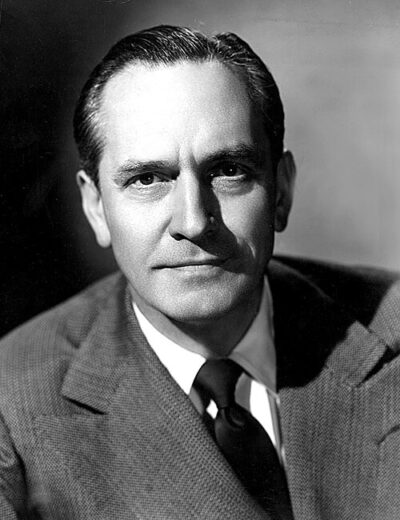
Fredric March
Fredric March was an American actor. Born August 31, 1897, in Racine. Died April 14, 1975, in Los Angeles. Educated at University of Wisconsin–Madison and Washington Park High School. Awards include Academy Award for Best Actor (2 times), Tony Award for Best Actor in a Play (2 times) and star on Hollywood Walk of Fame.
Facts
22 facts · 2 confirmed by two sources · 4 cited · 16 from one source
Where this comes from
Papalocal keeps its own record. It started from these sources; what each one said is kept here as it was copied, so a change on their side never changes this page by itself. Tap one to read its version.
What Wikidata says · copied November 13, 2026 · revision 2557885915
- Described as
- American actor (1897–1975)
- Other names
- Ernest Frederick McIntyre Bickel
- Born
- August 31, 1897 · 13 references
- Died
- April 14, 1975 · 13 references
- Born in
- Racine · 3 references
- Died in
- Los Angeles · 2 references
- Cause of death
- prostate cancer
- Name at birth
- Ernest Frederick McIntyre Bickel
- Citizen of
- United States
- Occupation
- actor · 3 references; character actor; stage actor; film actor; television actor · 1 reference
- Political party
- Democratic Party
- Education
- University of Wisconsin–Madison; Washington Park High School · 1 reference
- Awards
- Academy Award for Best Actor (2 times) (1932, 1947) · 1 reference; Tony Award for Best Actor in a Play (2 times) (1947, 1957); star on Hollywood Walk of Fame · 1 reference; David di Donatello for Best Foreign Actor; Volpi Cup for Best Actor
- Spouse
- Florence Eldridge (1927–1975); Ellis Baker
- Wikipedias with a page
- 58
Wikidata item Q181819 (wikidata.org/wiki/Q181819), public domain (CC0). Copied November 13, 2026.
What Wikipedia says · copied November 13, 2026 · revision 1380469222
Fredric March (born Ernest Frederick McIntyre Bickel; August 31, 1897 – April 14, 1975) was an American actor, regarded as one of Hollywood's most celebrated stars of the 1930s and 1940s. As a performer he was known for his versatility. He received numerous accolades including two Academy Awards, a Golden Globe Award, two Tony Awards, two Volpi Cups, the Silver Bear, as well as nominations for three BAFTA Awards and three Emmy Awards.
March began his career in 1920, by working as an extra in movies filmed in New York City. He made his stage debut on Broadway in 1926 at the age of 29, and by the end of the decade, he had signed a film contract with Paramount Pictures. He made seven pictures in 1929. He went on to receive
two Academy Awards, for his performances in Dr. Jekyll and Mr. Hyde (1931) and The Best Years of Our Lives (1946). His other Oscar-nominated performances were in the films The Royal Family of Broadway (1930), A Star is Born (1937), and Death of a Salesman (1951).
March gained popularity after establishing himself with leading man roles in films such as Honor Among Lovers (1931), Merrily We Go to Hell (1932), Design for Living (1933), Death Takes a Holiday, The Barretts of Wimpole Street (both 1934), Les Misérables, Anna Karenina, The Dark Angel (all 1935), Anthony Adverse (1936), Nothing Sacred (1937), and I Married a Witch (1942). His later film roles include Executive Suite, The Bridges at Toko-Ri (both 1954), The Desperate Hours (1955), Inherit the Wind (1960), and Seven Days in May (1964). He made his final film appearance in The Iceman Cometh (1973).
March was also known for his stage roles; he made his Broadway debut in the play The Melody Man (1926), and during his stage career he twice won the Tony Award for Best Actor in a Play, for his performances in the Ruth Gordon play Years Ago (1947) and in Eugene O'Neill's Long Day's Journey into Night (1956). He and Helen Hayes are the only actors to have won both the Academy Award and the Tony Award twice.
- Born, in its opening lines
- August 31, 1897
- Died, in its opening lines
- April 14, 1975
From the Wikipedia article “Fredric March” (en.wikipedia.org/wiki/Fredric_March), by its contributors, under CC BY-SA 4.0 (creativecommons.org/licenses/by-sa/4.0/). Copied November 13, 2026; not changed.
Confirmed Two sources agree. Cited One source, and it names where it got it. One source One source, without a reference of its own. Sources disagree The sources disagree. We show the best-supported value and keep theirs below.
