
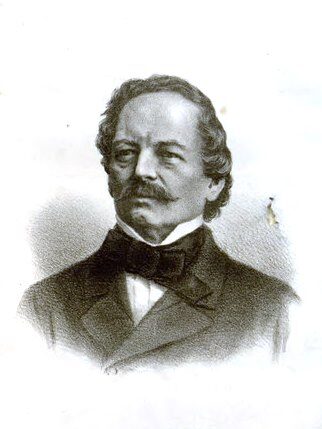
Friedrich Welwitsch
Friedrich Welwitsch was an Austrian botanist and explorer. Born February 25, 1806, in Maria Saal. Died October 20, 1872, in London. Educated at University of Vienna.
Facts
18 facts · 2 confirmed by two sources · 7 cited · 9 from one source
Where this comes from
Papalocal keeps its own record. It started from these sources; what each one said is kept here as it was copied, so a change on their side never changes this page by itself. Tap one to read its version.
What Wikidata says · copied November 18, 2026 · revision 2569174614
- Described as
- Austrian botanist and explorer (1806-1872)
- Other names
- Friderik Velbič, Welw., Welwitsch, F M J Welwitsch, Friedrich Martin Josef Welwitsch, F. M. J. Welwitsch, Friderich Martin Josef Welwitsch
- Born
- February 25, 1806 · 3 references
- Died
- October 20, 1872 · 3 references
- Born in
- Maria Saal · 2 references
- Died in
- London · 3 references
- Buried in
- Kensal Green Cemetery
- Citizen of
- Austria–Hungary
- Occupation
- explorer; pteridologist; botanist · 1 reference; mycologist; botanical illustrator · 1 reference; botanical collector · 7 references; scientific collector · 1 reference; biologist · 1 reference
- Education
- University of Vienna
- Member of
- German Academy of Sciences Leopoldina
- Field
- medicine; botany
- Wikipedias with a page
- 21
Wikidata item Q78609 (wikidata.org/wiki/Q78609), public domain (CC0). Copied November 18, 2026.
What Wikipedia says · copied November 18, 2026 · revision 1338157978
Friedrich Martin Josef Welwitsch (25 February 1806 – 20 October 1872) was an Austrian Empire explorer and botanist who in Angola was the first European to describe the plant Welwitschia mirabilis. His report received wide attention among the botanists and general public, comparable only to the discovery of two other plants in the 19th century, namely Victoria amazonica and Rafflesia arnoldii.
In Angola, Welwitsch also discovered Rhipsalis baccifera, the only cactus species naturally occurring outside the New World. It was found a few years later in Sri Lanka too, which reignited the now already one-and-a-half-century-old debate on the origin of cacti in Africa and Asia. At the time, the debate concluded with the conviction of numerous authors that they were introduced and spread by migratory birds.
Among the botanists, Welwitsch is also known after his descriptions of numerous other plants, for example Cyphostemma macropus (common name: Butter Tree), Tavaresia angolensis (common name: Devil's Trumpet), Dorstenia psilurus, Sarcocaulon mossamedense, Acanthosicyos horridus, Pachypodium namaquanum and Pachypodium lealii. The earthstar fungus Geastrum welwitschii, a species he collected in Portugal, is named in his honor. The standard author abbreviation Welw. is used to indicate this person as the author when citing a botanical name.
Botanical specimens collected by Welwitsch are now found in herbaria around the world, including the Natural History Museum, London, Kew Herbarium, the National Museum of Natural History and the National Herbarium of Victoria (MEL), Royal Botanic Gardens Victoria.
- Born, in its opening lines
- February 25, 1806
- Died, in its opening lines
- October 20, 1872
From the Wikipedia article “Friedrich Welwitsch” (en.wikipedia.org/wiki/Friedrich_Welwitsch), by its contributors, under CC BY-SA 4.0 (creativecommons.org/licenses/by-sa/4.0/). Copied November 18, 2026; not changed.
Confirmed Two sources agree. Cited One source, and it names where it got it. One source One source, without a reference of its own. Sources disagree The sources disagree. We show the best-supported value and keep theirs below.
