
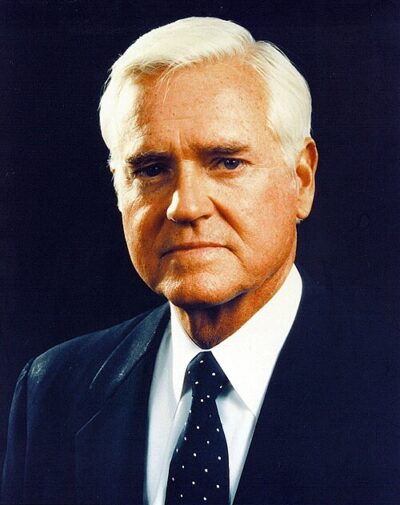
Fritz Hollings
Fritz Hollings was a politician from the United States. Born January 1, 1922, in Charleston. Died April 6, 2019, in Isle of Palms. Positions held include member of the South Carolina House of Representatives (1948–1952), Governor of South Carolina (1959–1963) and speaker. Educated at The Citadel and University of South Carolina. Awards include Bronze Star Medal.
Facts
20 facts · 2 confirmed by two sources · 10 cited · 8 from one source
Where this comes from
Papalocal keeps its own record. It started from these sources; what each one said is kept here as it was copied, so a change on their side never changes this page by itself. Tap one to read its version.
What Wikidata says · copied November 16, 2026 · revision 2566863503
- Described as
- politician from the United States (1922-2019)
- Other names
- Ernest Frederick Hollings, Ernest Hollings, Ernest F. Hollings
- Born
- January 1, 1922 · 2 references
- Died
- April 6, 2019 · 1 reference
- Born in
- Charleston · 1 reference
- Died in
- Isle of Palms
- Buried in
- South Carolina
- Citizen of
- United States
- Occupation
- politician · 1 reference
- Positions held
- member of the South Carolina House of Representatives (1948–1952) · 1 reference; Governor of South Carolina (1959–1963); speaker · 1 reference; Lieutenant Governor of South Carolina (1954–1959) · 1 reference; United States senator (1966–2005) · 1 reference
- Political party
- Democratic Party
- Education
- The Citadel (–1942) · 1 reference; University of South Carolina (–1947) · 1 reference; primary school · 1 reference
- Awards
- Bronze Star Medal
- Religion
- Lutheranism
- Military branch
- United States Army (1942–1945) · 1 reference
- Nickname
- Fritz
- Wikipedias with a page
- 21
Wikidata item Q596008 (wikidata.org/wiki/Q596008), public domain (CC0). Copied November 16, 2026.
What Wikipedia says · copied November 16, 2026 · revision 1385844251
Ernest Frederick "Fritz" Hollings (January 1, 1922 – April 6, 2019) was an American politician from the U.S. state of South Carolina. A member of the Democratic Party, he served as a member of the South Carolina House of Representatives representing Charleston County, South Carolina from 1949 to 1954, the 77th lieutenant governor of South Carolina from 1955 to 1959, the 106th governor of South Carolina from 1959 to 1963, and a member of the United States Senate from 1966 to 2005. He was the last Democrat to win a U.S. Senate seat in South Carolina until Annie Andrews was elected in 2026. At the time of his death, he was the oldest living former U.S. senator and the second-oldest living former American governor.
Born in Charleston, South Carolina, Hollings graduated from The Citadel in 1942 and joined a law practice in Charleston after attending the Joseph F. Rice School of Law. During World War II, he served as an artillery officer in campaigns in North Africa and Europe. After the war, Hollings successively won election to the South Carolina House of Representatives, as lieutenant governor, and as governor. He sought election to the Senate in 1962 but was defeated by incumbent U.S. Senate member Olin D. Johnston. Johnston died in 1965, and the following year Hollings won a special election to serve the remainder of Johnston's term.
Hollings remained popular and continually won re-election, becoming one of the longest-serving members of the United States Senate in history. He also served alongside Democrat-turned-Republican senator Strom Thurmond for 36 years, making them the longest-serving duo in U.S. Senate history. Hollings sought the Democratic nomination in the 1984 presidential election but dropped out of the race after the New Hampshire presidential primary. He declined to seek re-election in 2004 and was succeeded by Republican Jim DeMint.
- Born, in its opening lines
- January 1, 1922
- Died, in its opening lines
- April 6, 2019
From the Wikipedia article “Fritz Hollings” (en.wikipedia.org/wiki/Fritz_Hollings), by its contributors, under CC BY-SA 4.0 (creativecommons.org/licenses/by-sa/4.0/). Copied November 16, 2026; not changed.
Confirmed Two sources agree. Cited One source, and it names where it got it. One source One source, without a reference of its own. Sources disagree The sources disagree. We show the best-supported value and keep theirs below.
