
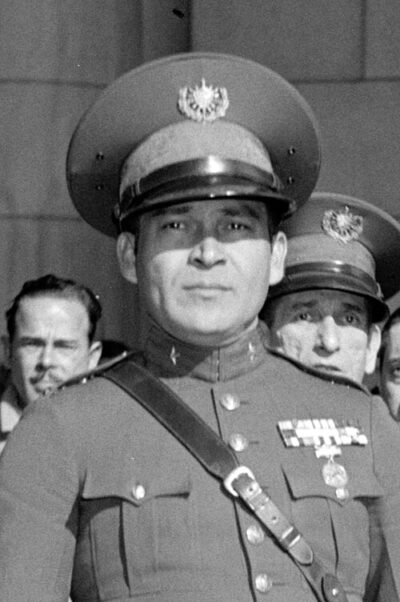
Fulgencio Batista
Fulgencio Batista was a President of Cuba, 1940–1944; dictator, 1952-1959. Born January 16, 1901, in Banes. Died August 6, 1973, in Marbella. Positions held include President of Cuba (1952–1959). Awards include Grand Cross Special Class of the Order of Merit of the Federal Republic of Germany and Grand Cross of the Cross of Military Merit with White Decoration.
Facts
21 facts · 2 confirmed by two sources · 4 cited · 15 from one source
Where this comes from
Papalocal keeps its own record. It started from these sources; what each one said is kept here as it was copied, so a change on their side never changes this page by itself. Tap one to read its version.
What Wikidata says · copied November 16, 2026 · revision 2568207812
- Described as
- President of Cuba, 1940–1944; dictator, 1952-1959 (1901-1973)
- Other names
- Fulgencio Batista y Zaldivar
- Born
- January 16, 1901 · 9 references
- Died
- August 6, 1973 · 9 references
- Born in
- Banes · 1 reference
- Died in
- Marbella · 1 reference
- Buried in
- San Isidro Cemetery · 1 reference
- Cause of death
- myocardial infarction
- Name at birth
- Fulgencio Batista
- Citizen of
- Cuba
- Occupation
- politician · 1 reference; military personnel
- Positions held
- President of Cuba (1952–1959)
- Political party
- Liberal Party of Cuba (1948–1949); Democratic Socialist Coalition (1939–1944); Progressive Action Party (1949–1959)
- Awards
- Grand Cross Special Class of the Order of Merit of the Federal Republic of Germany (1957); Grand Cross of the Cross of Military Merit with White Decoration (1936) · 1 reference
- Spouse
- Marta Fernandez Miranda de Batista (1945–); Elisa Godinez Gomez de Batista (1926–1945)
- Religion
- Roman Catholic
- Military branch
- Revolutionary Army
- Military rank
- major general
- Wikipedias with a page
- 88
Wikidata item Q11270 (wikidata.org/wiki/Q11270), public domain (CC0). Copied November 16, 2026.
What Wikipedia says · copied November 16, 2026 · revision 1385729216
Fulgencio Batista y Zaldívar (born Rubén Zaldívar; 16 January 1901 – 6 August 1973) was a Cuban military officer and politician who served as president of Cuba from 1940 to 1944, from 1952 to 1954 and again from 1955 to his resignation in 1959, when he was overthrown in the Cuban Revolution. From 1934 till 1940 he was the de facto leader of Cuba.
Batista first came to prominence in the Revolt of the Sergeants, which overthrew the provisional government of Carlos Manuel de Céspedes y Quesada. Batista then appointed himself chief of the armed forces, with the rank of colonel, and effectively controlled the five-member "pentarchy" that functioned as the collective head of state. He maintained control through a series of puppet presidents until 1940, when he was elected president on a populist platform. He then instated the 1940 Constitution of Cuba and presided over Cuban support for the Allies during World War II. After finishing his term in 1944, Batista moved to Florida, returning to Cuba to run for president in 1952. Facing certain electoral defeat, he led a military coup against President Carlos Prío Socarrás that pre-empted the election.
Back in power and receiving financial, military and logistical support from the United States government, Batista suspended the 1940 Constitution and revoked most political liberties, including the right to strike. He then aligned with the wealthiest landowners who owned the largest sugar plantations, and presided over a stagnating economy that widened the gap between rich and poor Cubans. Eventually, it reached the point where most of the sugar industry was in U.S. hands, and foreigners owned 70% of the arable land. Batista's repressive government then began to systematically profit from the exploitation of Cuba's commercial interests, by negotiating lucrative relationships both with the American Mafia, who controlled the drug, gambling, and prostitution businesses in Havana, and with large U.S.-based multinational companies who were awarded lucrative contracts.
To quell the growing discontent amongst the populace—which was subsequently displayed through frequent student riots and demonstrations—Batista established tighter censorship of the media, while also utilizing his Bureau for the Repression of Communist Activities secret police to carry out wide-scale violence, torture and public executions. These murders mounted in 1957, as socialist ideas became more influential. While exact numbers are unclear, estimates of the death toll attributed to Batista range from hundreds to up to 20,000 victims.
Batista's efforts to quell the unrest proved not only ineffective, but his tactics were the catalyst to even wider resistance against his regime. During this time, revolutionary leaders Fidel Castro and Che Guevara, founders of the 26th of July Movement, began a revolution that saw a combination of peaceful protests and guerrilla warfare in both rural and urban areas of Cuba between 1956 and 1958. After almost two years of fighting, rebel forces led by Guevara defeated Batista's forces at the Battle of Santa Clara on New Year's Eve, 1958, effectively collapsing the regime. On 1 January 1959, Batista announced his resignation, fleeing the country to the Dominican Republic under the protection of Rafael Trujillo, before settling in Portugal, spending the rest of his life in exile until his death in 1973.
- Born, in its opening lines
- January 16, 1901
- Died, in its opening lines
- August 6, 1973
From the Wikipedia article “Fulgencio Batista” (en.wikipedia.org/wiki/Fulgencio_Batista), by its contributors, under CC BY-SA 4.0 (creativecommons.org/licenses/by-sa/4.0/). Copied November 16, 2026; not changed.
Confirmed Two sources agree. Cited One source, and it names where it got it. One source One source, without a reference of its own. Sources disagree The sources disagree. We show the best-supported value and keep theirs below.
