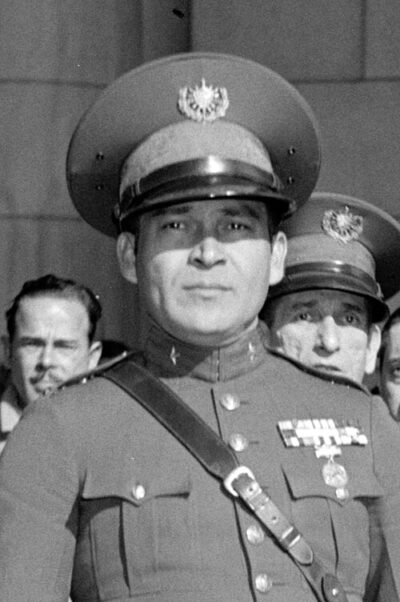
Progressive Action Party
The Progressive Action Party is a political party in Cuba. It was founded in 1949. Its headquarters are in Havana. It stands for conservatism, economic liberalism and anti-communism.
- Country
- Cuba
- Founded
- April 1, 1949
- Ideology
- conservatism
- Chair
- Fulgencio Batista
All 10 facts, and where they come from
Facts
10 facts · 0 confirmed by two sources · 0 cited · 9 from one source · 1 where the sources disagree
What’s different
- Founded: we show April 1, 1949 (Sources disagree). Wikidata also lists August 1, 1949
Where this comes from
Papalocal keeps its own record. It started from these sources; what each one said is kept here as it was copied, so a change on their side never changes this page by itself. Tap one to read its version.
What Wikidata says · copied November 17, 2026 · revision 2463870342
- Described as
- political party in Cuba
- Other names
- Unitary Action Party, United Action Party
- What it is
- political party
- Founded
- April 1, 1949; August 1, 1949
- Ended
- 1959
- Headquarters
- Havana
- Country
- Cuba · 1 reference
- Chair
- Fulgencio Batista
- Ideology
- conservatism; economic liberalism; anti-communism; right-wing populism
- Wikipedias with a page
- 7
Wikidata item Q15980912 (wikidata.org/wiki/Q15980912), public domain (CC0). Copied 2026-11-17.
What Wikipedia says · copied November 17, 2026 · revision 1380944778
The Progressive Action Party (Spanish: Partido Acción Progresista, PAP) was a Cuban political party led by Fulgencio Batista. The party was founded on 1 April 1949, in the aftermath of the 1948 general elections, under the name of Unitary Action Party (Spanish: Partido Acción Unitaria, PAU). It presented its first manifesto a few months later, on 1 August. In 1952, certain to lose the election, Batista made a coup d'état by seizing the Presidency.
The party also ran in the elections of 1954 and 1958, winning due to the early withdrawal of opponents, as well as electoral fraud.
The party was based on a combination of strong conservatism and economic liberalism on a large scale, to attract American capital in Cuba. This led to a high level of corruption and poverty plaguing the country. The other bulwark of the party was anti-communism, not only because of the alignment with the United States but also because most of the members of the anti-Batista left-wing nationalist 26th of July Movement could be branded as Communists, including Fidel Castro and Camilo Cienfuegos, along with genuine communists like Raúl Castro and Che Guevara. Batista's authoritarian rule and repression in response to Castro's movement led to the deaths of 1,583–1,816 Cubans through torture and extrajudicial killing.
The party was dissolved following the Cuban Revolution of 1959, which ousted Batista causing it to flee abroad and led to the establishment of the revolutionary government of Fidel Castro, which officially became a communist regime in 1961.
From the Wikipedia article “Progressive Action Party” (en.wikipedia.org/wiki/Progressive_Action_Party), by its contributors, under CC BY-SA 4.0 (creativecommons.org/licenses/by-sa/4.0/). Copied 2026-11-17; not changed.
Confirmed Two sources agree. Cited One source, and it names where it got it. One source One source, without a reference of its own. Sources disagree The sources disagree. We show the best-supported value and keep theirs below.