
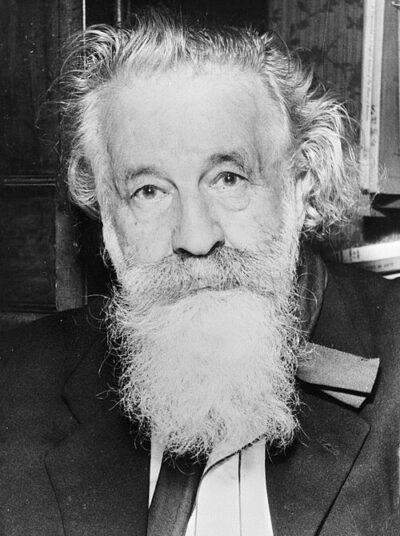
Gaston Bachelard
Gaston Bachelard was a French writer and philosopher. Born June 27, 1884, in Bar-sur-Aube. Died October 16, 1962, in 9th arrondissement of Paris. Positions held include university teacher (1940–1955). Known for The Psychoanalysis of Fire and L'expérience de l'espace dans la physique contemporaine. Educated at Faculty of Arts of Paris. Awards include Commander of the Legion of Honour and Grand prix national des Lettres.
Facts
29 facts · 2 confirmed by two sources · 9 cited · 18 from one source
Where this comes from
Papalocal keeps its own record. It started from these sources; what each one said is kept here as it was copied, so a change on their side never changes this page by itself. Tap one to read its version.
What Wikidata says · copied November 16, 2026 · revision 2557889819
- Described as
- French writer and philosopher (1884-1962)
- Other names
- G. Bachelard
- Born
- June 27, 1884 · 14 references
- Died
- October 16, 1962 · 15 references
- Born in
- Bar-sur-Aube · 1 reference
- Died in
- 9th arrondissement of Paris
- Buried in
- Bar-sur-Aube · 1 reference
- Citizen of
- France · 1 reference
- Occupation
- philosopher · 2 references; poet; writer; university teacher; employee of a public institution; mathematician · 1 reference; physicist · 1 reference; literary theorist · 1 reference
- Positions held
- university teacher (1940–1955)
- Worked for
- Faculty of Arts of Paris; Harvard University; Postes, télégraphes et téléphones
- Education
- Faculty of Arts of Paris (–1927) · 1 reference
- Member of
- Académie des Sciences Morales et Politiques; International Academy of the History of Science
- Known for
- The Psychoanalysis of Fire; L'expérience de l'espace dans la physique contemporaine
- Awards
- Commander of the Legion of Honour (1960) · 1 reference; Grand prix national des Lettres (1961) · 1 reference
- Field
- philosophy of science · 1 reference; aesthetics · 1 reference
- Children
- Suzanne Bachelard
- Military rank
- second lieutenant
- Wikipedias with a page
- 61
Wikidata item Q270800 (wikidata.org/wiki/Q270800), public domain (CC0). Copied November 16, 2026.
What Wikipedia says · copied November 16, 2026 · revision 1381320244
Gaston Louis Pierre Bachelard (; French: [baʃlaʁ]; 27 June 1884 – 16 October 1962) was a French philosopher. He made contributions in the fields of poetics and the philosophy of science. To the latter, he introduced the concepts of epistemological obstacle and epistemological break (obstacle épistémologique and rupture épistémologique). He influenced many subsequent French philosophers, among them Michel Foucault, Louis Althusser, Dominique Lecourt and Jacques Derrida, as well as the sociologists Pierre Bourdieu and Bruno Latour.
For Bachelard, the scientific object should be constructed and therefore different from the positivist sciences; in other words, information is in continuous construction. Empiricism and rationalism are not regarded as dualism or opposition but complementary, therefore studies of a priori and a posteriori, or in other words reason and dialectic, are part of scientific research.
- Born, in its opening lines
- June 27, 1884
- Died, in its opening lines
- October 16, 1962
From the Wikipedia article “Gaston Bachelard” (en.wikipedia.org/wiki/Gaston_Bachelard), by its contributors, under CC BY-SA 4.0 (creativecommons.org/licenses/by-sa/4.0/). Copied November 16, 2026; not changed.
Confirmed Two sources agree. Cited One source, and it names where it got it. One source One source, without a reference of its own. Sources disagree The sources disagree. We show the best-supported value and keep theirs below.
