
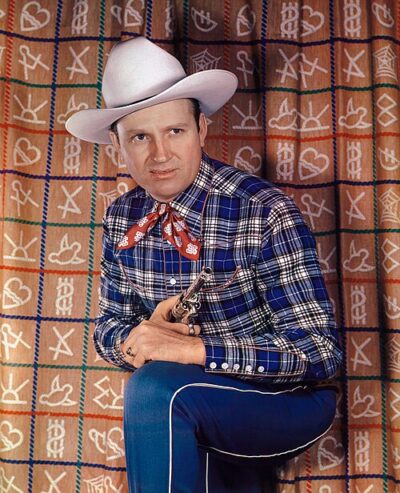
Gene Autry
Gene Autry was an American actor and singer. Born September 29, 1907, in Tioga. Died October 2, 1998, in Studio City. Awards include Grammy Lifetime Achievement Award, star on Hollywood Walk of Fame and Oklahoma Music Hall of Fame.
Facts
34 facts · 2 confirmed by two sources · 7 cited · 25 from one source
Where this comes from
Papalocal keeps its own record. It started from these sources; what each one said is kept here as it was copied, so a change on their side never changes this page by itself. Tap one to read its version.
What Wikidata says · copied November 13, 2026 · revision 2552146796
- Described as
- American actor and singer (1907–1998)
- Other names
- Orvon Gene Autry, Orvon Grover Autry
- Born
- September 29, 1907 · 6 references
- Died
- October 2, 1998 · 6 references
- Born in
- Tioga
- Died in
- Studio City
- Buried in
- Forest Lawn Memorial Park
- Cause of death
- lymphoma
- Name at birth
- Orvon Grover Autry · 1 reference
- Citizen of
- United States
- Occupation
- actor; singer; musician · 1 reference; screenwriter; television actor; radio personality; film actor · 1 reference; composer · 1 reference
- Political party
- Republican Party
- Genre
- country music; western music
- Instrument
- guitar; voice
- Record label
- Columbia Records (1939–1970); Challenge Records; Gennett (1929–1931); Victor (1930–1933); American Record Corporation (1930–1938); OKeh Records (1939–1945)
- Awards
- Grammy Lifetime Achievement Award (2009); star on Hollywood Walk of Fame (1960) · 2 references; Oklahoma Music Hall of Fame (1998) · 1 reference
- Spouse
- Jackie Autry (1981–1998) · 1 reference
- Lived in
- Los Angeles
- Height
- 1.75 m (5 ft 9 in)
- Website
- http://www.geneautry.com/
- Wikipedias with a page
- 45
Wikidata item Q342723 (wikidata.org/wiki/Q342723), public domain (CC0). Copied November 13, 2026.
What Wikipedia says · copied November 13, 2026 · revision 1384819118
Orvon Grover "Gene" Autry (September 29, 1907 – October 2, 1998), nicknamed the Singing Cowboy, was an American actor, musician, singer, composer, rodeo performer, and baseball team owner, who largely gained fame by singing in a crooning style on radio, in films, and on television for more than three decades, beginning in the early 1930s. During that time, he personified the straight-shooting hero—honest, brave, and true.
Autry was the owner of a television station and several radio stations in Southern California. From 1961 to 1997, he was the founding owner of the California Angels franchise of Major League Baseball (MLB).
From 1934 to 1953, Autry appeared in 93 motion pictures. Between 1950 and 1956, he hosted The Gene Autry Show television series. In many of them, he appeared with Champion, his Morgan horse.
Autry was also one of the most important pioneering figures in the history of country music, considered the second major influential artist in the genre's development after Jimmie Rodgers in terms of chronology. His films were the first media vehicle to carry Western music to a nationwide audience.
In addition to his signature song "Back in the Saddle Again", as well as his recording hit "At Mail Call Today", Autry is still remembered for his association with Christmas music, having debuted the seasonal standards "Rudolph, the Red-Nosed Reindeer", "Frosty the Snowman", and "Here Comes Santa Claus".
Autry is a member of both the Country Music Hall of Fame and the Nashville Songwriters Hall of Fame. He is the only person to be awarded stars in all then-five categories on the Hollywood Walk of Fame, for film, television, music, radio, and live performance.
The town of Gene Autry, Oklahoma, was named in his honor, as was the Gene Autry precinct in Mesa, Arizona.
- Born, in its opening lines
- September 29, 1907
- Died, in its opening lines
- October 2, 1998
From the Wikipedia article “Gene Autry” (en.wikipedia.org/wiki/Gene_Autry), by its contributors, under CC BY-SA 4.0 (creativecommons.org/licenses/by-sa/4.0/). Copied November 13, 2026; not changed.
Confirmed Two sources agree. Cited One source, and it names where it got it. One source One source, without a reference of its own. Sources disagree The sources disagree. We show the best-supported value and keep theirs below.
