
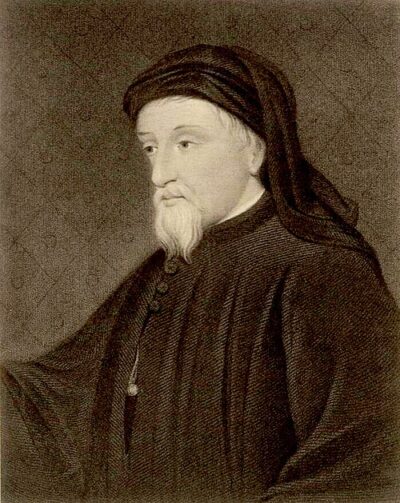
Geoffrey Chaucer
Geoffrey Chaucer was the 14th century English poet and author. Born 1343, in London. Died October 25, 1400, in London. Positions held include Member of the 1386 Parliament. Known for The Canterbury Tales, The Book of the Duchess and The House of Fame.
Facts
34 facts · 2 confirmed by two sources · 11 cited · 21 from one source
Where this comes from
Papalocal keeps its own record. It started from these sources; what each one said is kept here as it was copied, so a change on their side never changes this page by itself. Tap one to read its version.
What Wikidata says · copied November 16, 2026 · revision 2567476485
- Described as
- 14th century English poet and author (1343–1400)
- Other names
- Chaucer
- Born
- 1343 · 1 reference
- Died
- October 25, 1400 · 1 reference
- Born in
- London · 1 reference
- Died in
- London
- Buried in
- Westminster Abbey · 1 reference
- Citizen of
- Kingdom of England
- Occupation
- linguist; poet · 1 reference; lyricist; philosopher; politician · 1 reference; translator; astrologer; writer · 2 references
- Positions held
- Member of the 1386 Parliament · 1 reference
- Genre
- poetry
- Known for
- The Canterbury Tales; The Book of the Duchess; The House of Fame; Troilus and Criseyde; The Legend of Good Women; The compleynt unto Pity; A Treatise on the Astrolabe; The compleynt of Venus; The Complaint of Mars; Chaucer's complaint unto his purse
- Field
- bureaucracy
- Spouse
- Philippa Roet · 2 references
- Children
- Thomas Chaucer · 1 reference; Elizabeth Chaucer; Lewis Chaucer · 1 reference
- Father
- John Chaucer · 2 references
- Mother
- Agnes Copton · 1 reference
- Religion
- Catholic Church
- Wikipedias with a page
- 181
Wikidata item Q5683 (wikidata.org/wiki/Q5683), public domain (CC0). Copied November 16, 2026.
What Wikipedia says · copied November 16, 2026 · revision 1385591546
Geoffrey Chaucer (; JEF-ree CHAW-sər; c. 1343 – 25 October 1400) was an English poet, writer and civil servant best known for The Canterbury Tales. He has been called the 'father of English literature', or alternatively, the 'father of English poetry'. He was the first writer to be buried in what has since become Poets' Corner in Westminster Abbey.
Chaucer also gained fame as a philosopher and amateur astronomer, composing the scientific A Treatise on the Astrolabe for his ten-year-old son, Lewis. He maintained a career in public service as a bureaucrat, courtier, diplomat and member of the Parliament of England, having been elected shire knight for Kent.
Amongst his other works are The Book of the Duchess, The House of Fame, The Legend of Good Women, Troilus and Criseyde, and Parlement of Foules. A prolific writer, Chaucer has been seen as crucial in legitimising the literary use of Middle English at a time when the dominant literary languages in England were still Anglo-Norman French and Latin. His contemporary Thomas Hoccleve hailed him as "the firste fyndere of our fair langage" (i.e., the first one capable of finding poetic matter in English). Almost two thousand English words are first attested in Chaucerian manuscripts.
- Born, in its opening lines
- c. 1343
- Died, in its opening lines
- October 25, 1400
From the Wikipedia article “Geoffrey Chaucer” (en.wikipedia.org/wiki/Geoffrey_Chaucer), by its contributors, under CC BY-SA 4.0 (creativecommons.org/licenses/by-sa/4.0/). Copied November 16, 2026; not changed.
Confirmed Two sources agree. Cited One source, and it names where it got it. One source One source, without a reference of its own. Sources disagree The sources disagree. We show the best-supported value and keep theirs below.
