
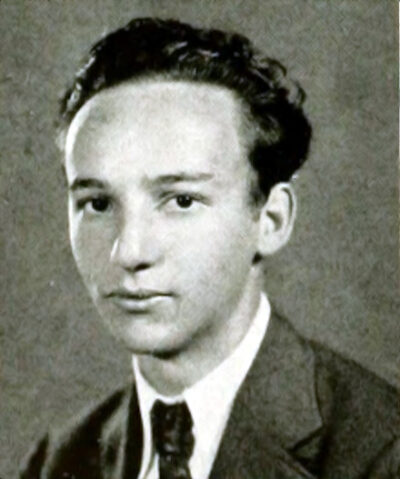
George Bernard Dantzig
George Bernard Dantzig was an American mathematician. Born November 8, 1914, in Portland. Died May 13, 2005, in Stanford. Known for simplex algorithm, Dantzig–Wolfe decomposition and Dantzig selector. Educated at University of Michigan and University of California, Berkeley. Awards include John von Neumann Theory Prize, Harold Pender Award and Harvey Prize.
Facts
40 facts · 2 confirmed by two sources · 27 cited · 11 from one source
Where this comes from
Papalocal keeps its own record. It started from these sources; what each one said is kept here as it was copied, so a change on their side never changes this page by itself. Tap one to read its version.
What Wikipedia says · copied November 13, 2026 · revision 1378114820
George Bernard Dantzig (; November 8, 1914 – May 13, 2005) was an American mathematical scientist who made contributions to industrial engineering, operations research, computer science, economics, and statistics.
Dantzig is known for his development of the simplex algorithm, an algorithm for solving linear programming problems, and for his other work with linear programming. In statistics, Dantzig solved two open problems in statistical theory, which he had mistaken for homework after arriving late to a lecture by Polish mathematician-statistician Jerzy Neyman.
At his death, Dantzig was professor emeritus of transportation sciences and professor of operations research and of computer science at Stanford University.
- Born, in its opening lines
- November 8, 1914
- Died, in its opening lines
- May 13, 2005
From the Wikipedia article “George Dantzig” (en.wikipedia.org/wiki/George_Dantzig), by its contributors, under CC BY-SA 4.0 (creativecommons.org/licenses/by-sa/4.0/). Copied November 13, 2026; not changed.
What Wikidata says · copied November 14, 2026 · revision 2569099631
- Described as
- American mathematician (1914-2005)
- Other names
- George B. Dantzig, George Dantzig
- Born
- November 8, 1914 · 7 references
- Died
- May 13, 2005 · 7 references
- Born in
- Portland · 1 reference
- Died in
- Stanford · 1 reference
- Buried in
- Los Gatos Memorial Park · 2 references
- Cause of death
- diabetes · 1 reference
- Name at birth
- George Bernard Dantzig
- Citizen of
- United States · 1 reference
- Occupation
- mathematician · 1 reference; computer scientist; statistician; university teacher · 1 reference
- Worked for
- University of California, Berkeley (1960–1966) · 1 reference; Stanford University (1966–1998) · 2 references; Bureau of Labor Statistics (1937–1939) · 1 reference; United States Air Force (1941–1946) · 1 reference; United States Department of Defense (1946–1952) · 1 reference; RAND Corporation (1952–1960) · 1 reference
- Education
- University of Michigan (1936–1937) · 1 reference; University of California, Berkeley (1939–1941) · 1 reference; Cardozo Education Campus (–1932); University of Maryland (–1936) · 1 reference
- Member of
- National Academy of Sciences; American Academy of Arts and Sciences; Institute of Mathematical Statistics (1959–) · 1 reference; Econometric Society (1953–) · 1 reference
- Known for
- simplex algorithm; Dantzig–Wolfe decomposition; Dantzig selector; Linear Programming and Extensions
- Awards
- John von Neumann Theory Prize (1975) · 1 reference; Harold Pender Award (1995) · 1 reference; Harvey Prize (1985) · 2 references; National Medal of Science (1975) · 1 reference; Josiah Willard Gibbs Lectureship (1990) · 1 reference; Fellow of the Econometric Society (1953) · 1 reference; Fellow of the Institute of Mathematical Statistics (1959) · 1 reference
- Field
- theory of computation; linear programming · 1 reference
- Father
- Tobias Dantzig · 1 reference
- Wikipedias with a page
- 42
Wikidata item Q337040 (wikidata.org/wiki/Q337040), public domain (CC0). Copied November 14, 2026.
Confirmed Two sources agree. Cited One source, and it names where it got it. One source One source, without a reference of its own. Sources disagree The sources disagree. We show the best-supported value and keep theirs below.
