
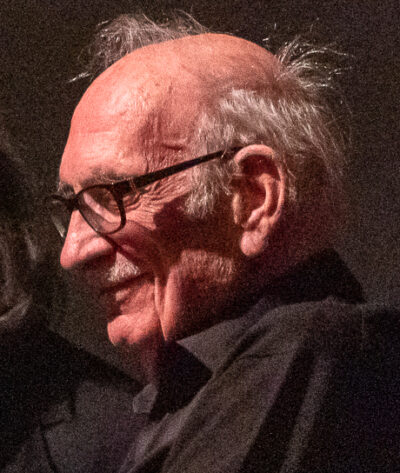
George Crumb
George Crumb was an American composer. Born October 24, 1929, in Charleston. Died February 6, 2022, in Media. Educated at University of Michigan and University of Illinois Urbana-Champaign. Awards include Guggenheim Fellowship, Pulitzer Prize for Music and Fulbright Scholarship.
Facts
29 facts · 2 confirmed by two sources · 9 cited · 18 from one source
Where this comes from
Papalocal keeps its own record. It started from these sources; what each one said is kept here as it was copied, so a change on their side never changes this page by itself. Tap one to read its version.
What Wikidata says · copied November 15, 2026 · revision 2567364584
- Described as
- American composer (1929-2022)
- Other names
- George Henry Crumb, George Henry Crumb Jr.
- Born
- October 24, 1929 · 6 references
- Died
- February 6, 2022 · 2 references
- Born in
- Charleston · 2 references
- Died in
- Media · 1 reference
- Name at birth
- George Henry Crumb Jr.
- Citizen of
- United States
- Occupation
- composer · 1 reference; university teacher
- Worked for
- Arizona State University; University of Pennsylvania · 1 reference; University of Colorado Boulder · 1 reference
- Education
- University of Michigan; University of Illinois Urbana-Champaign; UIUC College of Media
- Member of
- Academy of Arts, Berlin; American Academy of Arts and Letters; American Academy of Arts and Sciences; Bavarian Academy of Fine Arts
- Genre
- classical music · 1 reference; contemporary classical music
- Awards
- Guggenheim Fellowship · 1 reference; Pulitzer Prize for Music (1968) · 1 reference; Fulbright Scholarship; Arts and Letters Award in Music (1967) · 1 reference
- Field
- music composing · 1 reference; composed musical work · 1 reference; music composition · 1 reference
- Children
- Ann Crumb · 1 reference
- Website
- https://www.georgecrumb.net/
- Wikipedias with a page
- 29
Wikidata item Q356804 (wikidata.org/wiki/Q356804), public domain (CC0). Copied November 15, 2026.
What Wikipedia says · copied November 15, 2026 · revision 1372294571
George Henry Crumb Jr. (24 October 1929 – 6 February 2022) was an American composer of avant-garde contemporary classical music. Early in his life he rejected the widespread modernist usage of serialism, developing a highly personal musical language which "range[s] in mood from peaceful to nightmarish". Crumb's compositions are known for pushing the limits of technical prowess by way of frequent use of extended techniques. The unusual timbres he employs evoke a surrealist atmosphere which portray emotions of considerable intensity with vast and sometimes haunting soundscapes. His few large-scale works include Echoes of Time and the River (1967), which won the 1968 Pulitzer Prize for Music, and Star-Child (1977), which won the 2001 Grammy Award for Best Contemporary Classical Composition; however, his output consists of mostly music for chamber ensembles or solo instrumentalists. Among his best known compositions are Black Angels (1970), a striking commentary on the Vietnam War for electric string quartet; Ancient Voices of Children (1970) for a mixed chamber ensemble; and Vox Balaenae (1971), a musical evocation of the humpback whale, for electric flute, electric cello, and amplified piano.
Born to a musical family, Crumb was acquainted with classical music at an early age and his affinity for Classical and Romantic composers in particular would stay throughout his life. He was especially influenced by composers such as Mahler, Debussy and Bartók; Crumb wrote his four-volume piano set Makrokosmos (1972–1979) in response to Bartók's earlier piano set Mikrokosmos. His compositions often contain musical quotations from wide range of composers including Bach, Chopin, Schubert, Strauss, and the jazz pianist and composer Thelonious Monk. The use of pastiche is also found in his music, as is text by Federico García Lorca, whose poetry Crumb set eleven times. Elements of theatricality appear in numerous compositions, inspiring choreographies from contemporary dance groups. To convey his unorthodox and complex musical style, Crumb's musical scores are facsimile manuscripts, using special notation "distinguished by astonishing clarity, precision and elegance, and by arresting graphic symbols in which staves are bent into arches, circles and other pictorial devices." Among his students were the composers Osvaldo Golijov, Jennifer Higdon, Christopher Rouse and Melinda Wagner.
- Born, in its opening lines
- October 24, 1929
- Died, in its opening lines
- February 6, 2022
From the Wikipedia article “George Crumb” (en.wikipedia.org/wiki/George_Crumb), by its contributors, under CC BY-SA 4.0 (creativecommons.org/licenses/by-sa/4.0/). Copied November 15, 2026; not changed.
Confirmed Two sources agree. Cited One source, and it names where it got it. One source One source, without a reference of its own. Sources disagree The sources disagree. We show the best-supported value and keep theirs below.
