
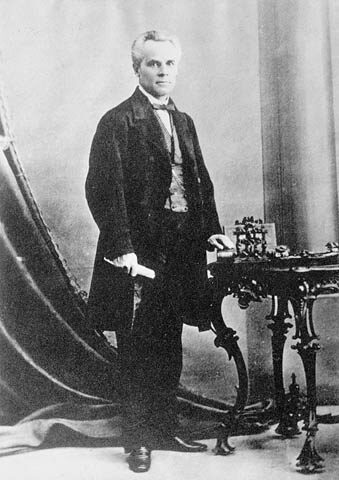
George-Étienne Cartier
George-Étienne Cartier was a Canadian politician and lawyer. Born September 6, 1814, in Saint-Antoine-sur-Richelieu. Died May 20, 1873, in London. Positions held include Joint Premier of the Province of Canada for Canada East, Member of the National Assembly of Quebec and Member of the Legislative Assembly of the Province of Canada. Educated at Collège de Montréal. Awards include Person of National Historic Significance.
Facts
23 facts · 2 confirmed by two sources · 7 cited · 14 from one source
Where this comes from
Papalocal keeps its own record. It started from these sources; what each one said is kept here as it was copied, so a change on their side never changes this page by itself. Tap one to read its version.
What Wikidata says · copied November 16, 2026 · revision 2559182696
- Described as
- Canadian politician and lawyer (1814-1873)
- Other names
- George-Etienne Cartier
- Born
- September 6, 1814 · 6 references
- Died
- May 20, 1873 · 6 references
- Born in
- Saint-Antoine-sur-Richelieu
- Died in
- London
- Buried in
- Notre Dame des Neiges Cemetery · 1 reference
- Cause of death
- nephritis · 1 reference
- Citizen of
- Canada
- Occupation
- politician · 1 reference; lawyer · 1 reference; statesperson · 1 reference; jurist · 1 reference
- Positions held
- Joint Premier of the Province of Canada for Canada East; Member of the National Assembly of Quebec; Member of the Legislative Assembly of the Province of Canada; member of the House of Commons of Canada (1867–1873) · 1 reference
- Political party
- Conservative Party of Canada; Liberal-Conservative Party
- Education
- Collège de Montréal
- Awards
- Person of National Historic Significance · 1 reference
- Field
- politics · 1 reference; law · 1 reference
- Spouse
- Hortense Fabre Cartier
- Children
- Josephine Cartier
- Wikipedias with a page
- 21
Wikidata item Q669955 (wikidata.org/wiki/Q669955), public domain (CC0). Copied November 16, 2026.
What Wikipedia says · copied November 16, 2026 · revision 1380822019
Sir George-Étienne Cartier, 1st Baronet (pronounced [ʒɔʁʒ etjɛn kaʁtje]; September 6, 1814 – May 20, 1873) was a Canadian statesman and Father of Confederation. He was named George, rather than the typical French, "Georges", in honour of King George III.
In the years leading up to Confederation, Cartier was a dominant figure in the politics of Canada East as leader of the Parti bleu. In 1838, he returned to Montreal after a year in exile for his role in the Lower Canada Rebellion. He officially entered politics in 1848. During his long career, he instituted the creation of the Civil Code of Lower Canada, replacing the increasingly out-dated Custom of Paris, which had been used in Lower Canada since it had been a French colony. He also promoted the introduction of primary education in the province. Cartier had several reasons for supporting Confederation, notably his fear of American expansion. He died in London, England, on May 20, 1873. Cartier is considered to be one of the most important of the Fathers of Confederation, along with John A. Macdonald and George Brown. He has been dubbed the "Kingpin of Confederation" because of his prominence.
- Born, in its opening lines
- September 6, 1814
- Died, in its opening lines
- May 20, 1873
From the Wikipedia article “George-Étienne Cartier” (en.wikipedia.org/wiki/George-Étienne_Cartier), by its contributors, under CC BY-SA 4.0 (creativecommons.org/licenses/by-sa/4.0/). Copied November 16, 2026; not changed.
Confirmed Two sources agree. Cited One source, and it names where it got it. One source One source, without a reference of its own. Sources disagree The sources disagree. We show the best-supported value and keep theirs below.
