
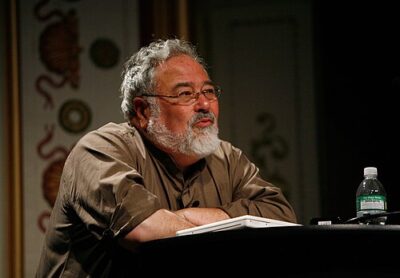
George Lakoff
George Lakoff is an American linguist. Born May 24, 1941, in Bayonne. Educated at Massachusetts Institute of Technology and Indiana University. Awards include Fellow of the Cognitive Science Society.
Facts
16 facts · 1 confirmed by two sources · 5 cited · 10 from one source
Where this comes from
Papalocal keeps its own record. It started from these sources; what each one said is kept here as it was copied, so a change on their side never changes this page by itself. Tap one to read its version.
What Wikidata says · copied November 15, 2026 · revision 2557892433
- Described as
- American linguist
- Other names
- George P. Lakoff, George Philip Lakoff
- Born
- May 24, 1941 · 4 references
- Born in
- Bayonne
- Citizen of
- United States
- Occupation
- linguist · 1 reference; university teacher; writer · 1 reference
- Worked for
- University of California, Berkeley
- Education
- Massachusetts Institute of Technology (–1962) · 1 reference; Indiana University (–1966) · 2 references
- Awards
- Fellow of the Cognitive Science Society
- Field
- cognitive linguistics · 1 reference
- Spouse
- Robin Lakoff
- Children
- Andrew Lakoff · 1 reference
- Siblings
- Sanford A. Lakoff · 1 reference
- Lived in
- Berkeley · 1 reference
- Website
- http://georgelakoff.wordpress.com
- Wikipedias with a page
- 36
Wikidata item Q313772 (wikidata.org/wiki/Q313772), public domain (CC0). Copied November 15, 2026.
What Wikipedia says · copied November 15, 2026 · revision 1384247703
George Philip Lakoff ( LAY-kawf; born May 24, 1941) is an American cognitive linguist and philosopher, best known for his thesis that people's lives are significantly influenced by the conceptual metaphors they use to explain complex phenomena. Lakoff served as professor of linguistics at the University of California, Berkeley, from 1972 until his retirement in 2016.
The conceptual metaphor thesis, introduced in his and Mark Johnson's 1980 book Metaphors We Live By has found applications in a number of academic disciplines. Applying it to politics, literature, philosophy and mathematics has led Lakoff into territory normally considered basic to political science. In his 1996 book Moral Politics, Lakoff described conservative voters as being influenced by the "strict father model" as a central metaphor for such a complex phenomenon as the state, and liberal/progressive voters as being influenced by the "nurturant parent model" as the folk psychological metaphor for this complex phenomenon.
According to Lakoff, an individual's experience and attitude towards sociopolitical issues are influenced by being framed in linguistic constructions. In Metaphor and War: The Metaphor System Used to Justify War in the Persian Gulf (1991), he argued that the American involvement in the Persian Gulf War was obscured or "spun" by the metaphors which were used by the first Bush administration to justify it. Between 2003 and 2008, Lakoff was involved with a progressive think tank, the now defunct Rockridge Institute.
Lakoff is a member of the scientific committee of the Fundación IDEAS (IDEAS Foundation), Spain's Socialist Party's think tank. The more general theory that elaborated his thesis is known as embodied mind. His first marriage was to linguist Robin Lakoff.
- Born, in its opening lines
- May 24, 1941
From the Wikipedia article “George Lakoff” (en.wikipedia.org/wiki/George_Lakoff), by its contributors, under CC BY-SA 4.0 (creativecommons.org/licenses/by-sa/4.0/). Copied November 15, 2026; not changed.
Confirmed Two sources agree. Cited One source, and it names where it got it. One source One source, without a reference of its own. Sources disagree The sources disagree. We show the best-supported value and keep theirs below.
