
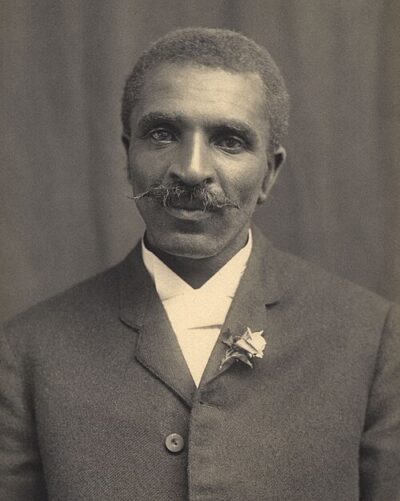
George Washington Carver
George Washington Carver was an African American botanist and inventor. Born January 1, 1864, in United States. Died January 5, 1943, in Tuskegee. Educated at Iowa State University. Awards include Spingarn Medal, National Inventors Hall of Fame and honorary doctorate.
Facts
27 facts · 2 confirmed by two sources · 7 cited · 17 from one source · 1 where the sources disagree
What’s different
- Born in: we show United States (Sources disagree). Wikidata also lists Diamond
Where this comes from
Papalocal keeps its own record. It started from these sources; what each one said is kept here as it was copied, so a change on their side never changes this page by itself. Tap one to read its version.
What Wikidata says · copied November 13, 2026 · revision 2561125574
- Described as
- African American botanist and inventor (1864-1943)
- Other names
- George Carver, George W. Carver, Geo. W. Carver, G. W. Carver, Carver
- Born
- January 1, 1864 · 1 reference
- Died
- January 5, 1943 · 4 references
- Born in
- Diamond; United States · 1 reference
- Died in
- Tuskegee · 2 references
- Buried in
- Tuskegee University Campus Cemetery · 1 reference
- Cause of death
- anemia
- Citizen of
- United States · 1 reference
- Occupation
- botanist; inventor; university teacher; mycologist; chemist; biologist; botanical collector · 1 reference; scientific collector · 1 reference
- Political party
- Republican Party
- Worked for
- Iowa State University; Tuskegee University
- Education
- Iowa State University
- Awards
- Spingarn Medal (1923) · 1 reference; National Inventors Hall of Fame (1990) · 1 reference; honorary doctorate (1928)
- Field
- botany; mycology; chemistry; pedagogy
- Lived in
- Tuskegee
- Wikipedias with a page
- 68
Wikidata item Q296898 (wikidata.org/wiki/Q296898), public domain (CC0). Copied November 13, 2026.
What Wikipedia says · copied November 13, 2026 · revision 1384406504
George Washington Carver (c. 1864 – January 5, 1943) was an American agricultural scientist and inventor who promoted alternative crops to cotton and methods to prevent soil depletion. He was one of the most prominent Black scientists of the early 20th century.
While a professor at Tuskegee Institute, Carver developed techniques to improve types of soils depleted by repeated plantings of cotton. He wanted poor farmers to grow other crops, such as peanuts and sweet potatoes, as a source of their own food and to improve their quality of life. Carver chose these crops due to the conditions of the soil in the area. Under his leadership, the Experiment Station at Tuskegee published over forty practical bulletins for farmers, many written by him, which included recipes; many of the bulletins contained advice for poor farmers, including combating soil depletion with limited financial means, producing bigger crops, and preserving food.
Apart from his work to improve the lives of farmers, Carver was also a leader in promoting environmentalism. He received numerous honors for his work, including the Spingarn Medal of the NAACP. In an era of high racial polarization, his fame reached beyond the black community. He was widely recognized and praised in the white community for his many achievements and talents. In 1941, Time magazine dubbed Carver a "Black Leonardo".
- Born, in its opening lines
- c. 1864
- Died, in its opening lines
- January 5, 1943
From the Wikipedia article “George Washington Carver” (en.wikipedia.org/wiki/George_Washington_Carver), by its contributors, under CC BY-SA 4.0 (creativecommons.org/licenses/by-sa/4.0/). Copied November 13, 2026; not changed.
Confirmed Two sources agree. Cited One source, and it names where it got it. One source One source, without a reference of its own. Sources disagree The sources disagree. We show the best-supported value and keep theirs below.
