
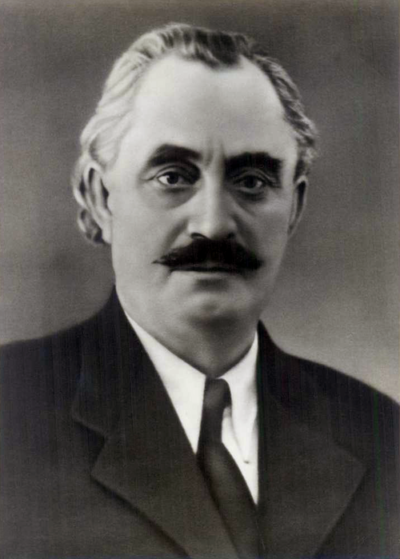
Georgi Dimitrov
Georgi Dimitrov was a Bulgarian politician. Born June 18, 1882, in Kovachevtsi. Died July 2, 1949, in Barvikha. Positions held include Prime Minister of Bulgaria (1946–1949), deputy of the Supreme Soviet of the Soviet Union and member of the Bulgarian National Assembly. Awards include Order of Lenin, Order of 9 September 1944 and Grand Cross of the Order of Polonia Restituta.
Facts
28 facts · 2 confirmed by two sources · 8 cited · 18 from one source
Where this comes from
Papalocal keeps its own record. It started from these sources; what each one said is kept here as it was copied, so a change on their side never changes this page by itself. Tap one to read its version.
What Wikidata says · copied November 16, 2026 · revision 2565529603
- Described as
- Bulgarian politician (1882–1949)
- Other names
- Georgi Dimitrov Mikhailov, Georgi Dimitrov Mihaylov
- Born
- June 18, 1882 · 4 references
- Died
- July 2, 1949 · 9 references
- Born in
- Kovachevtsi · 2 references
- Died in
- Barvikha
- Buried in
- Central Sofia Cemetery · 1 reference
- Cause of death
- liver disease
- Citizen of
- Kingdom of Bulgaria; People's Republic of Bulgaria; Soviet Union (1934–); Bulgaria
- Occupation
- politician · 4 references; trade unionist; printer; philatelist · 1 reference; head of government · 1 reference; general secretary · 1 reference
- Positions held
- Prime Minister of Bulgaria (1946–1949); deputy of the Supreme Soviet of the Soviet Union; member of the Bulgarian National Assembly
- Political party
- Bulgarian Communist Party; Communist Party of the Soviet Union
- Awards
- Order of Lenin (1945) · 1 reference; Order of 9 September 1944; Grand Cross of the Order of Polonia Restituta · 1 reference
- Spouse
- Ljubica Ivošević Dimitrov (1882–1933) · 2 references; Rosa Fleischman (1934–1949) · 1 reference
- Children
- Bojko Dimitrov · 1 reference
- Siblings
- Elena Dimitrova · 1 reference
- Wikipedias with a page
- 74
Wikidata item Q155074 (wikidata.org/wiki/Q155074), public domain (CC0). Copied November 16, 2026.
What Wikipedia says · copied November 16, 2026 · revision 1385559498
Georgi Dimitrov Mihaylov, also known as Georgiy Mihaylovich Dimitrov (18 June 1882 – 2 July 1949), was a Bulgarian communist politician and revolutionary who served as General Secretary of the Central Committee of the Bulgarian Communist Party from 1933 to 1949, and the first leader of the Communist People's Republic of Bulgaria from 1946 to 1949. From 1935 to 1943, he was the General Secretary of the Communist International.
Born in western Bulgaria, Dimitrov worked as a printer and trade unionist during his youth. He was elected to the Bulgarian parliament as a socialist during the First World War and campaigned against his country's involvement in the conflict, which led to his brief imprisonment for sedition. In 1919, he helped found the Bulgarian Communist Party. Two years later, he moved to Soviet Russia and was elected to the executive committee of Profintern. In 1923, Dimitrov led a failed communist uprising against the government of Aleksandar Tsankov and was subsequently forced into exile. He lived in the Soviet Union until 1929, at which time he relocated to Germany and became head of the Comintern operations in central Europe.
Dimitrov rose to international prominence in the aftermath of the 1933 Reichstag fire trial. Accused of plotting the arson, he refused counsel and mounted an eloquent defence against his Nazi accusers, in particular Hermann Göring, ultimately winning acquittal. After the trial, he relocated to Moscow and was elected head of Comintern.
In 1946, Dimitrov returned to Bulgaria after 22 years in exile and was elected prime minister of the newly founded People's Republic of Bulgaria. He negotiated with Josip Broz Tito to create a federation of Southern Slavs, which led to the 1947 Bled accord. The plan ultimately fell apart over differences regarding the future of the joint country as well as the Macedonian question, and was completely abandoned following the fallout between Stalin and Tito. Dimitrov died after a short illness in 1949 in Barvikha near Moscow. His embalmed body was housed in the Georgi Dimitrov Mausoleum in Sofia until its removal in 1990; the mausoleum was demolished in 1999.
- Born, in its opening lines
- June 18, 1882
- Died, in its opening lines
- July 2, 1949
From the Wikipedia article “Georgi Dimitrov” (en.wikipedia.org/wiki/Georgi_Dimitrov), by its contributors, under CC BY-SA 4.0 (creativecommons.org/licenses/by-sa/4.0/). Copied November 16, 2026; not changed.
Confirmed Two sources agree. Cited One source, and it names where it got it. One source One source, without a reference of its own. Sources disagree The sources disagree. We show the best-supported value and keep theirs below.
