
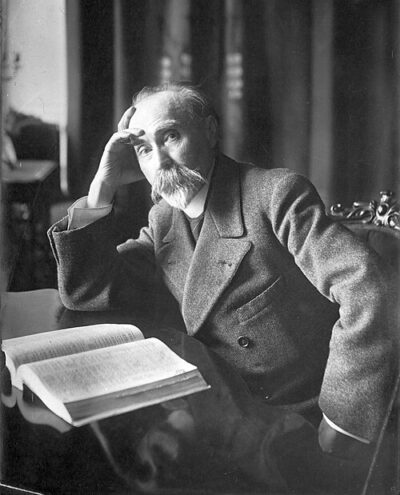
Georgi Plekhanov
Georgi Plekhanov was a Russian philosopher. Born November 29, 1856, in Gudalovka. Died May 30, 1918, in Zelenogorsk. Known for Anarchism and Socialism.
Facts
25 facts · 1 confirmed by two sources · 8 cited · 16 from one source
Where this comes from
Papalocal keeps its own record. It started from these sources; what each one said is kept here as it was copied, so a change on their side never changes this page by itself. Tap one to read its version.
What Wikidata says · copied November 16, 2026 · revision 2568212174
- Described as
- Russian philosopher (1856–1918)
- Other names
- Georgy Valentinovich Plekhanov, Georgy Plekhanov, George Plekhanov, Georgi Valentinovich Plekhanov
- Born
- November 29, 1856 · 3 references; November 29, 1856 · 2 references
- Died
- May 30, 1918 · 10 references
- Born in
- Gudalovka
- Died in
- Zelenogorsk
- Buried in
- Volkovo Cemetery Writer's Walkways
- Cause of death
- tuberculosis
- Citizen of
- Russian Empire
- Occupation
- philosopher · 3 references; politician · 2 references; journalist · 2 references; writer; historian; sociologist · 2 references; economist; art historian · 2 references
- Political party
- Land and Liberty; Black Repartition; Emancipation of Labour; Russian Social Democratic Labour Party
- Known for
- Anarchism and Socialism
- Field
- philosophy · 2 references; politics · 2 references
- Father
- Valentin Plekhanov
- Siblings
- Maria Plekhanova
- Religion
- atheism
- Wikipedias with a page
- 75
Wikidata item Q182905 (wikidata.org/wiki/Q182905), public domain (CC0). Copied November 16, 2026.
What Wikipedia says · copied November 16, 2026 · revision 1376516725
Georgi Valentinovich Plekhanov (Russian: Георгий Валентинович Плеханов [ɡʲɪˈorɡʲɪj vəlʲɪnʲˈtʲinəvʲɪtɕ plʲɪˈxanəf] ; 11 December [O.S. 29 November] 1856 – 30 May 1918) was a Russian Marxist theorist, philosopher, and revolutionary. After beginning his revolutionary career as a populist, in 1883 Plekhanov established the Emancipation of Labour group, the first Russian Marxist political organisation. He is widely regarded as the "father of Russian Marxism", and his theoretical works were instrumental in converting a generation of revolutionaries, including Vladimir Lenin, to the cause.
Plekhanov was a prominent leader in the Russian Social Democratic Labour Party (RSDLP) and the Second International. In 1900, he collaborated with Lenin in founding the party newspaper Iskra, and at the party's Second Congress in 1903, initially sided with Lenin's Bolshevik faction. However, he soon broke with the Bolsheviks over their organisational principles, which he criticised as overly centralist, and became a leading figure in the opposing Menshevik faction. During the 1905 Russian Revolution, Plekhanov maintained that Russia was only ready for a bourgeois-democratic revolution and argued against what he saw as premature attempts to seize power by the proletariat.
During World War I, Plekhanov adopted a staunchly nationalist position, "defensism", in support of the Allied cause, a stance that separated him from most international socialists. He returned to Russia after the 1917 February Revolution and supported the Provisional Government. He was a fierce opponent of the Bolsheviks, denouncing their leader Lenin and warning that their seizure of power in the October Revolution would be a disaster for the country. Plekhanov died of tuberculosis in Finland the following year.
Despite his political opposition to the Bolsheviks, Plekhanov was held in high esteem by Lenin and was posthumously enshrined in the Soviet Union as a founding father of Russian Marxism. His contributions to philosophy, historical materialism, and aesthetics made him one of the most important Marxist thinkers of his era. His legacy remains contested, with some viewing him as a democratic, orthodox Marxist alternative to Leninism, while others focus on his theoretical groundwork that paved the way for the Bolsheviks.
- Born, in its opening lines
- December 11, 1856
- Died, in its opening lines
- May 30, 1918
From the Wikipedia article “Georgi Plekhanov” (en.wikipedia.org/wiki/Georgi_Plekhanov), by its contributors, under CC BY-SA 4.0 (creativecommons.org/licenses/by-sa/4.0/). Copied November 16, 2026; not changed.
Confirmed Two sources agree. Cited One source, and it names where it got it. One source One source, without a reference of its own. Sources disagree The sources disagree. We show the best-supported value and keep theirs below.
