
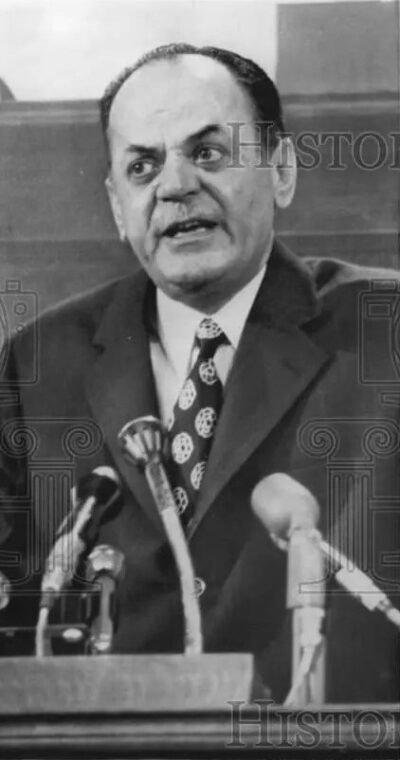
Georgios Papadopoulos
Georgios Papadopoulos was a dictator of Greece from 1967 to 1973. Born May 5, 1919, in Elaiochori. Died June 27, 1999, in Laiko General Hospital of Athens. Positions held include Prime Minister of Greece (1967–1973), Minister for National Defence of Greece (1967–1973) and Minister of National Education and Religious Affairs of Greece (1969–1970). Educated at Hellenic Military Academy and National Technical University of Athens. Awards include Grand Cross of the Order of the Redeemer, Grand Cross of the Order of Honour and Gold Cross of Valour.
Facts
46 facts · 2 confirmed by two sources · 4 cited · 40 from one source
Where this comes from
Papalocal keeps its own record. It started from these sources; what each one said is kept here as it was copied, so a change on their side never changes this page by itself. Tap one to read its version.
What Wikidata says · copied November 16, 2026 · revision 2567747267
- Described as
- dictator of Greece from 1967 to 1973 (1919–1999)
- Other names
- Geórgios Papadópulos, George Papadopoulos, Giorgos Papadopoulos, Yiorgos Papadopoulos, George Papadópoulos, Giórgos Papadópoulos, Yiórgos Papadópoulos
- Born
- May 5, 1919 · 7 references
- Died
- June 27, 1999 · 7 references
- Born in
- Elaiochori
- Died in
- Laiko General Hospital of Athens · 1 reference
- Buried in
- First Cemetery of Athens · 1 reference
- Cause of death
- cardiac arrest
- Citizen of
- Greece
- Occupation
- military personnel; military officer · 1 reference; dictator; politician · 1 reference
- Positions held
- Prime Minister of Greece (1967–1973); Minister for National Defence of Greece (1967–1973); Minister of National Education and Religious Affairs of Greece (1969–1970); Minister at the Presidency of the Government of Greece (1967–1973); President of Greece (1973); Regent of Greece (1972–1973); Minister for Foreign Affairs of Greece (1970–1973)
- Political party
- independent politician (1967–1973); National Political Union (1984–1990)
- Education
- Hellenic Military Academy (1937–1940); National Technical University of Athens (1941–); Supreme Joint War College (1953–1955)
- Member of
- Organization X (1943–1944); Greek junta (1967–1973)
- Awards
- Grand Cross of the Order of the Redeemer; Grand Cross of the Order of Honour; Gold Cross of Valour; Greek War Cross, 3rd Class; Medal for Outstanding Acts; Silver Cross of the Order of George I; Medal of Military Merit; War Cross; Medal of National Resistance 1941-1945; campaign medal
- Field
- politics; politician; politics of Greece
- Siblings
- Konstantinos Papadopoulos
- Religion
- Greek Orthodoxy
- Military branch
- Hellenic Army (1937–1967) · 1 reference
- Military rank
- brigadier general
- Lived in
- Kypseli, Athens; Patisia; Neo Psychiko; Lagonisi
- Wikipedias with a page
- 49
Wikidata item Q156505 (wikidata.org/wiki/Q156505), public domain (CC0). Copied November 16, 2026.
What Wikipedia says · copied November 16, 2026 · revision 1385486438
Georgios Papadopoulos (Greek: Γεώργιος Παπαδόπουλος, pronounced [ʝeˈorʝi.os papaˈðopulos]; 5 May 1919 – 27 June 1999) was a Greek military officer and dictator who ruled Greece from 1967 to 1973. He led the military junta that overthrew Prime Minister Panagiotis Kanellopoulos in 1967 and established his dictatorship. He was proclaimed Prime Minister of Greece from 1967 and served until 1973. He was elected President of Greece under the junta in June 1973, following a referendum. However, after causing a massacre by deploying military riflemen and a tank brigade to attack non-violent protestors to suppress the Athens Polytechnic uprising, he was overthrown by hardliner Dimitrios Ioannidis, in a string of events that would culminate in the fall of regime in 1974. His dictatorship's legacy, as well as its methods he constructed and effects on Greek economy and society as a whole, are still fiercely debated.
He joined the Hellenic Army during the Second World War and initially helped resist the Italian invasion of Greece in the Greco-Italian War. He is widely believed to have later collaborated as a member of the Axis-aligned Security Battalions. After the war, he rose to the rank of colonel.
In April 1967, Papadopoulos and a group of other mid-level Army officers overthrew the democratic government and established a military junta that lasted until 1974. Assuming dictatorial powers, he led an authoritarian, anti-communist and ultranationalist regime which eventually ended the Greek monarchy and established a republic, with himself as President. In 1973, he was overthrown and arrested by his co-conspirator Brigadier General Dimitrios Ioannidis. After the Metapolitefsi which restored democracy in 1974, Papadopoulos was tried for his part in the crimes of the junta and sentenced to death, but his sentence was commuted to life imprisonment. Refusing several offers of clemency in exchange for admitting guilt, he spent the remainder of his life in prison.
- Born, in its opening lines
- May 5, 1919
- Died, in its opening lines
- June 27, 1999
From the Wikipedia article “Georgios Papadopoulos” (en.wikipedia.org/wiki/Georgios_Papadopoulos), by its contributors, under CC BY-SA 4.0 (creativecommons.org/licenses/by-sa/4.0/). Copied November 16, 2026; not changed.
Confirmed Two sources agree. Cited One source, and it names where it got it. One source One source, without a reference of its own. Sources disagree The sources disagree. We show the best-supported value and keep theirs below.
