
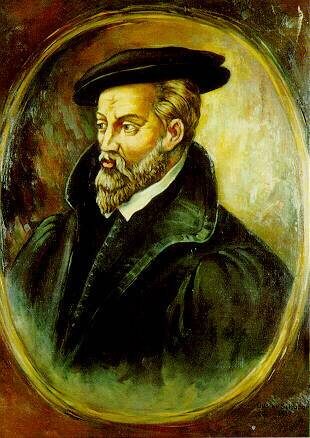
Georgius Agricola
Georgius Agricola was a German physician and mineralogist. Born March 24, 1494, in Glauchau. Died November 21, 1555, in Chemnitz. Positions held include mayor (1546–1553). Known for De Re Metallica, De Natura Fossilium and De Natura Fossilium. Educated at Leipzig University and University of Bologna.
Facts
28 facts · 2 confirmed by two sources · 8 cited · 18 from one source
Where this comes from
Papalocal keeps its own record. It started from these sources; what each one said is kept here as it was copied, so a change on their side never changes this page by itself. Tap one to read its version.
What Wikidata says · copied November 16, 2026 · revision 2568730282
- Described as
- German physician and mineralogist (1494-1555)
- Other names
- Georg Agricola, Georg Bauer
- Born
- March 24, 1494 · 7 references
- Died
- November 21, 1555 · 7 references
- Born in
- Glauchau · 4 references
- Died in
- Chemnitz · 5 references
- Buried in
- Zeitz Cathedral St. Peter and Paul · 1 reference
- Cause of death
- stroke · 1 reference
- Name at birth
- Georg Pawer · 1 reference
- Citizen of
- Electorate of Saxony
- Occupation
- physician · 1 reference; mineralogist · 1 reference; historian · 1 reference; engineer; chemist · 1 reference; philosopher · 1 reference; metallurgist · 1 reference
- Positions held
- mayor (1546–1553)
- Education
- Leipzig University (1514–1518) · 1 reference; University of Bologna (1523) · 2 references; University of Padua · 1 reference
- Known for
- De Re Metallica; De Natura Fossilium; De Natura Fossilium; De natura eorum quae effluunt ex terra; De ortu et causis subterraneorum; Bermannus; sive, de re metallica
- Field
- geology · 1 reference; mineralogy; mining
- Wikipedias with a page
- 63
Wikidata item Q76579 (wikidata.org/wiki/Q76579), public domain (CC0). Copied November 16, 2026.
What Wikipedia says · copied November 16, 2026 · revision 1385564149
Georgius Agricola (; born Georg Bauer; 24 March 1494 – 21 November 1555) was a German Renaissance humanist scholar, mineralogist and metallurgist. Born in the small town of Glauchau, in the Electorate of Saxony of the Holy Roman Empire, he was broadly educated, but took a particular interest in the mining and refining of metals. He was the first to drop the Arabic definite article al-, exclusively writing chymia and chymista in describing activity that we today would characterize as chemical or alchemical, giving chemistry its modern name. For his groundbreaking work De Natura Fossilium published in 1546, he is generally referred to as the father of mineralogy and the founder of geology as a scientific discipline.
He is well known for his pioneering work De re metallica libri XII, that was published in 1556, one year after his death. This 12-chapter work is a comprehensive and systematic study, classification and methodical guide on all available factual and practical aspects that are of concern for mining, the mining sciences and metallurgy, investigated and researched in its natural environment by means of direct observation. Unrivalled in its complexity and accuracy, it served as the standard reference work for two centuries. Agricola stated in the preface that he will exclude "all those things which I have not myself seen, or have not read or heard of". He continued, "That which I have neither seen, nor carefully considered after reading or hearing of, I have not written about."
As a scholar of the Renaissance, he was committed to a universal approach towards learning and research. He published over 40 complete scholarly works during his professional life on a wide range of subjects and disciplines, such as pedagogy, medicine, metrology, mercantilism, pharmacy, philosophy, geology, history, and many more. His innovative and comprehensive scholarly work, based on new and precise methods of production and control, has made his work a central part of scholarship and understanding of science during that period.
- Born, in its opening lines
- March 24, 1494
- Died, in its opening lines
- November 21, 1555
From the Wikipedia article “Georgius Agricola” (en.wikipedia.org/wiki/Georgius_Agricola), by its contributors, under CC BY-SA 4.0 (creativecommons.org/licenses/by-sa/4.0/). Copied November 16, 2026; not changed.
Confirmed Two sources agree. Cited One source, and it names where it got it. One source One source, without a reference of its own. Sources disagree The sources disagree. We show the best-supported value and keep theirs below.
