
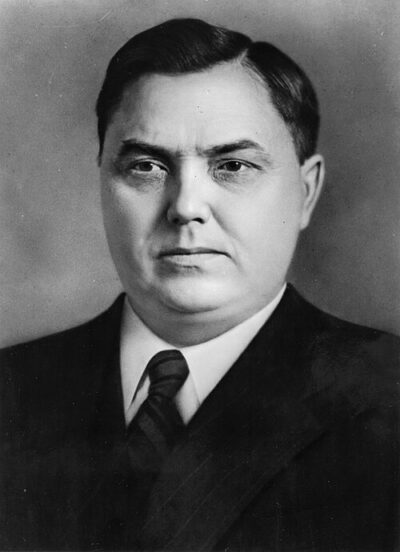
Georgy Malenkov
Georgy Malenkov was a Soviet politician. Born January 8, 1902, in Orenburg. Died January 14, 1988, in Moscow. Positions held include Chairman of the Council of Ministers of the USSR (1953–1955), member of the Presidium of the Supreme Soviet of the USSR (1938–) and deputy of the Supreme Soviet of the Soviet Union (1938–1958). Educated at Bauman Moscow State Technical University. Awards include Order of Lenin (3 times), "Hammer and Sickle" gold medal and Medal "For Valiant Labour in the Great Patriotic War 1941–1945".
Facts
24 facts · 2 confirmed by two sources · 4 cited · 18 from one source
Where this comes from
Papalocal keeps its own record. It started from these sources; what each one said is kept here as it was copied, so a change on their side never changes this page by itself. Tap one to read its version.
What Wikidata says · copied November 16, 2026 · revision 2567400383
- Described as
- Soviet politician (1902–1988)
- Other names
- Georgy Maximilianovich Malenkov, Георгий Максимилианович Маленков, Георгий Маленков, Malenkov, Georgi Malenkov
- Born
- January 8, 1902 · 3 references
- Died
- January 14, 1988 · 6 references
- Born in
- Orenburg · 1 reference
- Died in
- Moscow · 2 references
- Buried in
- Kuntsevo Cemetery
- Citizen of
- Russian Empire; Soviet Union
- Occupation
- politician · 1 reference
- Positions held
- Chairman of the Council of Ministers of the USSR (1953–1955); member of the Presidium of the Supreme Soviet of the USSR (1938–); deputy of the Supreme Soviet of the Soviet Union (1938–1958); Member of the Politburo of the CPSU Central Committee (1946–1957) · 1 reference; Secretary of the Communist Party of the Soviet Union (2 times) (1939–1953) · 1 reference
- Political party
- Communist Party of the Soviet Union (1920–)
- Education
- Bauman Moscow State Technical University
- Member of
- Politburo of the Central Committee of the Communist Party of the Soviet Union
- Awards
- Order of Lenin (3 times) (1943, 1945, 1952); "Hammer and Sickle" gold medal (1943); Medal "For Valiant Labour in the Great Patriotic War 1941–1945"; Hero of Socialist Labour · 1 reference
- Spouse
- Valeria Golubtsova · 1 reference
- Religion
- atheism; Eastern Orthodoxy
- Military rank
- lieutenant general (1943–)
- Wikipedias with a page
- 83
Wikidata item Q180588 (wikidata.org/wiki/Q180588), public domain (CC0). Copied November 16, 2026.
What Wikipedia says · copied November 16, 2026 · revision 1381011465
Georgy Maximilianovich Malenkov (8 January 1902 [O.S. 26 December 1901] – 14 January 1988) was a Soviet politician who succeeded Joseph Stalin as Premier and the overall leader of the Soviet Union in March 1953. Shortly thereafter, Malenkov entered into a power struggle with the party's First Secretary, Nikita Khrushchev, which culminated in his removal from the premiership in 1955 as well as the Central Committee Presidium in 1957.
Born and raised in Orenburg, Malenkov served in the Red Army during the Russian Civil War and joined the Communist Party in 1920. Beginning in 1925, he served in the staff of the party's Organizational Bureau (Orgburo), where he was entrusted with overseeing member records. In this role, Malenkov was heavily involved in facilitating Stalin's purges of the party's ranks during the 1930s. By 1939, he became a member of the Central Committee Secretariat. During World War II, Malenkov was appointed to the State Defense Committee where he was charged with overseeing aircraft and missile production. After the war's end, he became a full member of the Politburo in 1946. Later in 1948, Malenkov succeeded Andrei Zhdanov as Second Secretary of the Communist Party of the Soviet Union.
Upon Stalin's death on 5 March 1953, Malenkov succeeded him as Chairman of the Council of Ministers and the highest-ranking Secretary of the Central Committee. On 14 March, his colleagues within the Politburo (then known as the Presidium) forced him to give up his membership in the Secretariat, thereby allowing Nikita Khrushchev to become the party's acting First Secretary. Subsequently, Malenkov contented himself with serving as the Presidium's highest-ranking member and chairman until eventually being eclipsed by Khrushchev as the undisputed leader of the Soviet Union. After being compelled to leave office as Premier in February 1955, he conspired with other members of the Presidium to remove Khrushchev from the Soviet leadership. When the attempted coup by the so-called "Anti-Party Group" failed in 1957, Malenkov was dismissed from the Presidium and expelled from the party altogether by 1961. He kept a low profile for the rest of his life and died in 1988 of natural causes.
- Born, in its opening lines
- January 8, 1902
- Died, in its opening lines
- January 14, 1988
From the Wikipedia article “Georgy Malenkov” (en.wikipedia.org/wiki/Georgy_Malenkov), by its contributors, under CC BY-SA 4.0 (creativecommons.org/licenses/by-sa/4.0/). Copied November 16, 2026; not changed.
Confirmed Two sources agree. Cited One source, and it names where it got it. One source One source, without a reference of its own. Sources disagree The sources disagree. We show the best-supported value and keep theirs below.
