
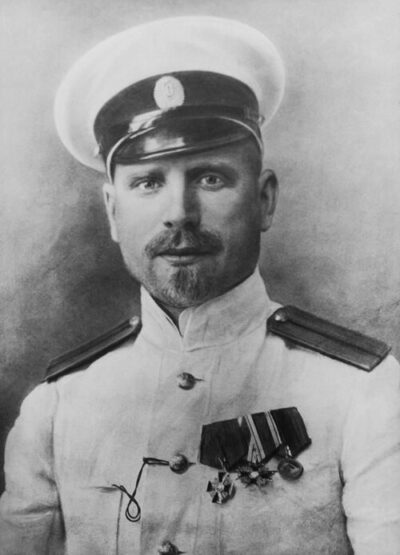
Georgy Sedov
Georgy Sedov was a Russian Arctic explorer. Born April 23, 1877, in Siedove. Died February 20, 1914, in Rudolf Island. Awards include Order of Saint Stanislaus, 3rd class and Order of Saint Anna, 3rd class.
Facts
14 facts · 0 confirmed by two sources · 2 cited · 10 from one source · 2 where the sources disagree
What’s different
- Born: we show April 23, 1877 (Sources disagree). Wikipedia says May 5, 1877
- Died: we show February 20, 1914 (Sources disagree). Wikipedia says March 5, 1914
Where this comes from
Papalocal keeps its own record. It started from these sources; what each one said is kept here as it was copied, so a change on their side never changes this page by itself. Tap one to read its version.
What Wikidata says · copied November 17, 2026 · revision 2522193181
- Described as
- Russian Arctic explorer (1877–1914)
- Other names
- Georgy Yakovlevich Sedov
- Born
- April 23, 1877 · 1 reference
- Died
- February 20, 1914
- Born in
- Siedove
- Died in
- Rudolf Island
- Buried in
- Arkhangelsk Oblast
- Cause of death
- scurvy
- Citizen of
- Russian Empire
- Occupation
- explorer; hydrographer; polar explorer · 1 reference
- Awards
- Order of Saint Stanislaus, 3rd class; Order of Saint Anna, 3rd class
- Field
- science · 1 reference
- Military rank
- senior lieutenant of the fleet
- Wikipedias with a page
- 26
Wikidata item Q358579 (wikidata.org/wiki/Q358579), public domain (CC0). Copied November 17, 2026.
What Wikipedia says · copied November 17, 2026 · revision 1375164099
Georgy Yakovlevich Sedov (Russian: Георгий Яковлевич Седов; 5 May [O.S. 23 April] 1877 – 5 March [O.S. 20 February] 1914) was a Russian Arctic explorer.
Sedov was born in the village of Krivaya Kosa of Taganrog district (now Novoazovskyi Raion, Donetsk Oblast) to a fisherman's family. In 1898, he finished navigation courses in Rostov-on-Don and acquired the rank of long voyage navigator. In 1901, he took an external degree at a naval college, passed all the exams, and was promoted to the rank of lieutenant.
From 1902 to 1903, Sedov participated in a hydrographic expedition in the Arctic Ocean. In 1905, during the Russo-Japanese War, he was in charge of a torpedo boat. In 1909, he led the expedition that would later describe the mouth of the Kolyma River. The following year, Sedov explored the Krestovaya Bay on Novaya Zemlya.
In 1912, he proposed a sleigh expedition for reaching the North Pole. The Tsarist government refused to finance this project and the expedition was organized with help from independent sources. On August 14 (27), 1912, Sedov's ship Svyatoy Muchenik Foka (Saint Phocas the Martyr) left Arkhangelsk and had to stay for the winter near Novaya Zemlya because of impassable ice. The expedition reached Franz Josef Land only in August 1913; however, it had to stay for the second winter in the Tikhaya Bay due to lack of coal.
On February 2 (15), 1914, Sedov (already sick with scurvy) and his accompanying seamen G. Linnik and A. Pustotniy set off for the North Pole with their draft dogs. Before reaching Rudolf Island, Sedov died at sea and was buried at Cape Auk on the island. On the way back, at Franz Josef Land, the Svyatoy Foka rescued two survivors of the Brusilov expedition, including Valerian Albanov. As part of the search for the Sedov expedition, Jan Nagórski made the first airplane flights over the Arctic, gaining valuable experience for later aeronautical expeditions to the region.
Two gulfs and a peak on Novaya Zemlya, a glacier and a cape on Franz Josef Land, an island in the Barents Sea, and a cape in Antarctica bear Sedov's name. There was also a steam icebreaker Georgy Sedov. Today, the sail training barque STS Sedov bears his name.
- Born, in its opening lines
- May 5, 1877
- Died, in its opening lines
- March 5, 1914
From the Wikipedia article “Georgy Sedov” (en.wikipedia.org/wiki/Georgy_Sedov), by its contributors, under CC BY-SA 4.0 (creativecommons.org/licenses/by-sa/4.0/). Copied November 17, 2026; not changed.
Confirmed Two sources agree. Cited One source, and it names where it got it. One source One source, without a reference of its own. Sources disagree The sources disagree. We show the best-supported value and keep theirs below.
