
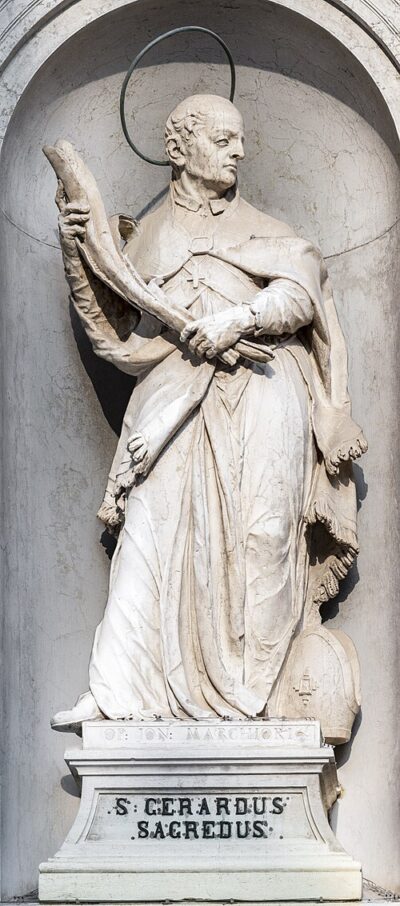
Gerard of Csanád
Gerard of Csanád was an Italian Benedictine monk, founder bishop of Roman Catholic Diocese of (Szeged-)Csanád, and martyr. Born 977, in Venice. Died September 24, 1046, in Buda. Positions held include Roman Catholic Bishop of Csanád (1030–1046), abbot (1021–1030) and prior (–1021).
Facts
13 facts · 2 confirmed by two sources · 5 cited · 5 from one source · 1 where the sources disagree
What’s different
- Born: we show 977 (Confirmed). Wikidata also lists April 23, 980
- Cause of death: we show stoning (Sources disagree). Wikidata also lists drowning
Where this comes from
Papalocal keeps its own record. It started from these sources; what each one said is kept here as it was copied, so a change on their side never changes this page by itself. Tap one to read its version.
What Wikidata says · copied November 17, 2026 · revision 2568966916
- Described as
- Italian Benedictine monk, founder bishop of Roman Catholic Diocese of (Szeged-)Csanád, and martyr
- Other names
- Gerard Sagredo, Saint Gerard
- Born
- April 23, 980 · 1 reference; 977 · 1 reference
- Died
- September 24, 1046 · 3 references
- Born in
- Venice · 2 references
- Died in
- Buda · 1 reference
- Cause of death
- stoning · 1 reference; drowning · 1 reference
- Citizen of
- Republic of Venice · 1 reference
- Occupation
- missionary · 1 reference; writer · 1 reference
- Positions held
- Roman Catholic Bishop of Csanád (1030–1046) · 2 references; abbot (1021–1030) · 1 reference; prior (–1021) · 1 reference
- Religion
- Catholicism · 1 reference
- Lived in
- San Giorgio Monastery (–1030) · 3 references
- Wikipedias with a page
- 28
Wikidata item Q117759 (wikidata.org/wiki/Q117759), public domain (CC0). Copied November 17, 2026.
What Wikipedia says · copied November 17, 2026 · revision 1354589217
Gerard or Gerard Sagredo (Hungarian: Gellért; Italian: Gerardo di Sagredo; Latin: Gerardus; 23 April 977/1000 – 24 September 1046) was the first bishop of Csanád in the Kingdom of Hungary from around 1030 to his death. Most information about his life was preserved in his legends, which contains most of the conventional elements of medieval saints' biographies. He was born in a Venetian noble family, associated with the Sagredo or Morosini families in sources written centuries later. At the age of five, after a serious illness, he was sent to the newly-founded Benedictine San Giorgio Monastery. He received an excellent monastic education and also learnt grammar, music, philosophy, and law.
He left Venice on a pilgrimage to the Holy Land around 1020, but a storm compelled him to break his journey near Istria. He decided to visit the Kingdom of Hungary. Maurus, bishop of Pécs, and King Stephen I of Hungary convinced him to discontinue his pilgrimage, emphasizing that Gerard's preaching could accelerate the conversion of the Hungarians. Gerard was made the tutor of the king's son and heir, Emeric. Before long, Gerard went to the Bakony Hills to live as a hermit near Bakonybél. Stephen I made him the first bishop of the newly established Diocese of Csanád (encompassing present-day Banat in Serbia, Romania and Hungary) around 1030. Benedictine monks who spoke Hungarian helped him preach to the local inhabitants.
- Born, in its opening lines
- April 23, 977
- Died, in its opening lines
- September 24, 1046
From the Wikipedia article “Gerard of Csanád” (en.wikipedia.org/wiki/Gerard_of_Csanád), by its contributors, under CC BY-SA 4.0 (creativecommons.org/licenses/by-sa/4.0/). Copied November 17, 2026; not changed.
Confirmed Two sources agree. Cited One source, and it names where it got it. One source One source, without a reference of its own. Sources disagree The sources disagree. We show the best-supported value and keep theirs below.
