
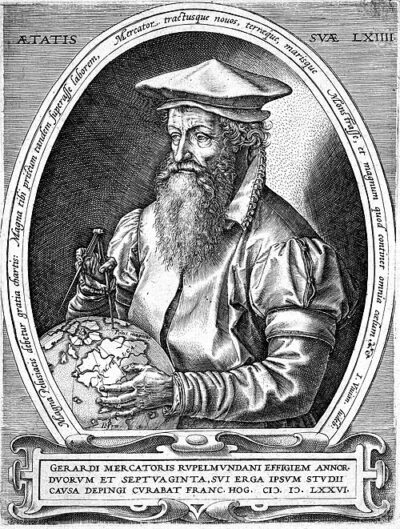
Gerardus Mercator
Gerardus Mercator was a Flemish geographer, cosmographer and cartographer. Born March 5, 1512, in Rupelmonde. Died December 2, 1594, in Duisburg. Positions held include cosmographer (1564–). Known for Mercator projection, Mercator 1569 world map and Mercator map of Palestine. Educated at Old University of Leuven and Brethren of the Common Life.
Facts
39 facts · 2 confirmed by two sources · 23 cited · 14 from one source
Where this comes from
Papalocal keeps its own record. It started from these sources; what each one said is kept here as it was copied, so a change on their side never changes this page by itself. Tap one to read its version.
What Wikidata says · copied November 16, 2026 · revision 2569336118
- Described as
- Flemish geographer, cosmographer and cartographer (1512–1594)
- Other names
- Mercator, Gerard Merkator, Gérard de Cremer, Mercatore, Gerardus Cremers, Gerard Mercator, Mercat.e, Gherardo Mercatore, Gerhard Mercator, Gerhard Kremer, Gerard De Kremer
- Born
- March 5, 1512 · 13 references
- Died
- December 2, 1594 · 15 references
- Born in
- Rupelmonde · 5 references
- Died in
- Duisburg · 5 references
- Buried in
- Church of Our Saviour · 1 reference
- Name at birth
- Gerard De Kremer
- Citizen of
- Habsburg Netherlands
- Occupation
- mathematician · 2 references; philosopher · 1 reference; theologian · 1 reference; cartographer · 4 references; inventor; cosmographer; university teacher; instrument maker · 2 references
- Positions held
- cosmographer (1564–) · 1 reference
- Worked for
- Old University of Leuven (1534–1552) · 1 reference
- Education
- Old University of Leuven (1530–1532) · 1 reference; Brethren of the Common Life (1527–1530) · 1 reference
- Known for
- Mercator projection; Mercator 1569 world map; Mercator map of Palestine; Angliae, Scotiae & Hiberniae nova descriptio; Mercator Europe map; Literarum latinarum, quas italicas, cursoriasque vocant, scribendarum ratio; Chronologia; Tabulae Geographicae; Mercator globe of the Earth (1541)
- Field
- geography · 1 reference; cartography · 1 reference; mathematics · 1 reference; theology · 1 reference; philosophy · 1 reference
- Spouse
- Barbara Schellekens (1536–1585) · 1 reference; Gertrude Vierlings (1589–1594) · 1 reference
- Children
- Bartholomeus Mercator · 1 reference; Rumold Mercator · 1 reference; Arnold Mercator · 1 reference
- Religion
- Lutheranism · 1 reference
- Wikipedias with a page
- 74
Wikidata item Q6353 (wikidata.org/wiki/Q6353), public domain (CC0). Copied November 16, 2026.
What Wikipedia says · copied November 16, 2026 · revision 1374282044
Gerardus Mercator (; 5 March 1512 – 2 December 1594) was a Flemish geographer, cosmographer and cartographer. He is most renowned for creating the 1569 world map based on a new projection which represented sailing courses of constant bearing (rhumb lines) as straight lines—an innovation that is still employed in nautical charts.
Mercator was a notable maker of globes and scientific instruments. In addition, he had interests in theology, philosophy, history, mathematics, and geomagnetism. He was also an accomplished engraver and calligrapher. Unlike other great scholars of the age, he travelled little and his knowledge of geography came from his library of over a thousand books and maps, from his visitors and from his vast correspondence (in six languages) with other scholars, statesmen, travellers, merchants and seamen. Mercator's early maps were in large formats suitable for wall mounting but in the second half of his life, he produced over 100 new regional maps in a smaller format suitable for binding into his Atlas of 1595. This was the first appearance of the word "atlas" in connection with maps, but Mercator did not intend the word to mean a collection of maps; it was a neologism for a treatise (Cosmologia) on the creation, history and description of the universe. He chose the word as a reference to a legendary king of Mauretania who was traditionally considered the first great geographer.
A large part of Mercator's income came from sales of terrestrial and celestial globes. For sixty years they were considered the finest in the world, and were sold in such numbers that there are many surviving examples. This was a substantial enterprise involving the manufacture of the spheres, printing the gores, building substantial stands, packing and distributing them all over Europe. He was also renowned for his scientific instruments, particularly his astrolabes and astronomical rings used to study the geometry of astronomy and astrology.
Mercator wrote on geography, philosophy, chronology and theology. All of the wall maps were engraved with copious text on the region concerned. As an example, the famous world map of 1569 is inscribed with over five thousand words in fifteen legends. The 1595 Atlas has about 120 pages of maps and illustrated title pages, but a greater number of pages are devoted to his account of the creation of the universe and descriptions of all the countries portrayed. His table of chronology ran to some 400 pages fixing the dates (from the time of creation) of earthly dynasties, major political and military events, volcanic eruptions, earthquakes and eclipses. He also wrote on the gospels and the Old Testament.
Mercator was a devout Christian born into a Catholic family at a time when Martin Luther's Protestantism was gaining ground. He never declared himself as a Lutheran but was clearly sympathetic, and he was accused of heresy by Catholic authorities; after six months in prison he was released unscathed. This period of persecution is probably the major factor in his move from Catholic Leuven (Louvain) to a more tolerant Duisburg, in the Holy Roman Empire, where he lived for the last thirty years of his life. Walter Ghim, Mercator's friend and first biographer, describes him as sober in his behaviour, yet cheerful and witty in company, and never more happy than in debate with other scholars.
- Born, in its opening lines
- March 5, 1512
- Died, in its opening lines
- December 2, 1594
From the Wikipedia article “Gerardus Mercator” (en.wikipedia.org/wiki/Gerardus_Mercator), by its contributors, under CC BY-SA 4.0 (creativecommons.org/licenses/by-sa/4.0/). Copied November 16, 2026; not changed.
Confirmed Two sources agree. Cited One source, and it names where it got it. One source One source, without a reference of its own. Sources disagree The sources disagree. We show the best-supported value and keep theirs below.
