
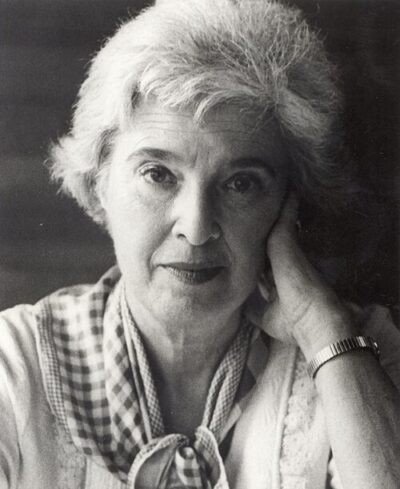
Gerda Lerner
Gerda Lerner was an Austrian-American women's history scholar. Born April 30, 1920, in Vienna. Died January 2, 2013, in Madison. Positions held include president (1987–1982). Known for Women and History. Educated at Columbia University and The New School. Awards include Guggenheim Fellowship, honorary doctor of the University of Vienna and Käthe Leichter Prize.
Facts
39 facts · 2 confirmed by two sources · 11 cited · 26 from one source
Where this comes from
Papalocal keeps its own record. It started from these sources; what each one said is kept here as it was copied, so a change on their side never changes this page by itself. Tap one to read its version.
What Wikidata says · copied November 15, 2026 · revision 2568909812
- Described as
- Austrian-American women's history scholar (1920-2013)
- Other names
- Gerda Hedwig Lerner
- Born
- April 30, 1920 · 2 references
- Died
- January 2, 2013 · 2 references
- Born in
- Vienna · 1 reference
- Died in
- Madison · 1 reference
- Name at birth
- Gerda Hedwig Kronstein
- Citizen of
- United States (1943–); Austria · 1 reference
- Occupation
- historian · 3 references; university teacher; writer · 1 reference; screenwriter; autobiographer · 1 reference; educator · 1 reference; author · 2 references; translator · 2 references
- Positions held
- president (1987–1982)
- Political party
- Communist Party of the United States of America (1946–)
- Worked for
- University of Wisconsin–Madison (1980–); Sarah Lawrence College (1968–); Duke University · 1 reference
- Education
- Columbia University; The New School
- Member of
- American Academy of Arts and Sciences (1998–); Congress of American Women (1946–); National Organization for Women (1966–)
- Known for
- Women and History
- Awards
- Guggenheim Fellowship (1980) · 1 reference; honorary doctor of the University of Vienna; Käthe Leichter Prize (2012); Austrian Decoration for Science and Art; Bruce Catton Prize (2002) · 1 reference; Bruno Kreisky Prize for the Political Book (2006); honorary doctor of the Hebrew University of Jerusalem; honorary doctorate from Columbia University (2006); honorary doctor of Harvard University (2008) · 1 reference; Fellow of the American Academy of Arts and Sciences; honorary doctor of Brandeis University
- Spouse
- Carl Lerner
- Website
- https://gerdalerner.com/
- Wikipedias with a page
- 34
Wikidata item Q85102 (wikidata.org/wiki/Q85102), public domain (CC0). Copied November 15, 2026.
What Wikipedia says · copied November 15, 2026 · revision 1379851992
Gerda Hedwig Lerner (née Kronstein; April 30, 1920 – January 2, 2013) was an Austrian-born American historian and woman's history author. In addition to her numerous scholarly publications, she wrote poetry, fiction, theatre pieces, screenplays, and an autobiography. She served as president of the Organization of American Historians from 1980 to 1981. In 1980, she was appointed Robinson Edwards Professor of History at the University of Wisconsin-Madison, where she taught until retiring in 1991.
Lerner was one of the founders of the academic field of women's history, known as the "godmother of women's history." In 1963, while still an undergraduate at the New School for Social Research, she taught "Great Women in American History", which is considered to be the first regular college course on women's history offered anywhere.
She taught at Long Island University from 1965 to 1967. She played a key role in the development of women's history curricula and was involved in the development of degree programs in women's history at Sarah Lawrence College (where she taught from 1968 to 1979 and established the nation's first master's degree program in women's history) and at the University of Wisconsin-Madison, where she launched the first Ph.D. program in women's history. She also worked at Duke University and Columbia University, where she was a co-founder of the Seminar on Women.
- Born, in its opening lines
- April 30, 1920
- Died, in its opening lines
- January 2, 2013
From the Wikipedia article “Gerda Lerner” (en.wikipedia.org/wiki/Gerda_Lerner), by its contributors, under CC BY-SA 4.0 (creativecommons.org/licenses/by-sa/4.0/). Copied November 15, 2026; not changed.
Confirmed Two sources agree. Cited One source, and it names where it got it. One source One source, without a reference of its own. Sources disagree The sources disagree. We show the best-supported value and keep theirs below.
