
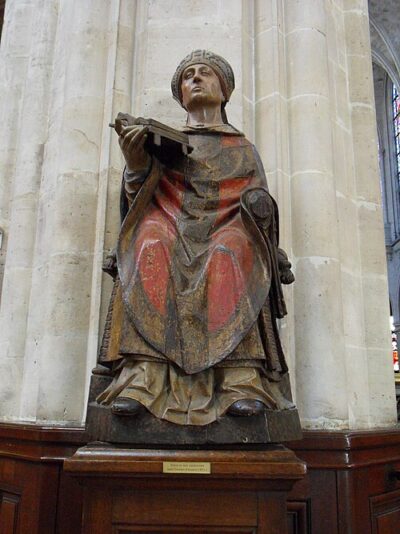
Germanus of Auxerre
Germanus of Auxerre was the 5th century Bishop of Auxerre and saint. Born 378, in Auxerre. Died July 31, 448, in Ravenna. Positions held include Roman Catholic Bishop of Auxerre (418–448).
Facts
9 facts · 1 confirmed by two sources · 2 cited · 5 from one source · 1 where the sources disagree
What’s different
- Born: we show 378 (Sources disagree). Wikipedia says 442
Where this comes from
Papalocal keeps its own record. It started from these sources; what each one said is kept here as it was copied, so a change on their side never changes this page by itself. Tap one to read its version.
What Wikidata says · copied November 18, 2026 · revision 2568915795
- Described as
- 5th century Bishop of Auxerre and saint
- Other names
- Germanus Autessiodurensis, St. Germain
- Born
- 378
- Died
- July 31, 448
- Born in
- Auxerre
- Died in
- Ravenna
- Citizen of
- Ancient Rome
- Occupation
- Catholic priest · 1 reference; Catholic bishop · 1 reference
- Positions held
- Roman Catholic Bishop of Auxerre (418–448) · 2 references
- Religion
- Catholic Church · 1 reference
- Wikipedias with a page
- 23
Wikidata item Q442516 (wikidata.org/wiki/Q442516), public domain (CC0). Copied November 18, 2026.
What Wikipedia says · copied November 18, 2026 · revision 1383873069
Germanus of Auxerre (Latin: Germanus Autissiodorensis; Welsh: Garmon Sant; French: Saint Germain l'Auxerrois; c. 378 – c. 442–448 AD) was a western Roman clergyman who was bishop of Autissiodorum in Late Antique Gaul. He abandoned a career as a high-ranking government official to devote his formidable energy towards the promotion of the church and the protection of his flock in dangerous times, personally confronting, for instance, the barbarian king Goar. In Britain he is best remembered for his journey to combat Pelagianism in or around 429 AD, and the records of this visit provide valuable information on the state of post-Roman British society. He also played an important part in the establishment and promotion of the Cult of Saint Alban. Alban was said to have revealed the story of his martyrdom to Germanus in a dream or holy vision, and Germanus ordered this to be written down for public display. Germanus is venerated as a saint in both the Catholic Church and Eastern Orthodox Church, which commemorate him on 31 July.
The principal source for the events of his life is the Vita Germani, a hagiography written by Constantius of Lyon around 480, and a brief passage added to the end of the Passio Albani, which may have been written or commissioned by Germanus. Constantius was a friend of Bishop Lupus of Troyes, who accompanied Germanus to Britain.
- Born, in its opening lines
- 442
- Died, in its opening lines
- 448
From the Wikipedia article “Germanus of Auxerre” (en.wikipedia.org/wiki/Germanus_of_Auxerre), by its contributors, under CC BY-SA 4.0 (creativecommons.org/licenses/by-sa/4.0/). Copied November 18, 2026; not changed.
Confirmed Two sources agree. Cited One source, and it names where it got it. One source One source, without a reference of its own. Sources disagree The sources disagree. We show the best-supported value and keep theirs below.
