
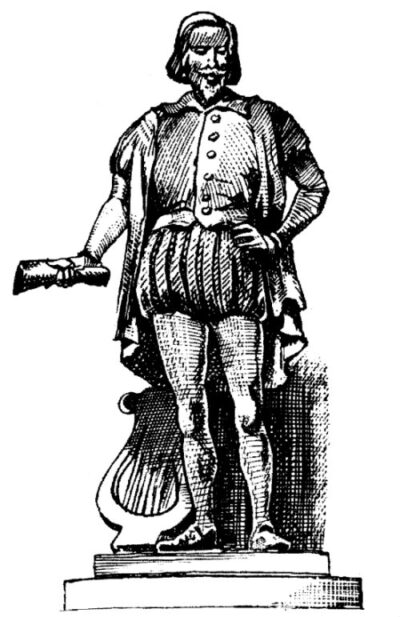
Gil Vicente
Gil Vicente was a Portuguese writer. Born 1465, in Guimarães. Died 1536, in Lisbon. Known for Auto da Barca do Inferno, Farsa de Inês Pereira and Auto da Índia. Educated at University of Salamanca.
Facts
19 facts · 0 confirmed by two sources · 8 cited · 11 from one source
Where this comes from
Papalocal keeps its own record. It started from these sources; what each one said is kept here as it was copied, so a change on their side never changes this page by itself. Tap one to read its version.
What Wikidata says · copied November 16, 2026 · revision 2552340676
- Described as
- Portuguese writer (1465–1536)
- Born
- 1465 · 6 references
- Died
- 1536 · 8 references
- Born in
- Guimarães · 1 reference
- Died in
- Lisbon · 1 reference
- Citizen of
- Kingdom of Portugal
- Occupation
- playwright · 2 references; poet · 1 reference; writer · 2 references; actor
- Education
- University of Salamanca
- Genre
- farce · 1 reference; comedy · 1 reference
- Known for
- Auto da Barca do Inferno · 1 reference; Farsa de Inês Pereira; Auto da Índia; The Soul's Journey; Tragicomédia de Dom Duardos
- Children
- Paula Vicente
- Religion
- Catholic Church · 1 reference
- Wikipedias with a page
- 38
Wikidata item Q360383 (wikidata.org/wiki/Q360383), public domain (CC0). Copied November 16, 2026.
What Wikipedia says · copied November 16, 2026 · revision 1377825112
Gil Vicente (Portuguese: [ˈʒil viˈsẽtɨ]; c. 1465 – c. 1536), called the Trobadour, was a Portuguese playwright and poet who acted in and directed his own plays. Considered the chief dramatist of Portugal he is sometimes called the "Portuguese Plautus," often referred to as the "Father of Portuguese drama" and as one of Western literature's greatest playwrights. Also noted as a lyric poet, Vicente worked in Spanish as much as he worked in Portuguese and is thus, with Juan del Encina, considered joint-father of Spanish drama.
Vicente was attached to the courts of the Portuguese kings Manuel I and John III. He rose to prominence as a playwright largely on account of the influence of Queen Dowager Leonor, who noticed him as he participated in court dramas and subsequently commissioned him to write his first theatrical work.
He may also have been identical to an accomplished goldsmith of the same name at the court of Évora; the goldsmith is mentioned in royal documents from 1509 to 1517 and worked for the widow of King John II, Dona Leonor. He was the creator of the famous Belém Monstrance, and master of rhetoric of King Manuel I.
His plays and poetry, written in both Portuguese and Spanish, were a reflection of the changing times during the transition from Middle Ages to Renaissance and created a balance between the former time of rigid mores and hierarchical social structure and the new society in which this order was undermined.
While many of Vicente's works were composed to celebrate religious and national festivals or to commemorate events in the life of the royal family, others draw upon popular culture to entertain, and often to critique, Portuguese society of his day.
Though some of his works were later suppressed by the Portuguese Inquisition, causing his fame to wane, he is now recognised as one of the principal figures of the Portuguese Renaissance.
From the Wikipedia article “Gil Vicente” (en.wikipedia.org/wiki/Gil_Vicente), by its contributors, under CC BY-SA 4.0 (creativecommons.org/licenses/by-sa/4.0/). Copied November 16, 2026; not changed.
Confirmed Two sources agree. Cited One source, and it names where it got it. One source One source, without a reference of its own. Sources disagree The sources disagree. We show the best-supported value and keep theirs below.
