
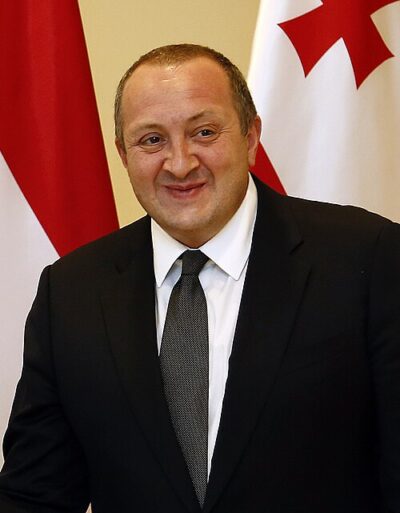
Giorgi Marghvilashvili
Giorgi Marghvilashvili is a Georgian politician and philosopher, fourth President of Georgia. Born September 4, 1969, in Tbilisi. Positions held include Minister of Education, Science and Youth of Georgia (2012–2013) and President of Georgia (2013–2018). Educated at Central European University and Tbilisi State University.
Facts
16 facts · 1 confirmed by two sources · 4 cited · 11 from one source
Where this comes from
Papalocal keeps its own record. It started from these sources; what each one said is kept here as it was copied, so a change on their side never changes this page by itself. Tap one to read its version.
What Wikidata says · copied November 16, 2026 · revision 2567594827
- Described as
- Georgian politician and philosopher, fourth President of Georgia (2013–2018)
- Other names
- Giorgi Margvelashvili
- Born
- September 4, 1969 · 2 references
- Born in
- Tbilisi · 1 reference
- Citizen of
- Soviet Union; Georgia
- Occupation
- politician · 1 reference; philosopher
- Positions held
- Minister of Education, Science and Youth of Georgia (2012–2013) · 1 reference; President of Georgia (2013–2018) · 2 references
- Political party
- independent politician; Georgian Dream
- Education
- Central European University; Tbilisi State University; Georgian National Academy of Sciences
- Spouse
- Maka Chichua
- Religion
- Eastern Orthodoxy
- Website
- https://president.gov.ge (2013–2018) · 1 reference
- Wikipedias with a page
- 77
Wikidata item Q13107337 (wikidata.org/wiki/Q13107337), public domain (CC0). Copied November 16, 2026.
What Wikipedia says · copied November 16, 2026 · revision 1378224912
Giorgi Margvelashvili (Georgian: გიორგი მარგველაშვილი; born 4 September 1969) is a Georgian academic and politician who was the fourth president of Georgia, in office from 17 November 2013 to 16 December 2018.
Having studied philosophy in university, he was twice the rector of the Georgian Institute of Public Affairs from 2000 to 2006 and again from 2010 to 2012. In October 2012, he became a member of the newly formed cabinet of Bidzina Ivanishvili as Minister of Education and Science of Georgia. In February 2013, he was additionally appointed as First Deputy Prime Minister. Margvelashvili was named by the Ivanishvili-led Georgian Dream coalition as its presidential candidate in May 2013 and he won the October 2013 presidential election with 62% of votes.
With Margvelashvili's election, a new constitution came into effect, significantly curtailing the president's powers in favor of the Prime Minister and the Parliament. Shortly thereafter, Margvelashvili's relations with Ivanishvili and the ruling Georgian Dream party leadership soured to the point of a full split. He was the first president in Georgia's history not to seek reelection for a second term.
- Born, in its opening lines
- September 4, 1969
From the Wikipedia article “Giorgi Margvelashvili” (en.wikipedia.org/wiki/Giorgi_Margvelashvili), by its contributors, under CC BY-SA 4.0 (creativecommons.org/licenses/by-sa/4.0/). Copied November 16, 2026; not changed.
Confirmed Two sources agree. Cited One source, and it names where it got it. One source One source, without a reference of its own. Sources disagree The sources disagree. We show the best-supported value and keep theirs below.
