
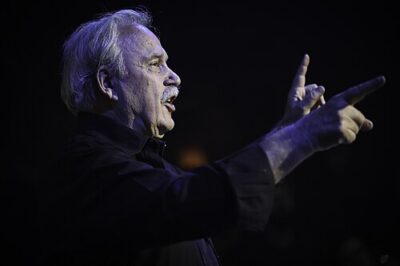
Giorgio Moroder
Giorgio Moroder is an Italian record producer and composer. Born April 26, 1940, in Urtijëi. Awards include Academy Award for Best Original Score, Academy Award for Best Original Song (2 times) and Bambi Award (2 times).
Facts
36 facts · 1 confirmed by two sources · 4 cited · 31 from one source
Where this comes from
Papalocal keeps its own record. It started from these sources; what each one said is kept here as it was copied, so a change on their side never changes this page by itself. Tap one to read its version.
What Wikidata says · copied November 16, 2026 · revision 2567002349
- Described as
- Italian record producer and composer (born 1940)
- Other names
- Giovanni Giorgio Moroder, Hansjörg Moroder
- Born
- April 26, 1940 · 6 references
- Born in
- Urtijëi · 2 references
- Name at birth
- Giovanni Giorgio Moroder
- Citizen of
- Italy
- Occupation
- composer · 1 reference; disc jockey; songwriter; record producer; film score composer; film producer · 1 reference; musician · 1 reference
- Member of
- Spinach
- Genre
- Eurodisco; disco; electronic dance music; electronic music · 1 reference; dance music · 1 reference
- Instrument
- synthesizer
- Record label
- London Records; Hansa Records; Philips Records; Casablanca Records; Polydor Records; RGE
- Awards
- Academy Award for Best Original Score (1979); Academy Award for Best Original Song (2 times) (1984, 1987) · 2 references; Bambi Award (2 times) (1984, 1987); Grammy Award for Best Dance/Electronic Recording (1998); Commander of the Order of Merit of the Italian Republic (2005); Golden Globe Award for Best Original Song (2 times) (1984, 1987); Golden Globe Award for Best Original Score (2 times) (1979, 1984); Grammy Award for Best Score Soundtrack for Visual Media (1984); Grammy Award for Best Instrumental Composition (1984); Grammy Award for Album of the Year (2014); David di Donatello Award for Lifetime Achievement
- Website
- https://www.giorgiomoroder.com/ · 1 reference
- Wikipedias with a page
- 51
Wikidata item Q312674 (wikidata.org/wiki/Q312674), public domain (CC0). Copied November 16, 2026.
What Wikipedia says · copied November 16, 2026 · revision 1385864270
Giovanni Giorgio Moroder (Italian: [dʒoˈvanni ˈdʒordʒo moˈrɔːder], Austrian German: [mɔˈroːdɐ]; born 26 April 1940) is an Italian composer and music producer. Dubbed the "Father of Disco", Moroder is credited with pioneering Euro disco and electronic dance music. His work with synthesizers had a significant influence on several music genres such as hi-NRG, Italo disco, synth-pop, new wave, house, and techno music.
While in Munich in the 1970s, Moroder started Oasis Records, later a subdivision of Casablanca Records. He is the founder of the former Musicland Studios in Munich, a recording studio used by many artists including the Rolling Stones, Donna Summer, Electric Light Orchestra, Led Zeppelin, Deep Purple, Deborah Harry, Queen, and Elton John. He produced singles for Donna Summer during the mid-to-late 1970s disco era, including "Love to Love You Baby", "I Feel Love", "Last Dance", "MacArthur Park", "Hot Stuff", "Bad Girls", "Dim All the Lights", "No More Tears (Enough Is Enough)", and "On the Radio". During this period, he also released many albums, including the synthesizer-driven From Here to Eternity (1977) and E=MC2 (1979).
He began to compose film soundtracks and scores, including Midnight Express, American Gigolo, Superman III, Scarface, The NeverEnding Story, and the 1984 restoration of Metropolis. Moroder's work on the film Midnight Express (1978), which contained the international hit "Chase", won him the Academy Award for Best Original Score and the Golden Globe Award for Best Original Score. Along with British singer and composer Philip Oakey, he composed the titular track "Together in Electric Dreams" for the film Electric Dreams (1984), which reached No. 3 on the singles chart in the UK and top five in Australia. He also produced a number of electronic disco songs for the Three Degrees and two albums for Sparks, Number 1 in Heaven in 1979 and Terminal Jive the following year. In 1990, he composed "Un'estate italiana", the official theme song of the 1990 FIFA World Cup.
Moroder has created songs for many performers including David Bowie, Falco, The Weeknd, Kylie Minogue, Irene Cara, Bonnie Tyler, Janet Jackson, Madleen Kane, Melissa Manchester, Blondie, Japan, Sabrina Salerno and France Joli. Moroder has stated that the work of which he is most proud is Berlin's "Take My Breath Away", which earned him the Academy Award for Best Original Song and the Golden Globe Award for Best Original Song after appearing in the film Top Gun in 1986; he had earned the same awards in 1983 for "Flashdance... What a Feeling" (as well as the Golden Globe Award for Best Original Score for all of his work on Flashdance). In addition to the three Academy Awards and four Golden Globes, Moroder has also received four Grammy Awards, two People's Choice Awards, and more than 100 Golden and Platinum discs. In 2004, he was inducted into the Dance Music Hall of Fame.
- Born, in its opening lines
- April 26, 1940
From the Wikipedia article “Giorgio Moroder” (en.wikipedia.org/wiki/Giorgio_Moroder), by its contributors, under CC BY-SA 4.0 (creativecommons.org/licenses/by-sa/4.0/). Copied November 16, 2026; not changed.
Confirmed Two sources agree. Cited One source, and it names where it got it. One source One source, without a reference of its own. Sources disagree The sources disagree. We show the best-supported value and keep theirs below.
