
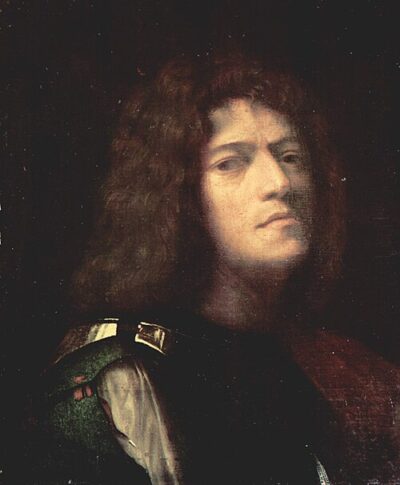
Giorgione
Giorgione was a Venetian Renaissance painter. Born 1478, in Castelfranco Veneto. Died 1510, in Venice. Known for Laura, The Three Philosophers and The Tempest.
Facts
23 facts · 0 confirmed by two sources · 14 cited · 9 from one source
Where this comes from
Papalocal keeps its own record. It started from these sources; what each one said is kept here as it was copied, so a change on their side never changes this page by itself. Tap one to read its version.
What Wikidata says · copied November 16, 2026 · revision 2569219688
- Described as
- Venetian Renaissance painter (1478–1510)
- Other names
- Giorgioni di Castelfranco, Georgoni, Giorgoni, Giorgone, Zorzo da Castelfranco, Giorgion di Castelfranco, Georges Giorgion, Giorgioni, Dzhordzhone, Cavaglier Georgione, Zorzo, Georgeonia
- Born
- 1478 · 4 references
- Died
- 1510 · 5 references
- Born in
- Castelfranco Veneto · 3 references
- Died in
- Venice · 4 references
- Cause of death
- plague
- Citizen of
- Republic of Venice
- Occupation
- painter · 3 references; visual artist · 2 references
- Genre
- history painting · 2 references; portrait · 2 references; landscape painting · 2 references; religious art · 1 reference; nude · 1 reference; religious painting · 1 reference
- Known for
- Laura; The Three Philosophers; The Tempest; Self-portrait; Christ Carrying the Cross · 1 reference; Frieze of the Liberal and Mechanical Arts · 1 reference; Nude · 1 reference
- Field
- painting · 1 reference; visual arts · 1 reference
- Wikipedias with a page
- 67
Wikidata item Q8459 (wikidata.org/wiki/Q8459), public domain (CC0). Copied November 16, 2026.
What Wikipedia says · copied November 16, 2026 · revision 1384853078
Giorgio Barbarelli da Castelfranco (1470s – 17 September 1510), known as Giorgione, was an Italian painter of the Venetian school during the High Renaissance, who died in his thirties. He is known for the elusive poetic quality of his work, though only about six surviving paintings are firmly attributed to him. The uncertainty surrounding the identity and meaning of his work has made Giorgione one of the most mysterious figures in European art.
Together with his younger contemporary Titian, he founded the Venetian school of Italian Renaissance painting, characterised by its use of colour and mood. The school is traditionally contrasted with Florentine painting, which relied on a more linear disegno-led style.
From the Wikipedia article “Giorgione” (en.wikipedia.org/wiki/Giorgione), by its contributors, under CC BY-SA 4.0 (creativecommons.org/licenses/by-sa/4.0/). Copied November 16, 2026; not changed.
Confirmed Two sources agree. Cited One source, and it names where it got it. One source One source, without a reference of its own. Sources disagree The sources disagree. We show the best-supported value and keep theirs below.
